Broker Liability, FMCSA Enforcement, And Motus: Why Freight Brokerage Risk Is Changing Fast
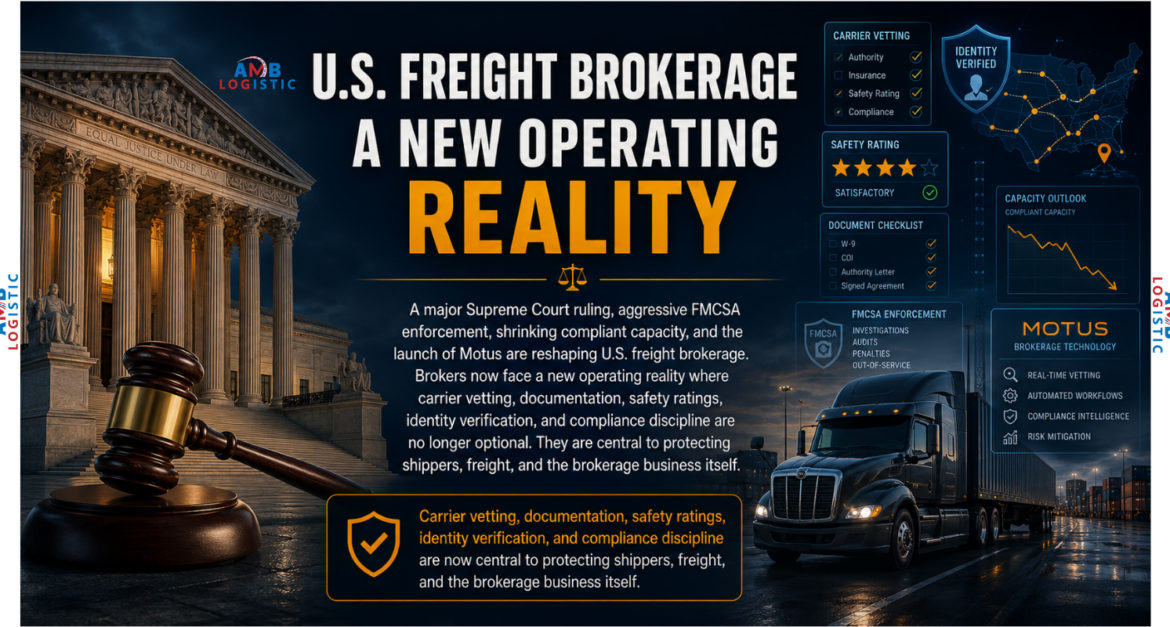
Freight brokerage is entering a new risk environment. A landmark Supreme Court ruling has exposed brokers to state-law negligent-hiring claims when they select unsafe motor carriers. At the same time, FMCSA enforcement is shrinking the available carrier pool, conditional-rated carriers are receiving more scrutiny, and the launch of Motus signals a stronger federal push against registration fraud, identity misuse, and carrier-account abuse. For brokers, shippers, 3PLs, and digital freight platforms, the message is clear: carrier vetting, safety review, identity verification, documentation, and compliance discipline are now core operating requirements.
Introduction
The U.S. freight brokerage market is facing a major shift. Legal exposure is rising. Carrier capacity is becoming more complicated. Fraud risk is increasing. Federal enforcement is tightening. Technology-driven identity controls are moving closer to the center of transportation compliance.
Three developments now need to be understood together. First, the Supreme Court’s ruling in Montgomery v. Caribe Transport II has changed the liability conversation for freight brokers by allowing state-law negligent-hiring claims to move forward when brokers are accused of selecting unsafe motor carriers.
Second, FMCSA enforcement is putting pressure on the carrier market. A large share of trucks operate without a formal FMCSA safety rating, while hundreds of thousands more operate with conditional ratings. At the same time, enforcement actions are removing non-compliant trucks and drivers from service, shrinking the pool of carriers brokers may feel comfortable using.
Third, FMCSA’s launch of Motus marks a new phase in registration and identity control. The platform is intended to modernize fragmented registration systems and strengthen fraud detection at a time when the industry is dealing with identity theft, hijacked carrier accounts, fake registrations, and deceptive activity tied to cargo theft and financial losses.
Individually, each development matters. Together, they create a new operating reality for brokers. Carrier selection can no longer be treated as a quick rate-and-availability decision. It must be managed as a safety, legal, fraud-prevention, and documentation process.
Why This Matters
Freight brokers sit at the center of the transportation market. Shippers depend on brokers to access qualified capacity. Brokers depend on carriers to operate safely, lawfully, and professionally. Carriers depend on brokers to tender legitimate freight. The public depends on the entire chain to keep unsafe operators off the road.
The risk is that each part of that chain is now under more pressure. Brokers are being asked to move freight quickly while also screening carriers more carefully. Shippers are trying to control cost while expecting better visibility, security, and service. Carriers are operating in a tighter compliance environment. Fraud actors are using more sophisticated methods to exploit gaps in registration, communication, and carrier identity.
The Supreme Court ruling makes carrier selection more legally significant. FMCSA enforcement makes qualified capacity harder to ignore. Motus makes identity and registration control more important. The result is a market where compliance discipline directly affects coverage, pricing, service, and legal exposure.
For brokers, the old question was often simple: “Who can cover the load?” The new question is broader: “Can this carrier be responsibly selected, verified, documented, and defended if something goes wrong?”
That shift changes how freight brokerage teams must operate.
The Broader Picture
The freight market is already dealing with tight margins, fraud, double brokering, cargo theft, rising insurance costs, shipper pressure, and uneven capacity conditions. Now legal and regulatory forces are adding another layer.
In Montgomery v. Caribe Transport II, the Supreme Court rejected the idea that the Federal Aviation Administration Authorization Act automatically protects brokers from state-law negligent-hiring claims when the claim is tied to motor vehicle safety. That means brokers accused of selecting unsafe carriers may need to defend the facts of their carrier-selection process.
This does not mean brokers are automatically liable whenever a carrier causes harm. It does not create strict liability. Plaintiffs still have to prove negligence and causation. But it does mean brokers can no longer assume federal preemption will end the claim before the carrier-selection process is examined.
At the same time, FMCSA enforcement pressure is changing the capacity landscape. Trucks without safety ratings, trucks with conditional ratings, and carriers with weak compliance profiles may become more difficult for brokers to justify. If brokers continue using higher-risk carriers without documented review, the exposure becomes more serious.
Motus adds another important dimension. Fraud in freight is no longer limited to stolen cargo after pickup. It often begins earlier, with identity misuse, false registrations, hijacked carrier accounts, deceptive contact information, and fraudulent operating profiles. A modern brokerage operation must verify not only whether a carrier exists, but whether the broker is communicating with the legitimate carrier and authorized representative.
The freight brokerage model is not disappearing. But it is becoming more compliance-driven, more documentation-heavy, and more dependent on disciplined carrier controls.
What This Means For Freight Brokers
For freight brokers, these developments should trigger a full review of carrier onboarding, carrier monitoring, load assignment, safety screening, identity verification, documentation, insurance, contracts, and employee training.
The first impact is legal exposure. Broker liability is no longer a distant legal theory. If a broker selects a carrier with visible safety concerns and that carrier causes harm, the broker may be forced to explain what was reviewed, what red flags existed, and why the carrier was accepted.
The second impact is capacity pressure. If enforcement removes more non-compliant trucks and drivers from the market, and if brokers become more cautious about conditional-rated carriers, the usable carrier pool may shrink. That can make coverage harder, especially on difficult lanes or urgent shipments.
The third impact is fraud control. Brokers must verify carrier identity more carefully. Active authority and insurance are no longer enough if the person communicating with the broker is not the real carrier, if the account has been hijacked, or if the registration profile is fraudulent.
The fourth impact is documentation. A broker’s defense may depend on whether the process was recorded clearly. If there is no record showing what was checked, when it was checked, who approved the carrier, and why the carrier was selected, the broker may be exposed.
The fifth impact is customer communication. Shippers need to understand that responsible carrier selection may affect rate and speed. The cheapest carrier is not always the safest, most reliable, or most defensible option.
The Freight Broker Playbook
1) Treat Carrier Selection As A Legal-Risk Decision
Carrier selection is no longer only an operational task. It is a legal-risk decision that can be reviewed after an accident, theft, fraud event, or service failure.
Brokers should ask whether each carrier-selection decision can be explained later. Was the carrier properly vetted? Was safety data reviewed? Was insurance verified? Was identity confirmed? Were red flags escalated? Was the decision documented?
A broker does not need a perfect process. But the process must be reasonable, consistent, and defensible.
2) Review Safety Ratings Before Load Assignment
Active authority alone is not enough. Brokers should review available carrier safety indicators before assigning freight, especially for new carriers, unfamiliar lanes, high-value freight, time-sensitive shipments, and high-risk commodities.
Safety review should include operating authority, insurance status, safety rating, inspection history, crash indicators, out-of-service patterns, authority age, and other available carrier information.
Brokers should define what level of risk triggers rejection, escalation, or management approval.
3) Treat Conditional-Rated Carriers With Extreme Caution
Conditional-rated carriers now deserve special attention. In the current legal environment, using a conditional-rated carrier without clear review and documentation can create serious exposure.
Brokers should decide whether conditional-rated carriers are automatically disqualified or allowed only after elevated compliance approval. If an exception is made, the reason should be documented clearly.
The key is not panic. The key is discipline. Conditional status cannot be ignored or treated as a minor detail.
4) Build A Written Red-Flag Policy
Brokers need a written red-flag policy that tells teams when to pause, escalate, or reject a carrier.
Red flags may include conditional or unsatisfactory safety ratings, inactive authority, insurance inconsistencies, recent authority changes, mismatched contact information, suspicious email domains, unusual pickup instructions, unclear dispatch contacts, weak inspection history, or identity-verification concerns.
The policy should be simple enough for operations teams to use under pressure. A policy that is too complicated will be ignored when the load becomes urgent.
5) Strengthen Carrier Identity Verification
Motus reflects a broader industry reality: registration fraud and identity misuse are now major freight risks. Brokers must confirm that the carrier they are speaking with is the legitimate carrier authorized to move the freight.
Carrier identity verification should include independent phone validation, email-domain review, insurance contact confirmation, operating authority consistency checks, dispatch contact verification, and careful review of sudden changes in pickup or payment instructions.
Fraud often passes surface checks. Independent verification must become standard.
6) Document Every Carrier-Selection Decision
Documentation is one of the strongest protections a broker can have. If a carrier decision is questioned later, the broker needs a record of what was checked and why the carrier was selected.
Documentation should include authority checks, insurance verification, safety-screening notes, carrier onboarding records, communication history, exception approvals, identity verification steps, and any red-flag review.
If the record is blank, a plaintiff may argue that nothing was checked. That is a dangerous position for any brokerage.
7) Do Not Let Urgency Override Compliance
Urgent freight creates pressure. A shipper may need immediate coverage. A lane may be difficult. A delivery appointment may be at risk. But urgency cannot be the reason safety and identity controls are skipped.
Many bad carrier decisions happen when teams feel they have no time. That is why strong brokerages need fast, practical verification workflows that work under pressure.
The strongest brokers are not the slowest. They are the ones who can move quickly without losing control.
8) Prepare For A Smaller Usable Carrier Pool
If enforcement removes more non-compliant trucks and drivers from service, and if brokers become more cautious about carriers with weak safety profiles, the practical carrier pool may shrink.
This can affect pricing, coverage, and service reliability. Shippers may see fewer low-cost options on some lanes. Brokers may need stronger carrier relationships and better planning windows to secure qualified capacity.
Capacity may not disappear evenly. The impact may be sharper in certain regions, equipment types, and high-pressure lanes.
9) Train Operations Teams On The New Risk Environment
Carrier vetting cannot live only in compliance. Dispatchers, carrier sales teams, account managers, and operations coordinators all need to understand the new environment.
Training should explain negligent-hiring exposure, conditional-rating risk, FMCSA safety data, identity fraud, red flags, escalation rules, and documentation expectations.
Teams do not need legal theory. They need practical workflows they can use during real load coverage.
10) Review Contracts And Insurance Coverage
Brokers should review shipper agreements, carrier agreements, indemnity language, insurance requirements, contingent auto coverage, errors and omissions coverage, contractual liability, exclusions, and record-retention obligations.
The federal broker bond is not the same as full liability protection. Brokers should work with qualified legal and insurance professionals to understand whether their coverage matches the current risk environment.
Contracts and insurance cannot replace good operations, but they are essential parts of the risk-control framework.
11) Communicate Risk Standards To Shippers
Shippers need to understand that responsible carrier selection can affect price and speed. A carrier may be cheaper, but if the carrier presents safety, compliance, or identity concerns, the broker should be prepared to reject the option.
Brokers should explain that vetting standards protect the shipper, the freight, the broker, and the public. A strong broker does not simply find the lowest truck. A strong broker finds the right carrier for the shipment.
In the new environment, good customer communication is part of risk management.
12) Use Technology Without Losing Human Judgment
Motus and other technology-driven systems may help improve identity verification, registration accuracy, and fraud detection. But technology alone does not eliminate broker responsibility.
Digital tools should support human judgment. A system can flag risk, but the brokerage must decide how to act on it. A platform can help verify identity, but teams must still review inconsistencies and escalate concerns.
The future of freight brokerage will combine technology, compliance discipline, and experienced operational judgment.
What This Means For Shippers
For shippers, the current environment is a reminder that broker quality matters. A broker’s carrier network, vetting process, documentation standards, fraud controls, and compliance culture can directly affect shipment risk.
Shippers should ask brokers how carriers are screened, how safety ratings are reviewed, how insurance is verified, how identity is confirmed, how red flags are handled, and how carrier-selection decisions are documented.
Shippers should also understand that the lowest rate may not be the safest or most reliable option. A responsible broker may reject a low-cost carrier because the safety or identity profile does not meet standards.
That is not a weakness. That is disciplined freight management.
What This Means For Carriers
For carriers, stronger enforcement and higher broker scrutiny will raise the importance of clean documentation, safety performance, insurance accuracy, stable authority, and professional communication.
Carriers with strong safety practices and transparent operations may become more attractive partners. Carriers with conditional ratings, inconsistent records, poor communication, or identity issues may find it harder to access freight.
Responsible carriers should view this environment as an opportunity to stand out. Safety and compliance are no longer only regulatory obligations. They are commercial advantages.
What This Means For Digital Freight Platforms
Digital freight platforms must also pay attention. If a platform influences or automates carrier selection, it should be able to explain what safety, identity, insurance, and authority checks are built into the process.
Algorithmic matching does not remove the need for reasonable care. A platform that assigns freight to a carrier still needs defensible rules around carrier eligibility, identity verification, safety screening, and red-flag escalation.
Digital speed must be matched with compliance discipline.
AMB Logistic’s Role
At AMB Logistic, we understand that freight brokerage is built on more than price and availability. It requires carrier discipline, verification, communication, visibility, documentation, and responsible execution.
The combination of Supreme Court liability exposure, FMCSA enforcement, shrinking compliant capacity, and Motus-driven fraud control reinforces one reality: freight coverage must be managed with care.
AMB Logistic supports customers with freight brokerage solutions built around clarity, control, and confidence. That means helping shippers move freight through a process that values carrier quality, communication, visibility, compliance awareness, and risk control.
- We help customers move freight with responsible carrier-selection discipline.
- We support shipment planning with clear communication and operational control.
- We focus on visibility, documentation, and exception management.
- We understand that freight coverage must balance speed, cost, service, safety, and risk.
- We help shippers move with clarity, control, and confidence in a changing freight market.
FAQ
Why Are Broker Liability And FMCSA Enforcement Connected?
Broker liability and FMCSA enforcement are connected because both focus attention on carrier quality. If enforcement removes non-compliant trucks and drivers while courts allow negligent-hiring claims to proceed, brokers must be more careful about which carriers they select and how they document those decisions.
What Did The Supreme Court Ruling Change For Brokers?
The ruling means brokers may face state-law negligent-hiring claims when they are accused of selecting unsafe carriers. Federal law does not automatically block those claims when they are tied to motor vehicle safety.
Does This Mean Brokers Are Automatically Liable For Carrier Accidents?
No. Plaintiffs still have to prove negligence and causation. The ruling allows certain claims to move forward, but it does not make brokers automatically liable.
Why Are Conditional-Rated Carriers A Bigger Concern Now?
Conditional-rated carriers may carry elevated scrutiny because their safety status can become central in negligent-hiring claims. Brokers should define clear policies for how those carriers are reviewed, escalated, accepted, or rejected.
What Is Motus And Why Does It Matter?
Motus is FMCSA’s newer registration platform intended to modernize carrier registration and strengthen identity verification and fraud detection. It matters because fraud, hijacked carrier accounts, and fake registrations have become serious freight-security concerns.
What Should Shippers Ask Their Brokers?
Shippers should ask how carriers are vetted, how safety ratings are reviewed, how insurance is verified, how carrier identities are confirmed, how red flags are handled, and how carrier-selection decisions are documented.
What Should Brokers Do Now?
Brokers should review carrier onboarding, safety screening, identity verification, red-flag policies, documentation standards, insurance coverage, contracts, employee training, and escalation procedures.
Is This Legal Advice?
No. This article is for general freight-market and logistics-risk discussion only. Brokers, shippers, carriers, and logistics platforms should consult qualified legal and insurance professionals for advice specific to their operations.
Final Word From AMB Logistic
Freight brokerage risk is changing fast. The Supreme Court ruling has exposed brokers to greater scrutiny over negligent carrier selection. FMCSA enforcement is shrinking the pool of compliant capacity. Conditional-rated carriers are becoming harder to justify without clear review. Motus reflects a stronger push toward identity verification and fraud control.
For brokers, the answer is not panic. The answer is process discipline. Stronger carrier vetting, better documentation, clearer red-flag escalation, identity verification, safety review, training, contract review, and insurance review can help reduce avoidable exposure.
For shippers, the message is equally clear. Broker quality matters. The right freight partner should be able to explain how carriers are selected, how risk is managed, how identities are verified, and how freight is monitored from pickup through delivery.
For carriers, this environment may reward professionalism. Strong safety practices, clean documentation, transparent communication, and reliable operations will matter more as brokers become more selective.
The freight market is becoming more complex. Legal exposure, enforcement pressure, fraud risk, safety expectations, insurance costs, and capacity challenges are converging. In this environment, responsible freight brokerage is not only about moving the load. It is about moving the load the right way.
Talk To AMB Logistic Today
If your business needs truckload, LTL, or freight brokerage support in a changing freight market, AMB Logistic can help you move with clarity, control, and confidence.
Web: amblogistic.us
Phone: +1 (888) 538-6433
Email: info@amblogistic.us
Tags
broker liability, FMCSA enforcement, Motus, freight broker negligence, carrier vetting, FAAAA, negligent hiring, motor carrier safety, conditional carrier rating, freight brokerage compliance, shipper risk, carrier selection, logistics fraud, cargo theft prevention, freight risk management, AMB Logistic