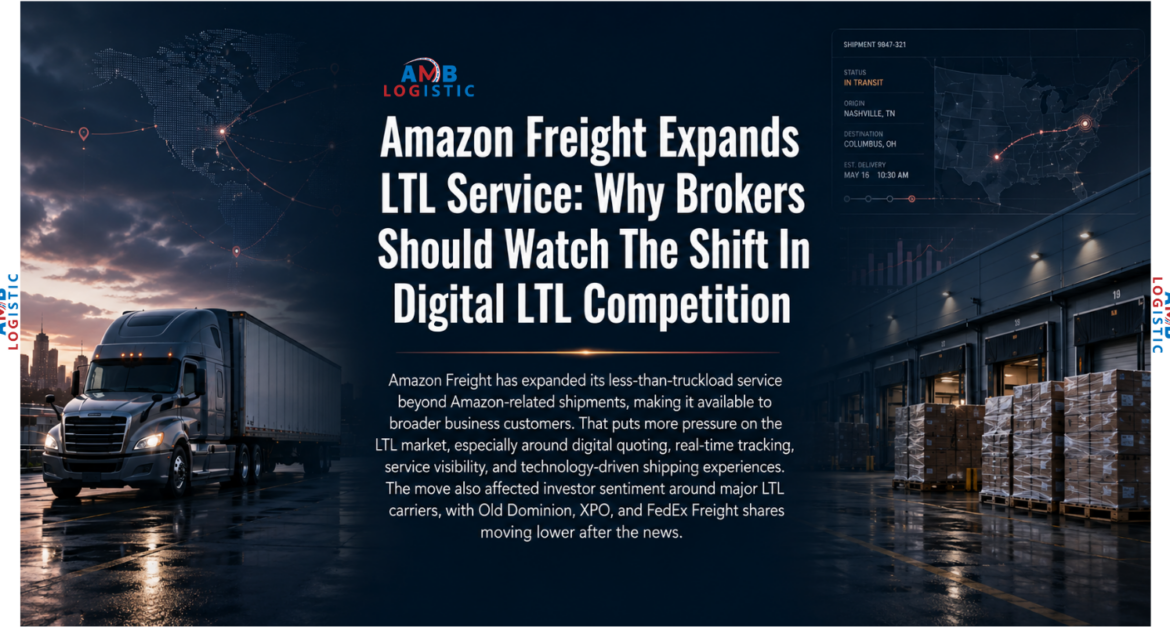
Amazon Freight’s LTL Expansion Raises The Bar For Freight Brokers: Why Service, Visibility, And Carrier Fit Matter More Than Ever
Amazon Freight’s expansion into broader less-than-truckload service is another signal that the U.S. LTL market is becoming more digital, more competitive, and more customer-experience driven. For freight brokers and shippers, this is not just an Amazon story. It is a reminder that LTL brokerage can no longer rely only on rate shopping. The market is moving toward faster quoting, cleaner visibility, stronger shipment control, better carrier-fit decisions, and more disciplined communication from pickup through delivery.
Introduction
Amazon Freight’s move to expand less-than-truckload service to a broader base of business customers adds another major competitive signal to the U.S. logistics market. Amazon has built its reputation around speed, visibility, digital execution, and customer experience. Now, as it pushes deeper into LTL freight, those expectations are moving further into the freight brokerage conversation.
LTL freight has always been operationally complex. It is not a simple point-to-point truckload move. Freight is picked up, consolidated, moved through terminals, sorted, transferred, and delivered alongside shipments from other customers. That creates efficiency, but it also creates more touchpoints, more handling, more exceptions, and more opportunities for cost changes or service failures.
Amazon’s expansion matters because it puts additional pressure on how LTL freight is sold, booked, tracked, and managed. Shippers are becoming more accustomed to digital visibility, fast quoting, simplified workflows, and clear shipment updates. That does not mean every shipper will move freight through Amazon. But it does mean the service standard across the market continues to rise.
For freight brokers, the message is direct: LTL brokerage has to become more consultative, more transparent, and more disciplined. Customers need more than a list of rates. They need help choosing the right carrier, understanding service tradeoffs, controlling accessorial exposure, protecting freight, and managing delivery performance.
In this environment, the broker’s value is no longer just access to capacity. The broker’s value is judgment, execution, visibility, and control.
Why This Matters
Amazon entering deeper into the LTL conversation matters because it changes shipper expectations. Amazon is associated with fast digital experiences, easy booking, shipment visibility, and customer-facing reliability. When a company with that reputation pushes further into freight services, it forces the broader market to look closely at how easy or difficult freight shipping feels for customers.
Many shippers still experience LTL as a complicated process. They may struggle with freight class, dimensions, weight accuracy, accessorials, liftgate requirements, limited-access delivery, appointment scheduling, reclass charges, reweighs, claims, and delivery exceptions. If the process is not managed carefully, the final invoice and delivery experience can look very different from the original quote.
Digital competitors can simplify parts of that experience. But freight still requires operational judgment. A platform may make booking faster, but it does not remove the need to choose the right carrier for the freight, the lane, the consignee, the commodity, the service level, and the delivery environment.
That is where freight brokers must improve their position. Brokers cannot compete only by saying they can find rates. The market already has digital tools for that. Brokers must compete by helping customers avoid service failures, invoice surprises, missed appointments, claims, and poor carrier fit.
Amazon Freight’s LTL expansion raises the bar. It makes speed, visibility, simplicity, and execution more important. Freight brokers who adapt can become more valuable. Brokers who stay transactional risk becoming easier to replace.
The Broader Picture
The LTL market is already becoming more strategic. FedEx Freight is now operating as a standalone LTL company. Major carriers are focused on profitable growth, yield management, service differentiation, and network efficiency. Shippers are paying closer attention to cost control and service performance. At the same time, technology-driven freight platforms are pushing customers to expect faster booking, cleaner tracking, and better shipment information.
Amazon’s expansion fits into this broader shift. It is not only about adding another LTL option. It is about bringing a digital customer-experience mindset into a freight segment that has historically been operationally complicated and sometimes difficult for smaller or mid-sized shippers to navigate.
LTL is especially sensitive to process quality. A truckload shipment may move directly from origin to destination with one carrier and one trailer. LTL freight moves through a shared network. That means shipment details matter more. Packaging matters more. Pickup and delivery instructions matter more. Carrier selection matters more. Visibility matters more.
The more digital the market becomes, the more shippers will expect freight partners to provide clarity. They want to know what the shipment will cost, when it will arrive, what can go wrong, how exceptions will be handled, and who is accountable when the freight does not move as planned.
This is why the rise of digital LTL competition should not be viewed only as a threat. It is also a signal. The market is telling brokers what customers value: speed, transparency, communication, reliability, and fewer surprises.
What This Means For Freight Brokers
For freight brokers, Amazon Freight’s LTL expansion reinforces the need to move beyond basic rate comparison. If a broker’s only value is quoting the lowest available LTL rate, the broker is exposed. Digital platforms can often provide quick rates. The broker has to provide something deeper.
The first area is carrier-fit analysis. Not every LTL carrier is right for every shipment. Some carriers are stronger in specific regions. Some perform better on long-haul lanes. Some are better for industrial freight. Others may be stronger for commercial delivery, retail freight, or appointment-sensitive shipments. Brokers need to understand those differences and guide customers accordingly.
The second area is visibility. Shippers increasingly expect clean tracking and proactive updates. In LTL, a shipment can pass through multiple terminals before final delivery. A missed scan, missed connection, damaged pallet, or appointment issue can quickly create customer-service pressure. Brokers must monitor freight actively, not react only after the customer asks.
The third area is accessorial control. LTL invoices can change because of liftgate service, inside delivery, residential delivery, limited access, appointment scheduling, detention, re-delivery, storage, reclass, or reweigh charges. Brokers must identify these risks before pickup and explain them clearly.
The fourth area is claims prevention. LTL freight is handled more than truckload freight, so packaging, pallet quality, labeling, and documentation are critical. Brokers who help customers reduce claims exposure create value that a simple quoting tool does not provide.
The fifth area is customer communication. In a more digital market, customers will not tolerate vague updates or slow responses. Brokers need to provide clear answers, realistic transit expectations, and immediate exception communication.
The Freight Broker Playbook
1) Compete On Execution, Not Just Rates
Rate shopping alone is not a strong enough LTL strategy. A low quote can become expensive if the shipment is delayed, damaged, reclassed, reweighed, or hit with avoidable accessorials.
Brokers should position themselves around execution quality. That means choosing the right carrier, confirming shipment details, managing pickup requirements, monitoring transit, communicating exceptions, and supporting delivery through completion.
The customer should feel that the broker is protecting the shipment, not simply booking it.
2) Make Digital Visibility A Baseline
Amazon’s logistics strength is closely tied to visibility and customer experience. That standard continues to influence shipper expectations across freight. Customers want to know where their shipment is, what is happening, and whether delivery is still on track.
Brokers should treat visibility as a baseline requirement. Tracking should not be passive. A shipment moving through an LTL network needs proactive monitoring, especially when it is time-sensitive, appointment-driven, high-value, or customer-critical.
Better visibility reduces uncertainty. Better communication reduces frustration.
3) Build Stronger Carrier-Fit Discipline
LTL carrier selection should be based on more than price. The right carrier depends on lane, freight type, region, terminal network, consignee requirements, service expectations, claims profile, and accessorial exposure.
Brokers should develop a clearer internal understanding of carrier strengths. Which carrier performs best in a certain region? Which carrier handles appointment freight well? Which carrier has better communication? Which carrier has fewer issues with certain commodities?
Carrier-fit discipline is one of the clearest ways brokers can separate themselves from purely digital rate tools.
4) Clean Up Shipment Data Before Booking
LTL problems often begin before the freight is picked up. Incorrect weight, wrong dimensions, unclear freight class, missing accessorial requirements, weak commodity descriptions, or incomplete delivery instructions can create invoice disputes and service failures.
Brokers should improve the front-end data process. Before booking, confirm pallet count, dimensions, weight, class, commodity, pickup conditions, delivery conditions, appointment needs, liftgate requirements, limited-access risks, and consignee instructions.
Clean data creates cleaner execution.
5) Explain Accessorials Before They Become Disputes
Accessorials are one of the biggest friction points in LTL shipping. Many shippers focus on the quoted rate but overlook the conditions that can change the final invoice.
Brokers should explain common accessorial triggers clearly before pickup. Liftgate, residential delivery, limited access, inside delivery, appointment scheduling, re-delivery, detention, storage, reclass, and reweigh charges should not surprise the customer after delivery.
Clear expectations protect trust.
6) Strengthen Claims Prevention
LTL freight is handled multiple times, which makes packaging and documentation critical. A poorly wrapped pallet, weak carton, overhanging freight, missing label, or unclear BOL can increase the chance of damage, delay, or dispute.
Brokers should help customers understand basic claims-prevention discipline. Freight should be packaged to survive terminal handling, properly labeled, accurately described, and documented before pickup.
Claims support is important, but claims prevention is more valuable.
7) Respond Faster To Exceptions
Digital freight competition raises expectations for response time. If a shipment is delayed, missed, damaged, or facing delivery issues, the customer expects a quick and clear answer.
Brokers should build an exception process that identifies issues early and communicates them quickly. A late update often creates more frustration than the delay itself. Customers can plan around problems when they receive accurate information early.
Speed of communication is now part of service quality.
8) Use Technology Without Losing Human Judgment
Technology is necessary in modern freight brokerage. Fast quoting, automated tracking, digital documentation, and shipment alerts all improve the customer experience. But LTL still requires human judgment.
A system can show rates. A broker must understand whether the carrier, lane, timing, freight type, delivery requirement, and risk profile make sense together.
The strongest brokerage model combines digital speed with operational experience.
What This Means For Shippers
For shippers, Amazon Freight’s LTL expansion means more options, more digital access, and potentially more pressure on traditional providers to improve service experience. But more options do not automatically mean better outcomes.
Shippers still need to evaluate service reliability, freight handling, carrier network strength, claims performance, delivery requirements, accessorial exposure, and visibility. A fast booking process is valuable, but it does not replace careful freight planning.
Shippers should also avoid choosing LTL providers based only on the lowest rate. The better question is whether the provider can move the shipment correctly, communicate clearly, manage exceptions, and protect the customer relationship.
In a more competitive LTL market, shippers should expect more from their freight partners. They should expect clarity before booking, visibility during transit, and support when problems occur.
What This Means For Carriers
For LTL carriers, Amazon’s expansion adds another competitive pressure point. Carriers are already focused on density, network efficiency, yield, service performance, and profitable freight. Digital competition increases the pressure to deliver a cleaner customer experience.
Carriers that provide reliable pickup, consistent transit performance, clear tracking, disciplined claims handling, and strong communication will remain important partners for brokers and shippers.
At the same time, carriers may become more selective about freight that fits their network. Accurate shipment data and clean tendering will become even more important. Freight that is poorly described, poorly packaged, or operationally difficult may face more scrutiny.
AMB Logistic’s Role
At AMB Logistic, we understand that LTL shipping is not just a rate decision. It is a service, visibility, carrier-fit, and execution decision.
As digital LTL competition increases, our role is to help customers move freight with more clarity and control. That means helping shippers understand the real cost of a shipment, choose the right carrier for the lane, reduce accessorial exposure, improve shipment preparation, and manage exceptions before they become bigger problems.
AMB Logistic supports customers with truckload, LTL, and freight brokerage solutions built around disciplined execution and proactive communication. Whether the market is becoming more digital, more competitive, or more cost-sensitive, the goal remains the same: move freight reliably, transparently, and professionally.
- We help customers evaluate carrier fit, not just the lowest quote.
- We support LTL planning with accurate shipment details and clear expectations.
- We focus on visibility, tracking, and proactive exception communication.
- We help reduce avoidable accessorials, claims risk, and service failures.
- We help shippers move freight with clarity, control, and confidence.
FAQ
Why Does Amazon Freight’s LTL Expansion Matter?
Amazon Freight’s LTL expansion matters because it adds more digital competition to the less-than-truckload market and raises shipper expectations around quoting, visibility, tracking, and customer experience.
What Is LTL Freight?
LTL, or less-than-truckload freight, is used when a shipment does not require a full trailer. Freight from multiple customers is consolidated through a carrier network and delivered through terminal and final-mile operations.
Why Is LTL More Complicated Than Truckload?
LTL freight usually moves through a shared network with multiple handling points. That creates more exposure to reclass charges, reweighs, accessorials, delays, damages, missed appointments, and tracking issues.
Does Digital LTL Replace Freight Brokers?
Digital LTL tools can make quoting and booking faster, but they do not replace operational judgment. Freight brokers still add value through carrier selection, shipment planning, visibility, exception management, claims prevention, and customer communication.
What Should Shippers Watch When Choosing An LTL Option?
Shippers should look at carrier fit, transit reliability, claims performance, accessorial exposure, shipment visibility, delivery requirements, and total cost. The lowest quote is not always the best freight decision.
How Can Brokers Compete In A More Digital LTL Market?
Brokers can compete by combining digital speed with human logistics expertise. That means faster quoting, better tracking, stronger carrier-fit decisions, proactive communication, and disciplined exception management.
Final Word From AMB Logistic
Amazon Freight’s LTL expansion is another reminder that the freight brokerage market is changing. Shippers are expecting faster access, better visibility, clearer communication, and fewer surprises. In LTL, those expectations matter because the mode itself is complex.
For freight brokers, this is a clear signal to strengthen the value proposition. Rate shopping is not enough. Brokers need to help customers understand service tradeoffs, choose the right carrier, control accessorials, protect freight, and manage execution from pickup through delivery.
For shippers, the takeaway is simple. More options are useful, but the right freight decision still requires strategy. LTL freight should be planned carefully, documented accurately, packaged properly, and monitored closely.
In a more digital and competitive LTL market, the strongest logistics partners will be the ones who combine technology, service discipline, and real freight judgment.
Talk To AMB Logistic Today
If your business needs truckload, LTL, or freight brokerage support in a changing freight market, AMB Logistic can help you move with clarity, control, and confidence.
Web: amblogistic.us
Phone: +1 (888) 538-6433
Email: info@amblogistic.us
Tags
Amazon Freight, LTL freight, less-than-truckload, freight brokerage, digital freight, U.S. logistics, carrier selection, shipment visibility, accessorial control, claims prevention, freight technology, transportation strategy, AMB Logistic