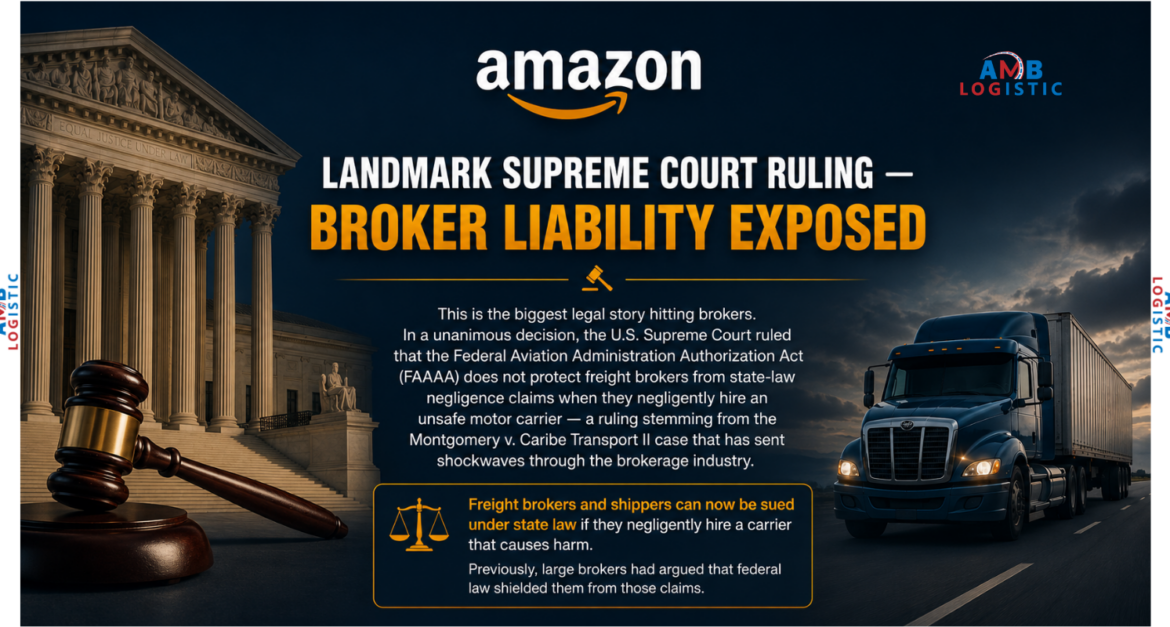
Landmark Supreme Court Ruling Exposes Broker Liability: Why Carrier Vetting Is Now A Boardroom Risk
A unanimous U.S. Supreme Court ruling has changed the liability conversation for freight brokers across America. In Montgomery v. Caribe Transport II, the Court ruled that the Federal Aviation Administration Authorization Act does not automatically shield freight brokers from state-law negligent-hiring claims when they are accused of selecting an unsafe motor carrier. For brokers, shippers, 3PLs, freight forwarders, and digital freight platforms, this is not just a legal headline. It is a carrier-selection, documentation, safety, insurance, and risk-management issue that may reshape how freight is tendered, covered, verified, and defended.
Introduction
Freight brokerage has always carried operational risk. Brokers work under pressure, cover loads quickly, manage shipper expectations, source capacity, coordinate pickup and delivery, and make carrier-selection decisions in real time. But the Supreme Court’s decision in Montgomery v. Caribe Transport II has moved that risk into a much larger legal and compliance conversation.
The case centers on whether federal law protects freight brokers from state-law negligence claims when a broker is accused of hiring an unsafe motor carrier that later causes harm. For years, many brokers relied on the Federal Aviation Administration Authorization Act, commonly known as the FAAAA, as a powerful federal preemption defense. The argument was that state negligence claims related to broker carrier-selection decisions were connected to broker services and therefore should be blocked by federal law.
The Supreme Court rejected that broad shield in this context. In a unanimous ruling, the Court allowed a negligent-hiring claim to move forward, holding that the FAAAA’s safety exception can preserve state-law claims when those claims concern motor vehicle safety.
That does not mean every broker is automatically liable when a carrier causes an accident. It does not create strict liability. It does not mean plaintiffs automatically win. But it does mean brokers can no longer rely on federal preemption as a near-automatic dismissal tool when the claim is tied to safety and negligent carrier selection.
The message for the freight brokerage industry is clear: carrier vetting is no longer just an operational step. It is a legal-risk control, a compliance function, and a boardroom issue.
Why This Matters
This ruling matters because brokers sit at the center of the modern transportation market. Shippers depend on brokers to access qualified capacity. Brokers depend on carriers to operate safely, lawfully, and professionally. The public depends on the freight industry to move goods without putting unsafe operators on the road.
Before this ruling, many negligent-hiring claims against brokers could be dismissed early under federal preemption arguments. That legal shield gave brokers a strong defense before a plaintiff’s claim ever reached discovery or a jury. The Supreme Court’s decision changes that practical reality.
A broker accused of negligently hiring an unsafe carrier may now have to defend the carrier-selection process on the facts. That means courts, plaintiffs, insurers, and customers may ask what the broker reviewed, what red flags existed, what safety data was available, what documentation was created, and why the broker decided that carrier was acceptable for the load.
This is a major shift because freight brokerage decisions are often made under speed and margin pressure. A shipper may need urgent coverage. A lane may be difficult. A carrier may offer availability at the right time and price. But after this ruling, price and availability alone cannot carry the decision if safety indicators raise questions.
For shippers, the ruling matters because broker selection now deserves closer scrutiny. A shipper relying on a broker should understand how that broker vets carriers, verifies insurance, reviews authority, monitors safety data, handles red flags, and documents carrier-selection decisions.
For carriers, the ruling may increase scrutiny as brokers become more selective. Carriers with strong safety records, clean documentation, stable authority, valid insurance, transparent communication, and professional operations may become more valuable. Carriers with conditional ratings, poor inspection history, questionable contact information, or inconsistent records may face reduced access to loads.
For the brokerage industry, the ruling lands at a time when fraud, cargo theft, identity misuse, insurance pressure, FMCSA enforcement, and capacity-quality concerns are already reshaping risk management. Broker liability is now part of that same conversation.
The Broader Picture
The brokerage industry grew because shippers needed flexibility, market access, and carrier options. Brokers help companies move freight without building their own carrier networks from scratch. They provide access to truckload, LTL, expedited, flatbed, refrigerated, cross-border, and specialized transportation solutions.
But that flexibility depends on trust. A shipper trusts the broker to select a capable carrier. The broker trusts the carrier to operate safely and follow instructions. The carrier trusts that the load is legitimate and properly tendered. When one part of that chain fails, the consequences can be severe.
Montgomery v. Caribe Transport II challenges the industry to show that carrier selection is not casual, reactive, or purely rate-driven. It pushes freight brokerage toward stronger process discipline.
The case also highlights a wider accountability gap. Freight brokers have historically argued that federal law prevented state tort claims from regulating their services, while federal law itself has not imposed detailed carrier-selection safety standards on brokers. That left a difficult question: if a broker knowingly or carelessly selects a dangerous carrier, who is accountable?
The Supreme Court’s answer is that safety-related state negligence claims are not automatically wiped out by the FAAAA. The claim can proceed. The broker can defend itself. The facts matter.
That distinction is important. The Court did not say brokers are responsible for every bad outcome. The Court said the federal preemption shield does not automatically block safety-related negligent-hiring claims. That places renewed focus on ordinary care, reasonable process, and documented decision-making.
The broader trend is unmistakable. Freight brokerage is moving from transactional coverage toward controlled execution. Customers want visibility, security, compliance, carrier quality, insurance discipline, and risk-aware decision-making. Legal exposure now strengthens that trend.
What This Means For Freight Brokers
For freight brokers, this ruling should trigger a serious review of carrier onboarding, carrier monitoring, load assignment, documentation, contracts, insurance coverage, and employee training.
The first impact is vetting discipline. Brokers need to ensure that carrier selection is based on more than active authority, available capacity, and a workable rate. Safety history, authority status, insurance coverage, operating profile, inspection data, crash indicators, identity verification, and fraud signals should all be part of the decision.
The second impact is documentation. If a claim arises later, the broker may need to show what was reviewed and why the carrier was selected. A verbal process or informal judgment may not be enough. Written records, timestamps, carrier packets, insurance certificates, authority checks, safety-screening history, and internal notes matter.
The third impact is consistency. A carrier-vetting policy only helps if teams actually follow it. A strong written standard becomes dangerous if employees skip it when the load is urgent. Plaintiffs will look for gaps between policy and practice.
The fourth impact is escalation. Not every carrier issue should be handled at the desk level. Poor safety history, conditional ratings, recent authority changes, insurance inconsistencies, suspicious contact changes, identity concerns, or unusual pickup instructions should trigger compliance or leadership review.
The fifth impact is insurance. The federal broker bond requirement is not the same as liability insurance. Brokers should review contingent auto liability, errors and omissions coverage, contractual liability, exclusions, limits, and claims-handling expectations with qualified insurance advisors.
The sixth impact is customer communication. Shippers may need to understand why a broker rejects a cheaper carrier or refuses to use a questionable option. Responsible carrier selection may affect cost and speed, but it protects the shipment, the shipper, the broker, and the public.
This ruling does not eliminate freight brokerage. It raises the standard for responsible freight brokerage.
The Freight Broker Playbook
1) Treat Carrier Vetting As A Risk-Control Function
Carrier vetting should not be treated as a clerical task or a quick onboarding form. It is a risk-control function that protects the broker, the shipper, the freight, the carrier network, and the public.
Brokers should review whether their current process would hold up if questioned in litigation. The question is not only whether the carrier had active authority. The better question is whether the broker made a reasonable carrier-selection decision based on available information.
A stronger vetting process should include authority status, insurance verification, safety indicators, operating history, contact validation, fraud screening, and lane or equipment fit. It should also include clear rules for when a carrier cannot be used.
2) Do Not Let Urgency Override Safety
Freight brokerage is fast-moving. Urgent loads are common. But urgency cannot become the reason safety controls are skipped.
When a customer needs a load covered immediately, brokers may feel pressure to accept the first available carrier. That is often when risk increases. A last-minute carrier, unfamiliar contact, unusually low rate, incomplete profile, conditional rating, weak safety record, or inconsistent insurance information should not be ignored because the appointment window is tight.
A disciplined brokerage operation must protect the process even under pressure. The strongest brokers move quickly without losing control.
3) Build A Written Red-Flag Policy
Brokers need a written red-flag policy that tells teams when to pause, escalate, or reject a carrier. Without clear standards, different employees may make different decisions under similar circumstances.
Red flags may include conditional or unsatisfactory safety ratings, poor crash or inspection history, inactive or recently changed authority, insurance inconsistencies, mismatched contact information, suspicious email domains, sudden changes in pickup instructions, high-risk commodities, unusual urgency, or identity-verification concerns.
The policy should not only list red flags. It should explain what happens when a red flag appears. The process must be practical enough for operations teams to follow during real load coverage.
4) Treat Conditional-Rated Carriers With Extreme Caution
Conditional safety ratings now deserve special attention. If a carrier has a conditional rating, the broker should not treat that as a minor detail. It is the type of safety signal that can become central in negligent-hiring litigation.
Brokers should define whether conditional-rated carriers are automatically disqualified or subject to elevated compliance review. If an exception is allowed, the justification should be reviewed, approved, and documented.
A broker that uses a conditional-rated carrier without a clear process, documented review, and defensible reason may be accepting avoidable legal exposure.
5) Document Every Carrier-Selection Decision
Documentation is one of the most important protections a broker can have. If a carrier decision is questioned later, the broker needs a record of what was reviewed and why the decision was made.
Documentation should include carrier onboarding records, authority checks, insurance verification, safety-screening notes, communication history, compliance approvals, and exception reviews. If a red flag was reviewed and cleared, the reason should be documented.
The goal is not paperwork for its own sake. The goal is to create a clear record showing that the broker acted responsibly and followed a defined process.
6) Review Carrier Safety Data Before Load Assignment
A carrier may have active authority and insurance, but that does not automatically make the carrier the right choice for a specific load. Brokers should review available safety indicators before assigning freight, especially for new carriers, high-value shipments, time-sensitive freight, unfamiliar lanes, or high-risk commodities.
Safety review may include crash history, inspection patterns, out-of-service indicators, safety ratings, authority age, operating status, insurance details, and other available carrier information.
Brokers should define what thresholds trigger escalation or rejection. A safety check must be more than a casual glance. It should be part of a repeatable operating process.
7) Strengthen Carrier Identity Verification
Broker risk is no longer limited to unsafe carriers. Fraudulent carrier identities, compromised accounts, double brokering, spoofed emails, deceptive pickup instructions, and cargo theft are also major threats.
Carrier identity verification should include independent contact validation, email-domain review, phone-number verification, insurance contact confirmation, authority consistency checks, and attention to sudden changes in dispatch or pickup communication.
A carrier that appears legitimate on the surface can still create risk if the broker is communicating with the wrong person. Independent verification is now a basic freight-security requirement.
8) Train Operations Teams On Legal Exposure
Carrier vetting cannot sit only with compliance. Dispatchers, account managers, carrier sales teams, and operations staff all need to understand why carrier-selection discipline matters.
Training should explain how negligent-hiring claims can arise, what red flags look like, when to escalate concerns, and why documentation matters. Employees should understand that skipping a step to cover a load quickly can create exposure for the company.
Training should be practical, not theoretical. Teams need simple workflows they can apply during real-time load coverage.
9) Review Contracts, Insurance, And Compliance Policies
Brokers should review shipper contracts, carrier agreements, indemnity provisions, insurance coverage, compliance policies, and record-retention practices with qualified legal and insurance advisors.
Carrier agreements should address safety representations, insurance requirements, authority status, compliance obligations, indemnification, and documentation expectations. Shipper agreements should be reviewed to understand service commitments, liability allocation, and risk assumptions.
Insurance review is equally important. Brokers should understand what their coverage includes, what it excludes, and whether current limits are appropriate for the risk environment.
10) Communicate Standards To Shippers
Shippers need to understand that responsible carrier selection can affect price, speed, and coverage. A safer or better-qualified carrier may not always be the cheapest option.
Brokers should communicate that vetting standards protect the shipper as well as the broker. When a customer demands the lowest rate regardless of carrier quality, the broker should be prepared to push back professionally.
The best customer relationships are built around realistic expectations, not shortcuts.
11) Build A Culture That Rewards Safe Coverage
Brokerage teams often measure speed, margin, load count, customer responsiveness, and coverage success. Those metrics matter, but they should not create incentives to ignore risk.
Leadership should make clear that safe and compliant coverage is part of performance. Employees should not feel punished for escalating a questionable carrier or rejecting a risky option.
A strong compliance culture does not slow a brokerage down. It helps the brokerage grow without exposing the business to avoidable damage.
12) Prepare For Discovery Before A Claim Exists
If a negligent-hiring claim is filed, discovery may focus on the broker’s written policies, internal carrier-screening criteria, communications with the carrier, safety data reviewed before dispatch, exception approvals, and documentation of the carrier-selection decision.
Brokers should assume that every carrier-selection process could later be reviewed by attorneys, insurers, courts, customers, or regulators. That does not mean operations must become slow. It means the process must be clear, consistent, and documented.
If the record does not show what was checked, a plaintiff may argue that nothing was checked. That is a dangerous position for any brokerage.
What This Means For Shippers
For shippers, this ruling is a reminder to evaluate brokerage partners more carefully. Shippers should ask how brokers vet carriers, how often carrier information is reviewed, what safety standards are used, how red flags are handled, and how decisions are documented.
Shippers should also recognize that the lowest price may not be the safest or most reliable option. If a broker is using weak carriers to win freight, that creates risk for everyone involved.
Responsible shippers should work with brokers who can clearly explain their carrier-selection process. A strong freight partner should be able to discuss compliance, insurance, carrier monitoring, fraud prevention, shipment visibility, and exception management.
In a more legally exposed environment, shippers should not treat brokerage procurement as a pure rate exercise. The quality of the broker’s carrier network, vetting process, and documentation standards matters.
What This Means For Carriers
For motor carriers, the ruling may lead brokers to apply more scrutiny during onboarding and load assignment. Carriers with clean records, consistent communication, valid insurance, stable authority, and transparent operations may benefit from stronger broker confidence.
Carriers should expect more questions about safety history, insurance, driver qualification, operating authority, dispatch contact information, and load-specific requirements. Carriers should keep documentation current and respond quickly to verification requests.
This does not mean responsible carriers should view the ruling as negative. Strong carriers may stand out more clearly in a market where brokers are under pressure to reduce risk.
The carriers most likely to benefit are those that treat safety, compliance, communication, and documentation as commercial advantages.
What This Means For Digital Freight Platforms
Digital freight platforms also need to pay attention. If a platform matches loads to carriers, assigns freight, or influences carrier selection, the same basic risk question may arise: what process determined that the carrier was acceptable?
Algorithmic carrier selection does not remove the need for safety review. A system may automate matching, but it still needs defensible rules around carrier eligibility, safety status, insurance, authority, identity verification, and red-flag escalation.
Technology can improve brokerage, but technology does not eliminate the duty to use reasonable care. Digital speed must be matched with compliance discipline.
AMB Logistic’s Role
At AMB Logistic, we understand that freight brokerage is built on more than price and availability. It requires carrier discipline, verification, communication, visibility, and responsible execution.
The Supreme Court ruling reinforces what strong logistics teams already know: carrier selection matters. The process behind a load matters. Documentation matters. Safety and compliance cannot be separated from freight coverage.
AMB Logistic supports customers with freight brokerage solutions built around clarity, control, and confidence. That means helping shippers move freight through a process that values carrier quality, communication, visibility, risk awareness, and disciplined execution.
- We help customers move freight with responsible carrier-selection discipline.
- We support shipment planning with clear communication and operational control.
- We focus on visibility, documentation, and exception management.
- We understand that freight coverage must balance speed, cost, service, and risk.
- We help shippers move with clarity, control, and confidence in a changing freight market.
FAQ
What Did The Supreme Court Ruling Mean For Freight Brokers?
The ruling means freight brokers may face state-law negligence claims when they are accused of negligently hiring an unsafe motor carrier. Federal law does not automatically shield brokers from those claims when the claim falls within the safety-related exception.
Does This Mean Brokers Are Automatically Liable For Carrier Accidents?
No. The ruling allows certain claims to move forward, but it does not mean a broker automatically loses the case. Plaintiffs still have to prove that the broker failed to exercise reasonable care and that the failure caused the injury.
Why Is Carrier Vetting More Important Now?
Carrier vetting is more important because brokers may need to show that they made reasonable carrier-selection decisions. Safety history, authority status, insurance, documentation, identity verification, and red-flag review may all matter.
What Should Brokers Review After This Ruling?
Brokers should review carrier onboarding, safety-screening standards, red-flag policies, documentation practices, insurance coverage, contracts, employee training, and escalation procedures.
What Should Shippers Ask Their Brokers?
Shippers should ask how brokers vet carriers, how safety data is reviewed, how insurance is verified, how red flags are handled, how carrier identities are confirmed, and how carrier-selection decisions are documented.
Can Brokers Still Use Small Or New Carriers?
Yes, but brokers should apply consistent vetting standards. A carrier’s size alone should not determine selection. The broker should review available safety, authority, insurance, identity, and operational information before assigning freight.
Should Brokers Automatically Reject Conditional-Rated Carriers?
Brokers should treat conditional-rated carriers as high-risk and review their policies carefully. Many operations may choose to disqualify them or require elevated compliance approval. If an exception is made, it should be clearly justified and documented.
Is This Legal Advice?
No. This article is for general freight-market and logistics-risk discussion only. Brokers, shippers, carriers, and logistics platforms should consult qualified legal and insurance professionals for advice specific to their operations.
Final Word From AMB Logistic
The Supreme Court ruling is a major moment for freight brokerage. It reminds the industry that carrier selection is not just an operational decision. It can also be a legal-risk decision.
For brokers, the strongest response is not panic. It is process improvement. Stronger vetting, better documentation, clearer red-flag escalation, employee training, contract review, and insurance review can help reduce avoidable exposure.
For shippers, the ruling is a reminder that broker quality matters. The right freight partner should be able to explain how carriers are selected, how risk is managed, and how freight is monitored from pickup through delivery.
For carriers, the ruling may reward professionalism. Carriers with strong safety practices, clean documentation, reliable communication, and transparent operations may become more attractive partners in a more risk-aware brokerage environment.
The freight market is becoming more complex. Legal exposure, fraud risk, safety expectations, customer pressure, insurance cost, and capacity challenges are all converging. In this environment, responsible freight brokerage is not only about moving the load. It is about moving the load the right way.
Talk To AMB Logistic Today
If your business needs truckload, LTL, or freight brokerage support in a changing freight market, AMB Logistic can help you move with clarity, control, and confidence.
Web: amblogistic.us
Phone: +1 (888) 538-6433
Email: info@amblogistic.us
Tags
broker liability, freight broker negligence, carrier vetting, Supreme Court freight ruling, FAAAA, negligent hiring, motor carrier safety, freight brokerage, shipper risk, carrier selection, logistics compliance, freight risk management, transportation law, digital freight platforms, AMB Logistic