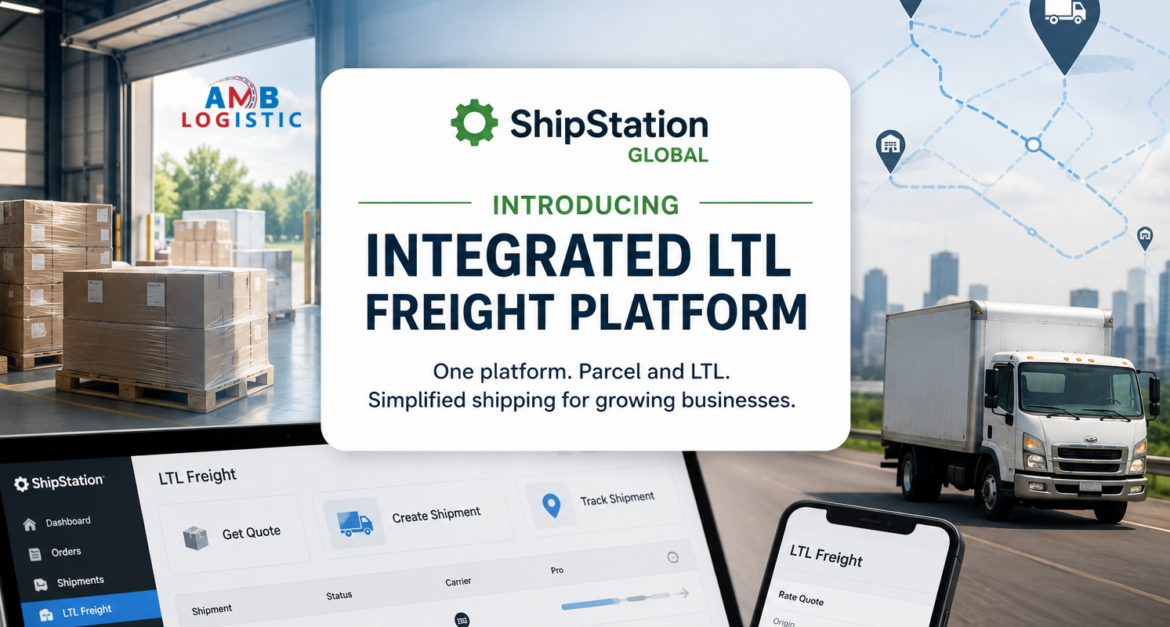
ShipStation Moves Into LTL
ShipStation Global has introduced less-than-truckload freight capabilities inside the platform many small and midsize businesses already use for parcel shipping. The development places parcel and LTL purchasing inside one workflow—and raises the competitive standard for traditional freight brokerages.
ShipStation Global reportedly offers access to more than 75 LTL carriers, with over 50 live at launch. Merchants can compare rates, manage orders, review estimated delivery performance, evaluate damage-risk information, and coordinate parcel and LTL transportation through one interface.
This is more than a software update.
It represents a broader change in how businesses purchase transportation. Freight buying is moving directly into the systems where merchants already manage orders, inventory, parcel labels, fulfillment, and customer deliveries.
For conventional freight brokers, rate access alone is becoming easier to automate. The future competitive advantage will come from shipment expertise, carrier judgment, exception management, claims support, risk control, and direct accountability.
Key Takeaways
- ShipStation Global reports access to more than 75 LTL carriers, with over 50 available at launch.
- Merchants can manage parcel and LTL transportation through one interface.
- The platform combines rate comparisons with estimated delivery and damage-risk information.
- ShipStation says approximately 78% of its merchants already move freight in some form.
- More than half of those merchants reportedly managed freight through systems separate from their parcel workflows.
- The launch follows the combination of Auctane and WWEX Group.
- The combined ShipStation Global business is reportedly valued at approximately $12 billion.
- Traditional brokers must increasingly compete through service quality and problem-solving—not access to rates alone.
What ShipStation Global Has Introduced
Many businesses begin with parcel transportation. As their sales and distribution networks grow, their shipping requirements become more complicated.
A growing merchant may eventually need to:
- Replenish inventory between warehouses.
- Send pallets to retail locations.
- Move wholesale orders to distributors.
- Coordinate inbound freight from suppliers.
- Deliver equipment to commercial customers.
- Ship products that are too large or heavy for parcel networks.
- Support both direct-to-consumer and business-to-business operations.
Historically, that transition forces businesses into separate transportation workflows.
A merchant might process parcel labels through one platform but move to another website, broker portal, spreadsheet, email chain, or telephone process whenever it needs an LTL shipment.
That separation creates additional work:
- Shipment information must be entered more than once.
- Tracking data becomes fragmented.
- Employees must learn multiple systems.
- Transportation reports become difficult to consolidate.
- Invoices must be reconciled across separate providers.
- Customers receive inconsistent visibility.
ShipStation Global is attempting to close that gap by bringing LTL transportation into an environment merchants already use.
The Merger Behind the LTL Expansion
The launch follows the combination of Auctane and WWEX Group.
Auctane brought established parcel and e-commerce shipping technology, including ShipStation. WWEX Group contributed freight brokerage operations, transportation experience, and carrier relationships through companies including:
- Worldwide Express.
- GlobalTranz.
- Unishippers.
- JEAR Logistics.
- BLX Logistics.
The combined ShipStation Global business is reportedly valued at approximately $12 billion.
The strategic logic is clear.
Auctane already had access to a large population of merchants managing daily parcel shipments. WWEX Group brought the freight capabilities required to serve those same customers when their needs expanded beyond packages.
Together, the businesses can follow a customer from its first parcel shipment to pallets, inventory transfers, LTL, truckload, expedited, and other transportation requirements.
Instead of allowing those freight transactions to move to another provider, ShipStation Global can retain more of the customer’s transportation activity inside one commercial ecosystem.
Why LTL Is the Logical Next Step
LTL is a natural bridge between parcel shipping and full truckload transportation.
A growing merchant may not have enough freight to fill an entire trailer, but its shipments may become too large, heavy, or expensive for conventional parcel service.
LTL allows several shippers to share trailer capacity. Each shipper pays for the portion of transportation resources required for its freight.
The concept is efficient, but LTL pricing and execution remain complex. The final cost can depend on:
- Shipment weight and dimensions.
- Pallet count.
- Commodity description.
- Freight classification and density.
- Origin and destination.
- Commercial or residential delivery.
- Liftgate requirements.
- Inside pickup or delivery.
- Limited-access locations.
- Appointment requirements.
- Terminal coverage.
- Reweigh and reclassification exposure.
- Damage and claims risk.
A digital platform can simplify the transaction, but it cannot remove these physical and operational requirements.
If a shipper enters the wrong dimensions, weight, freight class, or accessorial requirements, the lowest displayed quote may not become the final invoice.
Technology can make LTL easier to purchase. Accurate shipment information still determines whether the quoted price is reliable.
The Rise of Embedded Freight Buying
The most important part of this launch is not simply the number of carriers available.
The larger development is that freight purchasing is becoming embedded inside the software businesses already use.
Merchants increasingly expect transportation tools to connect with:
- E-commerce platforms.
- Order-management systems.
- Warehouse operations.
- Inventory data.
- Accounting workflows.
- Returns management.
- Customer-service platforms.
- Shipment tracking.
When freight buying appears inside the system already managing the customer’s order, the merchant faces less friction.
The user does not need to create another account, transfer shipment details manually, or reconcile multiple systems.
That convenience can influence purchasing decisions even when the platform does not always display the lowest available rate.
For many smaller businesses, saving time and reducing administrative complexity can be as valuable as saving a few dollars on one shipment.
Why This Matters for Freight Brokers
Rate Access Is Becoming a Standard Feature
Carrier rates were once difficult for smaller shippers to access and compare. Digital marketplaces, broker portals, and transportation-management platforms have made basic rate visibility increasingly common.
ShipStation Global places that capability directly inside a familiar parcel workflow.
A brokerage offering little more than a quote can now be compared with an automated platform in seconds.
This does not eliminate the broker’s role. It changes what customers expect the broker to contribute.
The Platform Controls the Customer Workflow
The provider controlling a merchant’s daily shipping workflow has a significant competitive advantage.
If the customer already manages orders, parcel labels, documents, and tracking through ShipStation, adding LTL inside the same system reduces the reason to contact another provider.
A traditional brokerage may still offer better support or deeper expertise, but it must give the customer a compelling reason to leave an established workflow.
Smaller Freight Buyers Become Easier to Serve
Small businesses can be expensive for traditional brokerages to serve when each customer ships limited volume but requires extensive manual support.
An integrated platform can distribute its technology and service costs across a large merchant population.
It can also identify customers whose transportation requirements are expanding. A merchant beginning with occasional LTL shipments may eventually need:
- Full truckload capacity.
- Expedited transportation.
- Cross-border service.
- Warehousing and fulfillment.
- Specialized equipment.
- Managed transportation.
The first LTL transaction can become the beginning of a much broader logistics relationship.
Transportation Data Becomes More Valuable
A platform managing parcel and freight can observe more of the customer’s transportation activity.
That data may reveal:
- Order patterns.
- Seasonal peaks.
- Inventory-transfer activity.
- Parcel-to-LTL conversion opportunities.
- Carrier performance.
- Damage patterns.
- Consolidation opportunities.
- Potential truckload demand.
As more shipment history and workflow rules accumulate inside one platform, the service becomes more useful—and potentially more difficult for the customer to replace.
What Integrated Technology Can Simplify
An integrated platform can remove significant administrative friction through:
- Fewer systems and passwords.
- Less duplicate shipment entry.
- Faster carrier comparisons.
- Centralized order information.
- More consistent tracking.
- Unified reporting.
- Easier parcel-to-freight conversion.
- Reduced employee training.
- Simplified invoice reconciliation.
For a growing merchant without a dedicated transportation department, these improvements can be substantial.
The business may not want employees to become LTL specialists. It wants a simple way to enter accurate information, select an appropriate option, and move freight reliably.
What Technology Does Not Eliminate
LTL transportation remains complicated after the shipment is booked.
No platform can prevent every:
- Missed pickup.
- Terminal delay.
- Reweigh or reclassification.
- Damaged pallet.
- Concealed-damage claim.
- Limited-access charge.
- Liftgate dispute.
- Delivery appointment failure.
- Capacity embargo.
- Billing discrepancy.
- Weather disruption.
These exceptions reveal the continuing value of experienced logistics professionals.
When a shipment stops following the original plan, the customer needs to know:
- Who contacts the carrier?
- Who investigates the delay?
- Who communicates with the receiver?
- Who challenges an incorrect charge?
- Who coordinates a recovery option?
- Who manages the claim?
- Who remains accountable until resolution?
Producing a rate is increasingly easy to automate. Managing responsibility after something goes wrong is not.
The Lowest Rate Is Not Always the Best Decision
The lowest displayed price may not represent the lowest total transportation cost.
A more complete decision should consider:
- Expected transit time.
- Pickup reliability.
- Damage exposure.
- Terminal coverage.
- Claims responsiveness.
- Destination requirements.
- Commodity characteristics.
- The cost of shipment failure.
A shipment that costs slightly less but arrives late, damaged, or with unexpected charges may create a much higher total expense.
This is where an experienced broker can deliver meaningful value: interpreting available transportation options according to the actual freight instead of presenting price as the only decision factor.
The Freight Broker Playbook
1. Compete on Exception Management
Routine quoting and booking will continue becoming more automated. Complex and disrupted freight still requires judgment.
Brokerages should demonstrate how they manage missed pickups, delays, damage, billing disputes, capacity shortages, urgent recoveries, claims, and customer escalations.
2. Develop Specialized LTL Knowledge
Generic rate access will become easier. Specialized knowledge will remain valuable.
Brokerages can differentiate through expertise in industrial products, food and beverage, healthcare, retail distribution, high-value cargo, trade-show freight, cross-border transportation, and appointment-sensitive deliveries.
3. Improve Shipment Data Before Quoting
Many LTL billing disputes begin with incomplete or inaccurate information.
Before quoting, confirm:
- Exact weight.
- Pallet dimensions.
- Commodity description.
- Packaging type.
- Freight classification.
- Pickup and delivery conditions.
- Accessorial requirements.
- Shipment value.
- Appointment requirements.
4. Sell Total Transportation Value
Help customers evaluate the complete cost, including fuel, accessorials, reclassification exposure, redelivery, storage, damage risk, administrative time, and service failures.
A slightly higher initial rate may deliver better value when it reduces delays, claims, and billing disputes.
5. Combine Technology With Human Support
Customers expect fast quoting, online tracking, document access, automated updates, and shipment history.
They also need an experienced person available when information conflicts or an exception requires judgment.
6. Strengthen Carrier and Claims Management
A large carrier list does not automatically produce better service.
Brokerages should understand which LTL carriers perform best for particular regions, commodities, shipment sizes, facility types, and service requirements.
Customers should also understand packaging standards, delivery-receipt procedures, photographic evidence, and claims requirements before a loss occurs.
7. Build Solutions Around Customer Industries
A large digital platform can serve a broad market efficiently. A specialized brokerage can compete by understanding one customer segment more deeply.
A broker capable of coordinating specialized unloading, jobsite access, retail compliance, strict appointments, or emergency replacement freight offers value beyond a rate-comparison screen.
What Small and Midsize Shippers Should Evaluate
ShipStation Global gives smaller businesses another way to access LTL transportation, but shippers should still evaluate the complete service.
Before selecting an option, ask:
- Is the displayed rate all-inclusive?
- Which additional charges may apply?
- Who manages a missed pickup or delayed delivery?
- What claims assistance is available?
- How are carriers selected?
- Can the system support unusual shipment requirements?
- What happens after a reweigh or reclassification?
- Can the provider support larger transportation needs later?
A merchant shipping occasional standard pallets may value a self-service workflow. A business moving fragile, high-value, or time-sensitive products may require more direct logistics support.
Frequently Asked Questions
What did ShipStation Global launch?
ShipStation Global introduced integrated LTL freight capabilities that allow eligible merchants to compare transportation options and manage parcel and LTL shipments through one interface.
How many LTL carriers are available?
The platform reportedly provides access to more than 75 LTL carriers, with over 50 live at launch.
Why is ShipStation Global adding LTL?
Many existing merchants already move freight but previously managed it through separate systems. Integrating LTL allows ShipStation Global to support a larger portion of their transportation activity.
What companies are behind ShipStation Global?
The business combines Auctane’s shipping technology with the freight capabilities of WWEX Group, whose companies include Worldwide Express, GlobalTranz, Unishippers, JEAR Logistics, and BLX Logistics.
Does the platform replace freight brokers?
No. It can automate important quoting, booking, and tracking activities, but complex freight, carrier selection, claims, risk management, and shipment exceptions may still require experienced support.
Why does this matter for traditional brokerages?
It brings freight purchasing directly into software many businesses already use, increasing pressure on brokerages that compete mainly through rate access.
What risks remain when purchasing LTL digitally?
Potential risks include incorrect shipment information, accessorial charges, reclassification, damage, missed pickups, delivery delays, and claims-management challenges.
How can freight brokers remain competitive?
Brokerages can differentiate through specialized expertise, accurate shipment preparation, carrier knowledge, exception management, claims support, risk control, and direct accountability.
Should shippers always select the lowest displayed rate?
No. Transit performance, damage exposure, carrier suitability, terminal coverage, service requirements, and the cost of failure should also influence the decision.
The Bottom Line
ShipStation Global’s move into LTL demonstrates how quickly freight purchasing is becoming integrated into everyday business software.
For small and midsize shippers, this can reduce administrative work and simplify the transition from parcel transportation to palletized freight.
For traditional freight brokerages, it establishes a higher competitive standard.
Customers no longer need a broker simply to access a rate. They need a broker who can select the right option, identify hidden costs, prevent avoidable problems, manage risk, and take responsibility when transportation does not proceed as planned.
Technology will continue automating routine freight transactions. That does not eliminate the broker’s role. It raises the level of value the broker must provide.
A rate can be automated. Responsibility cannot.
About AMB Logistic
AMB Logistic helps businesses manage freight requirements that demand more than a price displayed on a screen.
We combine transportation options with shipment-specific planning, dependable carrier coordination, and clear communication from pickup through delivery.
AMB Logistic supports less-than-truckload, full truckload, expedited, specialized, and time-sensitive freight.
Need help selecting and managing the right transportation solution? Connect with AMB Logistic today.
AMB Logistic
Website: www.amblogistic.us
Email: info@amblogistic.us
Phone: +1 (888) 538-6433
Tags
ShipStation Global, ShipStation LTL, LTL Freight, Freight Brokerage, Digital Freight Platform, Auctane, WWEX Group, Worldwide Express, GlobalTranz, Unishippers, Freight Technology, Integrated Shipping, Parcel Shipping, Small Business Logistics, 3PL, U.S. Logistics, AMB Logistic