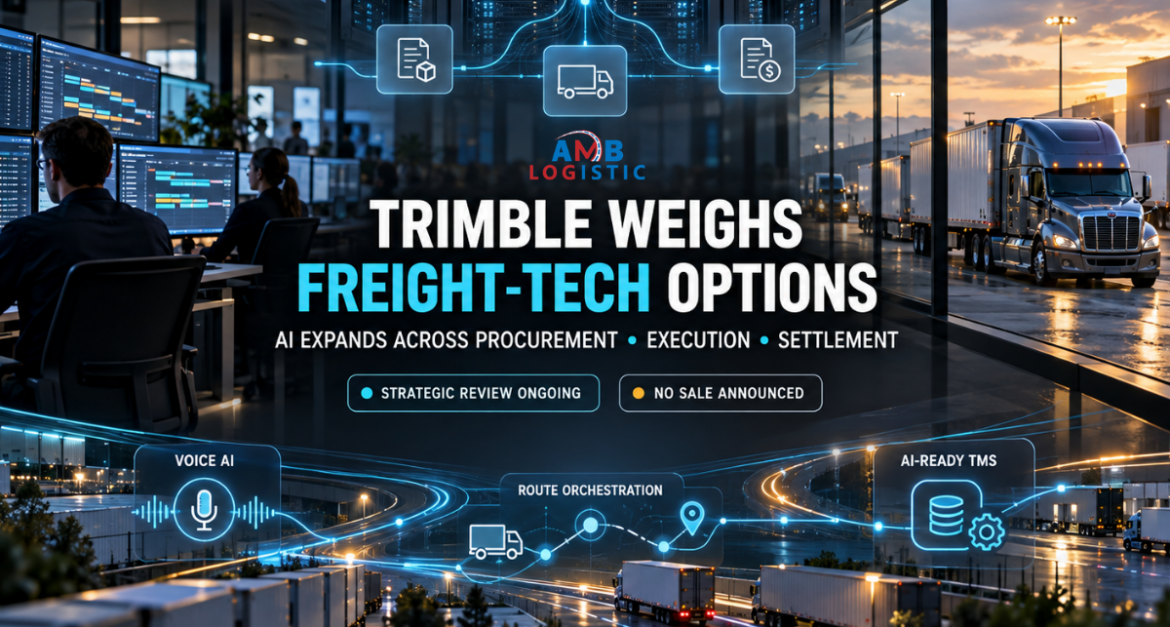
Trimble is evaluating the future of its transportation and logistics technology business while continuing to introduce artificial-intelligence tools designed for carriers, freight brokers, shippers and managed-transportation providers.
The company confirmed that its strategic review remains active and that multiple outside parties continue to show interest in the transportation division.
However, Trimble has not announced a sale, selected a buyer or established a timetable for completing the review. The process could result in a sale, a separation of the division into an independent company or Trimble retaining the business under its existing ownership.
At the same time, the company is moving forward with new freight technologies involving voice AI, transportation-management systems, route planning, trailer orchestration, maintenance automation and agent-based workflow execution.
The combination creates an important industry story: ownership of a major transportation-technology ecosystem may change, but investment in its underlying freight capabilities is continuing.
What Trimble Announced
Trimble’s transportation and logistics division remains under strategic review after the company received unsolicited interest from multiple parties.
The review is intended to determine which ownership structure would create the best outcome for customers, employees and shareholders.
Potential outcomes could include:
- Trimble continuing to own and operate the division
- A sale of the transportation business to another company
- A separation or spinoff into an independent organization
- Another strategic structure involving outside investment
Trimble leadership emphasized that the company is continuing to operate the division normally while the review proceeds.
No final decision has been announced, and interested parties have not been publicly identified.
This distinction matters. The strategic review does not mean that a sale is certain. It means Trimble is evaluating credible alternatives while maintaining the business and continuing to invest in its products.
Why Trimble’s Transportation Business Matters
Trimble occupies an influential position inside the transportation-technology market.
Its systems support functions such as fleet management, routing, dispatch, transportation procurement, shipment execution, visibility, settlement, mapping and equipment maintenance.
The company’s transportation portfolio also includes Transporeon, the freight-technology platform Trimble acquired in 2023.
Through these systems, Trimble technology can connect multiple participants across the freight transaction:
- Shippers tendering and managing freight
- Freight brokers sourcing capacity
- Carriers dispatching drivers and equipment
- Drivers executing shipments
- Facilities managing appointments and arrivals
- Financial teams auditing and settling transportation charges
That connectivity makes the transportation business more than a collection of individual software products. It creates a network of operational relationships, integrations and transportation data.
A change in ownership could therefore influence how those systems evolve, how quickly new capabilities are introduced and how the platform connects with the broader freight-technology market.
AI Development Is Continuing During the Review
Trimble is not placing its transportation strategy on hold while it evaluates ownership alternatives.
The company has introduced and demonstrated technologies centered on:
- Voice-powered artificial intelligence
- Route and trailer orchestration
- Automated maintenance workflows
- Modernized transportation-management interfaces
- AI-supported operational decisions
- Agent-based freight execution
The company’s approach is particularly relevant for established carriers and logistics providers operating older transportation-management platforms.
Replacing a deeply integrated TMS can be expensive, disruptive and operationally risky. Decades of customer information, workflows, carrier connections, accounting rules and internal processes may be tied to the existing system.
Trimble’s strategy is designed to bring AI capabilities into those established environments without requiring every customer to abandon its current technology and rebuild its operation from the beginning.
For freight companies, that could reduce the cost and disruption associated with adopting more advanced automation.
From AI Assistance to AI Execution
Much of the logistics industry’s early AI adoption focused on recommendations.
Systems could identify a likely delay, recommend a carrier, estimate a rate or highlight an exception. A human employee would then decide what action to take.
The next phase is more operational.
Agent-based systems are being designed to complete tasks across procurement, shipment execution and financial settlement—not simply analyze information.
That can include activities such as:
- Collecting and organizing shipment information
- Comparing available transportation options
- Preparing carrier communications
- Monitoring operational exceptions
- Updating shipment records
- Coordinating routine workflow steps
- Reviewing documents and transaction data
- Supporting invoice and settlement processes
The objective is not necessarily to remove people from freight operations. It is to reduce repetitive work so employees can concentrate on customer relationships, negotiations, exceptions and decisions requiring experience.
How Trimble’s Arc Agent Is Intended to Work
Trimble is developing Arc Agent as an adaptable system that can acquire multiple operational skills.
Instead of using a different AI application for every individual task, the company’s concept centers on one agent that can be taught how to complete different activities.
Users can define a task, review the agent’s work and gradually provide additional responsibility as the system proves reliable.
This creates a training model that resembles onboarding a new employee:
- Explain the task and the expected result.
- Allow the system to complete the work under supervision.
- Review the output and correct errors.
- Establish approval requirements.
- Expand responsibility after performance is validated.
Trimble has also emphasized a human-in-the-loop structure. Users can approve actions, provide feedback and review a history of what the system completed.
That auditability will be important as AI systems move deeper into freight transactions.
Why This Matters to Freight Brokers
Freight brokers manage large volumes of repetitive but operationally important work.
Employees may spend substantial time entering shipment details, sending routine messages, checking appointments, monitoring tracking updates, comparing carrier options, reviewing documents and resolving minor exceptions.
AI agents could reduce the time required for those tasks, allowing brokers to manage more freight without increasing administrative headcount at the same rate.
Potential brokerage applications include:
- Building loads from customer emails and documents
- Preparing carrier-search workflows
- Monitoring pickup and delivery appointments
- Identifying missing shipment information
- Flagging unusual changes during execution
- Organizing communications around active loads
- Supporting document collection
- Preparing invoice and settlement files
The greatest value may come from connecting these tasks rather than automating them individually.
An agent capable of working across procurement, execution and settlement could follow a shipment through its entire operational lifecycle.
The Risk of Automating a Weak Process
Automation does not automatically create better freight operations.
If a company’s workflow contains unclear responsibilities, weak controls or inconsistent data, AI can reproduce those problems at greater speed.
Before allowing an agent to execute transportation tasks, a brokerage should define:
- Which actions the system may complete independently
- Which decisions require human approval
- What information the agent may access
- How sensitive customer and carrier data will be protected
- When an exception must be escalated
- How decisions and changes will be recorded
- Who is responsible when an automated action is incorrect
The strongest implementation model combines automation with clear operational authority.
Routine, low-risk work can move faster. High-impact decisions remain subject to human review.
Data Governance Becomes a Core Freight Issue
AI systems require access to data before they can perform useful work.
In freight brokerage, that data may include:
- Customer information
- Carrier records
- Contracted rates
- Shipment history
- Pickup and delivery locations
- Driver and equipment details
- Payment information
- Internal operating procedures
- Customer-specific business rules
Connecting that information creates operational value, but it also increases the importance of security, permissions and governance.
A company should know exactly which data an AI agent can access, which systems it can change and which external parties can receive information.
Important safeguards include:
- Role-based access controls
- Multi-factor authentication
- Complete action histories
- Approval requirements for sensitive changes
- Restrictions on exporting proprietary information
- Testing before production deployment
- Continuous monitoring for unusual system behavior
AI governance is not only a technology responsibility. It requires cooperation among operations, compliance, finance, security and executive leadership.
Modernizing Without Replacing the Entire TMS
One of the most practical elements of Trimble’s strategy is its focus on adding intelligence to existing transportation systems.
Many freight companies want the benefits of AI but cannot justify replacing a TMS that supports years of integrations and operating knowledge.
A modernization layer can potentially allow those companies to introduce automation gradually.
That approach may offer several advantages:
- Lower implementation risk
- Reduced disruption to active operations
- Faster employee adoption
- Preservation of existing integrations
- More controlled testing of AI workflows
- Shorter time between development and operational use
Incremental modernization can also help management measure whether a new capability is producing a real return before expanding it across the organization.
U.S.–Mexico Freight Is Receiving Additional Attention
Trimble is also expanding mapping and transportation technology for increasingly complex cross-border freight movements between the United States and Mexico.
Cross-border transportation involves more than calculating a highway route. It may require coordination among shippers, brokers, carriers, transfer operators, customs professionals, border facilities and delivery partners.
Reliable truck-specific mapping can improve planning around:
- Commercial border crossings
- Truck-restricted roads
- Industrial facilities
- Trailer yards
- Transfer locations
- Customs-processing points
- Final delivery facilities
Trimble has millions of mapped North American locations and is adding more truck-relevant places in Mexico.
Better mapping and orchestration could help carriers and brokers manage cross-border shipments with greater visibility, particularly when multiple parties are responsible for different sections of the movement.
What a Potential Sale Could Mean
If Trimble eventually sells or separates its transportation division, the result could produce a significant change in the freight-technology market.
A new owner could pursue additional acquisitions, accelerate product investment, combine the platform with another logistics network or reorganize the existing portfolio.
An independent transportation company could also concentrate more directly on freight customers without competing internally for resources with Trimble’s other business segments.
However, ownership changes can create uncertainty involving:
- Product road maps
- Customer-support structures
- Integration priorities
- Pricing models
- Leadership teams
- Data-governance policies
- Long-term technology strategy
Customers should avoid assuming that any particular outcome is guaranteed. No transaction has been announced, and Trimble has stated that retaining the business remains a viable option.
What Freight Brokers Should Do Now
1. Identify Repetitive Workflows
Document tasks that consume significant employee time but follow predictable rules. These activities may be the best early candidates for automation.
2. Establish Human Approval Points
Determine which actions can be completed automatically and which require an experienced employee to review the decision.
3. Clean Operational Data
AI performance depends on accurate information. Duplicate carrier records, outdated customer rules and inconsistent location data should be corrected before deeper automation begins.
4. Protect Sensitive Information
Review who can access customer, carrier, pricing and payment information. AI agents should receive only the permissions required to complete approved tasks.
5. Evaluate Technology Dependence
Brokerages should understand which critical workflows depend on a single technology provider and how a change in ownership could affect those systems.
6. Measure Operational Results
Track whether automation actually reduces manual work, improves service, shortens response times or lowers error rates.
7. Preserve Human Expertise
Technology should strengthen the judgment of experienced freight professionals—not remove oversight from consequential decisions.
Questions Shippers and Brokers Should Ask
As more logistics platforms introduce agent-based automation, customers should ask:
- Which transportation tasks can the AI perform?
- Can it make changes without human approval?
- What information can it access?
- Is every action recorded?
- Can an employee reverse an automated decision?
- How is customer data separated and protected?
- Can the system work with an existing TMS?
- What happens when the agent encounters incomplete information?
- Who is accountable for an incorrect action?
- How will service continue if an integration becomes unavailable?
These questions are becoming as important as traditional comparisons involving features, implementation costs and subscription pricing.
The Larger Industry Shift
The Trimble announcement reflects two major forces shaping logistics technology.
First, freight platforms with large networks, connected data and established customer relationships are becoming strategically valuable assets.
Second, AI is moving closer to direct operational execution.
The companies that benefit most will not necessarily be those that adopt the largest number of AI tools. They will be the organizations that connect automation to disciplined workflows, dependable data and clear accountability.
The objective is not automation for its own sake.
The objective is faster, more consistent and more controllable freight execution.
AMB Logistic Perspective
At AMB Logistic, we believe freight technology creates the greatest value when it strengthens communication, visibility and operational control.
AI can accelerate repetitive work, identify exceptions and support faster decisions, but successful transportation still depends on responsible oversight and dependable execution.
As technology continues to reshape freight brokerage, shippers need partners that combine modern systems with experienced coordination and human accountability.
Move your freight with responsive communication, stronger visibility and dependable transportation support.
AMB Logistic
www.amblogistic.us
info@amblogistic.us
+1 (888) 538-6433
Tags: Trimble, Freight Technology, Logistics Technology, Artificial Intelligence, Freight AI, Agentic AI, Arc Agent, Transportation Management System, TMS, Freight Brokerage, Digital Freight, Transportation Automation, Route Orchestration, Trailer Management, Fleet Technology, Supply Chain Technology, Freight Procurement, Shipment Execution, Freight Settlement, Cross-Border Logistics, U.S.–Mexico Freight, Third-Party Logistics, 3PL Technology, Logistics News, AMB Logistic