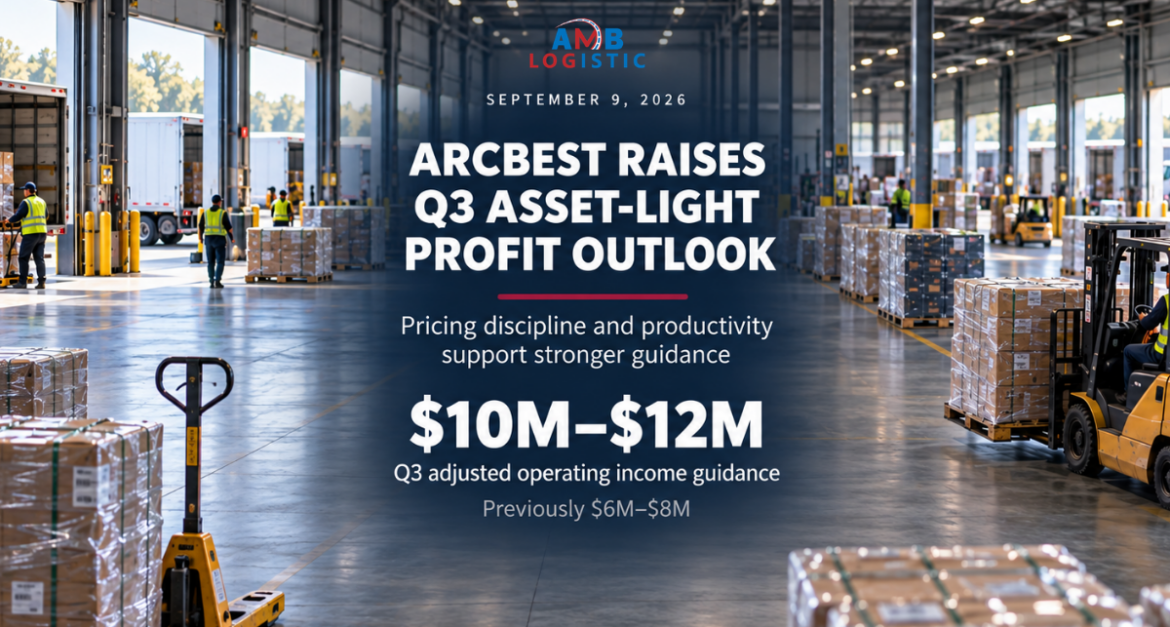
ArcBest Raises Q3 Asset-Light Profit Outlook
More revenue does not automatically mean more freight—or better margins. ArcBest’s latest operating update brings that distinction into focus. The company raised its third-quarter 2026 adjusted operating income outlook for its asset-light segment, which includes truck brokerage, while August shipment counts remained flat year over year.
For freight brokers and shippers, the update offers a useful opportunity to examine what drives profitability: the price of transportation, the cost of securing capacity, and the work required to execute each shipment.
What ArcBest Announced
In an update released after market close on September 8 and reported on September 9, ArcBest increased its expected Q3 asset-light adjusted operating income to $10 million–$12 million, compared with its previous forecast of $6 million–$8 million.
The segment’s August daily revenue increased 26% year over year, while shipments were flat. Revenue per shipment also rose 26%, with higher fuel prices accounting for much of that increase. Purchased transportation costs improved by 60 basis points from July, reaching 85% of revenue.
Management attributed the stronger outlook to pricing discipline and continuing productivity improvements. These figures describe the asset-light segment, rather than ArcBest’s entire business or its brokerage operations alone. The profit range remains guidance, not a completed quarterly result.
Why Revenue Growth Needs a Closer Look
A brokerage can invoice more dollars without moving more loads. Fuel surcharges, longer distances, equipment requirements and changes in customer mix can all increase revenue per shipment.
That makes headline revenue an incomplete measure of operating performance. A higher customer invoice may arrive alongside a higher carrier payment, leaving little additional gross profit.
For brokers reviewing their own results, three separate questions help make the picture clearer:
- Volume: Are we moving more shipments?
- Gross profit: What remains after paying for transportation?
- Operating contribution: What remains after the work and overhead required to serve the account?
Tracking these measures together makes it easier to distinguish a growing business from a more expensive flow of freight.
Purchased Transportation Costs Are Only Part of the Margin Story
Carrier purchasing decisions directly influence the difference between what a customer pays and what the broker spends to move the shipment. However, that spread still needs to support the brokerage’s operating expenses.
A purchased transportation ratio of 85% should therefore not be interpreted as a 15% operating profit margin. Compensation, technology, administration and other expenses must also be considered.
For an individual brokerage, the practical opportunity is to understand where transportation spending changes after a quote is accepted. Last-minute recovery coverage, unplanned accessorials and incomplete shipment details can turn an attractive booking into a weak result.
Better purchasing starts before the carrier call. Accurate weight, equipment specifications, appointment requirements and loading conditions give the broker a more reliable basis for pricing and coverage.
Productivity Should Include the Cost of Exceptions
Loads handled per employee can help a brokerage understand its capacity to grow. That number becomes more useful when paired with service quality and the amount of rework each shipment creates.
A load that requires repeated appointment changes, missing-document follow-ups and an invoice dispute consumes more operating time than its booking record suggests.
Reducing that work can create room for additional freight without increasing staffing at the same pace. Clear handoffs, complete shipment records and defined escalation responsibilities are practical starting points.
The aim is to help employees spend more time on decisions that require judgment: resolving disruptions, maintaining carrier relationships and communicating meaningful updates to customers.
A Five-Step Playbook for Freight Brokers
- Separate fuel from underlying pricing. Review customer revenue and carrier costs on a consistent basis. Distinguish fuel-related changes from changes in linehaul pricing before drawing conclusions about rate strength or margin improvement.
- Compare quoted and realized gross profit. Check what the shipment was expected to earn against its final result. Record why the difference occurred, including recovery costs, accessorials or billing adjustments.
- Measure account workload alongside revenue. Identify accounts that require frequent manual intervention. Use that information to improve operating instructions, discuss recurring problems with the customer and evaluate pricing.
- Build a clear process for shipment changes. Specify who approves equipment substitutions, revised appointments and additional charges. Document decisions where the people handling the load can find them.
- Review profitability with service performance. Assess margin alongside pickup reliability, delivery performance and claims. A cheaper coverage decision has limited value if it creates a costly service failure.
What Shippers Should Take From This News
For shippers, the useful question is how a logistics provider manages the full shipment process. A competitive quote matters, but so do dependable coverage, clear communication and an understandable approach to additional charges.
Ask how shipment changes are handled, how backup capacity is arranged and how exceptions are communicated. These conversations help establish expectations before a disruption puts the shipment under pressure.
ArcBest’s update should also be read within its scope. One company’s improved outlook does not establish that every brokerage is experiencing stronger margins or that every lane has become easier to cover.
Frequently Asked Questions
Does the higher outlook mean ArcBest moved more asset-light shipments in August?
No. Reported shipment counts were flat year over year. Revenue growth and shipment growth are separate measures.
Is the revised profit forecast a confirmed quarterly result?
No. It is management’s expectation for Q3 adjusted operating income. Final results may differ.
What should smaller freight brokers focus on?
Start with realized gross profit per shipment, the cost of servicing each account and the recurring reasons loads miss their expected margin. Those measures can reveal specific opportunities to improve execution.
Final Word
ArcBest’s stronger asset-light outlook puts the relationship between pricing, purchased transportation and productivity in focus. For freight brokers, the practical lesson is to understand what each shipment contributes after both transportation costs and operating effort are considered.
Profitable growth depends on knowing which freight works for the business—and executing that freight consistently.
Talk to AMB Logistic
Planning your next shipment or reviewing your transportation needs? Contact AMB Logistic to discuss your lanes, equipment requirements and delivery priorities.
Website: www.amblogistic.us
Email: info@amblogistic.us
Phone: +1 (888) 538-6433
Tags: ArcBest, Freight Brokerage, Asset-Light Logistics, Freight Margins, Transportation Management, U.S. Logistics, AMB Logistic