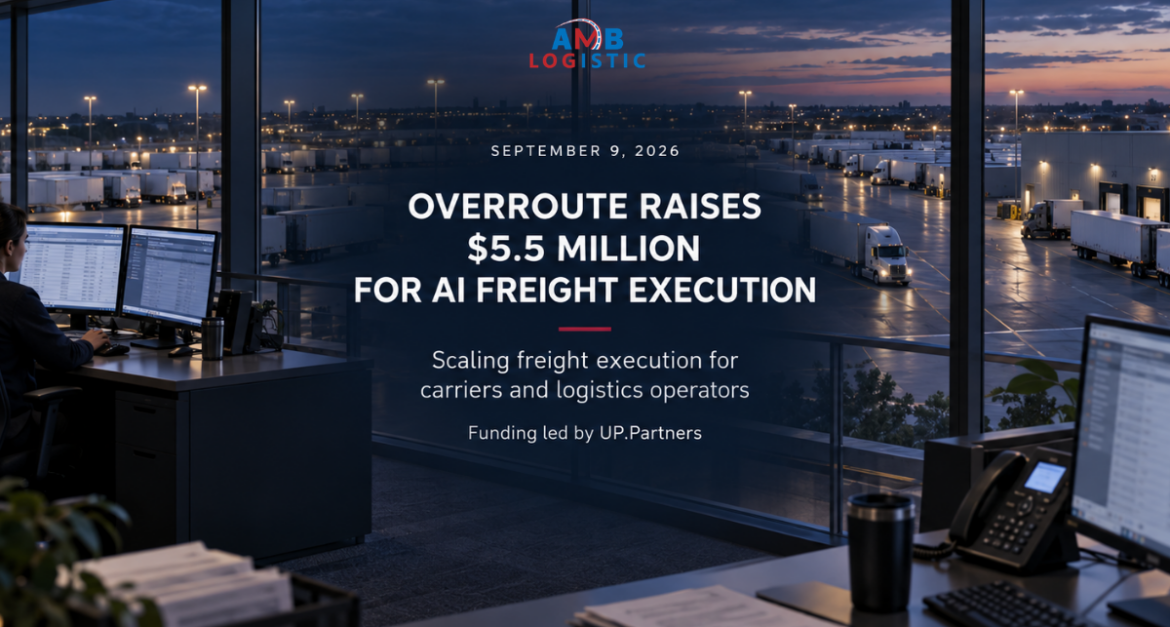
Overroute Raises $5.5 Million
Booking a truck is one step in a much longer process. Between pickup and delivery, logistics teams coordinate appointments, follow up on shipment status, communicate changes and resolve exceptions. Overroute’s newly announced $5.5 million funding round puts attention on the technology being built to support that daily execution work.
For freight brokers, the announcement raises a practical question: where can automation reduce repetitive work while keeping shipment decisions accurate, accountable and connected to customer needs?
What Overroute Announced
On September 9, 2026, Over-route announced that it had raised $5.5 million in funding, led by UP.Partners, with participation from EIC Rose Rock, 1834 Ventures, Tulane Ventures and other investors.
The company describes itself as an AI-native freight execution business built for large carriers and logistics operators. The funding is intended to support its expansion in complex freight operations.
The announcement establishes the investment and the company’s focus. It does not, by itself, establish a particular level of cost savings, service improvement or return on investment for a brokerage adopting the technology.
Why Freight Execution Deserves Attention
A shipment can generate substantial work after the carrier accepts the load. Teams may need to confirm arrival, reconcile conflicting updates, request documents, explain delays and arrange revised appointments.
That work often crosses several communication channels. The appointment may be in an email, the latest driver update in a message and the customer’s delivery instructions in the transportation management system.
When those records disagree, someone must establish what is current and decide what happens next. A missing update can be inconvenient; an incorrect update can lead another person to make the wrong decision.
This is why freight execution is a useful area to examine when evaluating AI. The opportunity lies in connecting information to a defined operational task and making the result available to the people responsible for the shipment.
Where AI Could Support a Brokerage Workflow
The following are potential applications to evaluate across freight technology products. They should be treated as assessment areas, rather than a confirmed list of Overroute features.
- Status coordination: Collecting incoming updates and identifying shipments that need further confirmation.
- Exception triage: Organizing issues by urgency so employees can address time-sensitive disruptions first.
- Document handling: Matching received documents to shipment records and flagging missing information.
- Customer communication: Preparing updates from verified shipment details for review or delivery under established rules.
- Shift handoffs: Summarizing unresolved issues, recent actions and the next person responsible.
Each application needs a clear definition of success. For example, processing more messages is useful only if the system associates them with the correct shipment and preserves the information needed for the next decision.
Accuracy Begins With the Shipment Record
Automation depends on the quality of the information available to it. Duplicate load numbers, outdated appointment times and unclear facility instructions create uncertainty that a faster workflow cannot automatically resolve.
Before introducing a tool, a brokerage should decide which record governs each important detail. Appointment times, carrier assignments and customer instructions need an identifiable source and a process for recording changes.
It also helps to distinguish between different levels of certainty. A driver’s estimated arrival, a tracking-based prediction and a facility-confirmed check-in describe different things. Presenting them as interchangeable can create misleading customer updates.
A useful system should make it possible to understand where an update came from, when it was received and whether it requires confirmation.
Define Who Can Make Each Decision
A brokerage evaluating automation should establish the actions a system can take independently and the decisions that require an employee’s approval.
Requesting a missing document may fit a routine workflow. Agreeing to an additional charge, changing a delivery location or accepting a revised service commitment carries a different level of responsibility.
Those boundaries should reflect customer instructions and the brokerage’s operating procedures. Employees also need a clear way to take control when information conflicts or a shipment falls outside the expected process.
For the customer, accountability should remain straightforward: there is a known person or team responsible for resolving the issue and explaining the next step.
A Five-Step Evaluation Plan for Freight Brokers
- Choose one recurring workflow. Start with a specific task, such as requesting delivery documents or preparing shift handoffs. Define where the process begins, what information it needs and what a completed task looks like.
- Measure the current workload. Record the time spent, the number of manual touches and the frequency of errors or repeated follow-ups. This gives the team a baseline for evaluating any improvement.
- Set approval and escalation rules. Identify which actions can proceed automatically, which need review and who receives unresolved issues. Include situations involving missing or contradictory information.
- Run a limited pilot. Use a manageable group of shipments and review the results with the employees handling them. Include ordinary exceptions so the evaluation reflects real operating conditions.
- Expand based on verified results. Compare time saved, correction work, service performance and total cost. Expand when the process produces consistent benefits and the team can explain how it works.
Measure Outcomes That Matter to Customers
The number of automated tasks is an activity measure. A more complete evaluation asks whether the work improves the shipment experience.
Useful measures include the time between identifying an exception and assigning it to an owner, the accuracy of customer updates, the speed of document completion and the amount of work employees must redo.
Costs also need to include implementation, training, integration and ongoing review. A tool that saves time in one task may create additional checking elsewhere.
For shippers, the practical benefit should be visible in clearer communication, fewer information gaps and a more organized response when plans change.
Frequently Asked Questions
What is AI freight execution?
In this context, it refers to applying AI to operational work involved in coordinating shipments. The exact tasks, integrations and level of autonomy depend on the product and its configuration.
Does Overroute’s funding announcement prove that its technology will reduce brokerage costs?
No. Funding supports the company’s development and expansion. A brokerage would need to evaluate performance in its own workflow before making a savings claim.
Can smaller brokers learn from this development?
Yes. The broader evaluation approach applies regardless of company size: identify repetitive work, improve the underlying records, define responsibility and measure results before expanding automation.
Final Word
Overroute’s funding announcement brings fresh attention to the work required to execute freight after booking. For brokers evaluating AI, that is a useful place to begin: a specific operational problem with a measurable outcome.
The value of automation will depend on accurate information, clear decision boundaries and consistent shipment execution.
Talk to AMB Logistic
Planning your next shipment or reviewing your transportation needs? Contact AMB Logistic to discuss your lanes, equipment requirements and delivery priorities.
Website: www.amblogistic.us
Email: info@amblogistic.us
Phone: +1 (888) 538-6433
Tags: Overroute, Freight Technology, AI Freight Execution, Freight Brokerage, Logistics Automation, Transportation Management, AMB Logistic