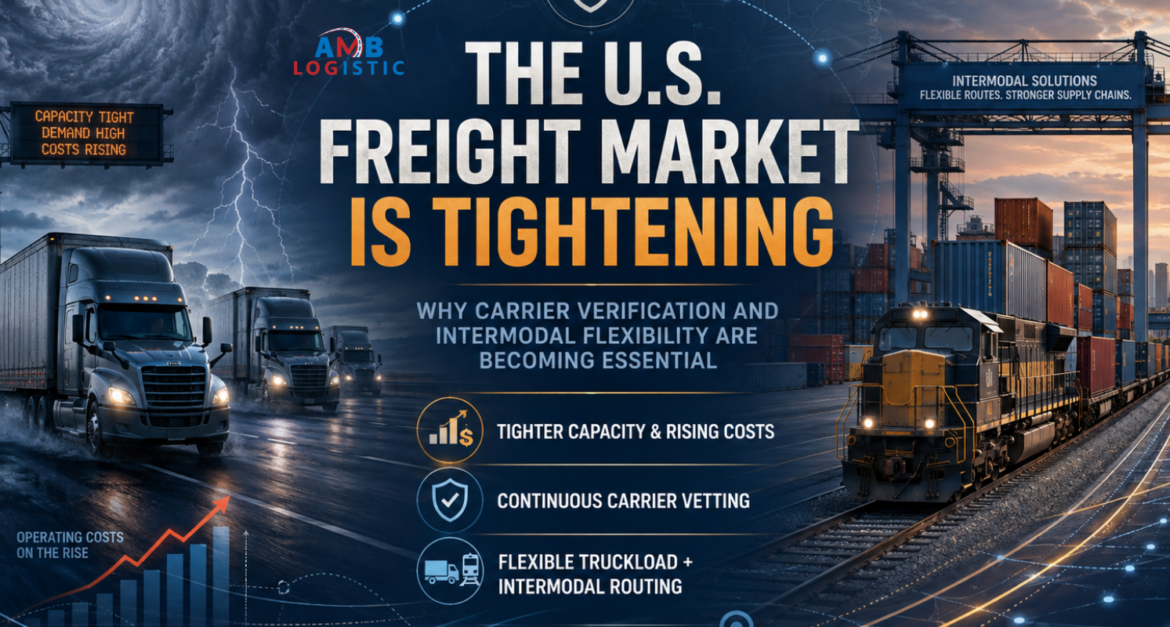
Truckload capacity is tightening, operating costs are rising, hurricane season is increasing disruption risk, and more freight is moving toward intermodal alternatives. For freight brokers and logistics teams, the message is clear: securing a truck is no longer enough. Every carrier must be continuously verified, every lane must be evaluated strategically, and every shipment should have a practical backup plan.
Introduction
The U.S. freight market is entering a more demanding phase. Dependable truckload capacity is becoming harder to secure in several regions, transportation costs are facing renewed pressure, and weather-related disruptions can quickly affect lanes far beyond the original impact area.
At the same time, freight brokers face greater responsibility for the carriers they select. A carrier that passed onboarding several months ago may no longer have the same insurance, operating status, safety position, contact information, equipment availability, or authorized personnel. One-time approval is therefore becoming insufficient for a market shaped by identity theft, double brokering, cargo theft, changing capacity, and growing legal scrutiny.
Intermodal transportation is also gaining attention. As long-distance truckload rates increase and capacity becomes less predictable, rail intermodal can offer shippers another way to control costs and protect capacity. It is not appropriate for every shipment, but it is becoming an important part of a flexible transportation strategy.
These developments are not separate trends. They are three parts of the same market transition:
- Truckload capacity is becoming more difficult and expensive to secure.
- Carrier selection requires deeper and more frequent verification.
- Intermodal is becoming a stronger alternative for suitable long-distance freight.
Freight brokers that connect these three realities can provide more than transactional coverage. They can help shippers build transportation plans that are safer, more flexible, and better prepared for market disruption.
Why This Matters
A tightening freight market changes the balance of negotiating power. When available truck capacity exceeds demand, shippers can often obtain multiple options at competitive rates with limited lead time. When capacity tightens, dependable carriers gain more control over pricing, scheduling, equipment placement, and lane selection.
This shift can happen nationally, regionally, or on specific lanes. A market may appear balanced overall while particular origins, destinations, equipment types, or pickup windows become difficult to cover. Produce seasons, storms, port activity, construction demand, retail promotions, holidays, and regional economic changes can all pull trucks away from normal freight patterns.
For shippers, the immediate effects may include:
- Higher linehaul rates and fuel-related expenses.
- More rejected contract tenders.
- Longer lead times for dependable capacity.
- Reduced flexibility for same-day or next-day requests.
- Higher premiums for urgent, specialized, or weekend freight.
- Greater exposure to inexperienced or insufficiently verified carriers.
For freight brokers, tightening capacity creates a difficult responsibility. The broker must move quickly enough to protect the customer’s schedule, but carefully enough to avoid compromising carrier quality. Accepting the first available truck without proper verification may solve an immediate capacity problem while creating a much larger safety, fraud, cargo, or liability problem.
That is why carrier verification becomes even more important when capacity tightens. Urgency should increase operational discipline, not reduce it.
The same market pressure also explains the renewed interest in intermodal. If a shipment has sufficient lead time, compatible cargo, suitable origin and destination access, and reasonable tolerance for rail schedules, intermodal may provide an effective alternative to increasingly expensive long-haul truckload service.
The best response is not to choose truckload or intermodal as a universal solution. It is to evaluate both modes against the shipment’s actual requirements and select the option that offers the strongest balance of cost, service, security, and reliability.
The Broader Picture
The freight market is moving away from the unusually loose conditions that allowed many shippers to purchase transportation reactively. Capacity is not disappearing everywhere at once, but the system has less room to absorb disruption than it did during the deepest period of the freight downturn.
Several forces are contributing to this change.
Carrier exits are reducing available capacity. Prolonged weak rates, expensive insurance, equipment payments, maintenance, labor, and fuel have placed significant pressure on smaller carriers. When operators leave the market, sell equipment, or reduce fleet size, the effect may not appear immediately. It becomes more visible when demand rises or a disruption pulls available trucks toward another region.
Operating costs remain elevated. Even when diesel prices temporarily stabilize, carriers still manage higher expenses across insurance, repairs, replacement parts, tires, labor, compliance, financing, and equipment. Carriers cannot absorb those costs indefinitely. As market conditions improve, they are more likely to pursue higher rates and prioritize profitable freight.
Hurricane season creates network-wide uncertainty. A major storm can close roads, interrupt ports, delay rail service, damage warehouses, and redirect trucks toward emergency or recovery freight. The impact can extend far beyond the storm’s path because equipment and drivers become displaced from their normal cycles.
Freight fraud has increased the cost of trust. Criminals can imitate legitimate carriers, alter contact details, compromise email accounts, manipulate documents, or obtain shipment information through deceptive methods. Basic onboarding checks may fail to detect a carrier identity that has been stolen or changed after initial approval.
Broker liability is receiving greater attention. Freight brokers are expected to demonstrate that their carrier-selection processes are thoughtful, consistent, and properly documented. This does not mean that a broker automatically becomes responsible for every carrier incident. It does mean that careless selection, inconsistent procedures, and weak records can create serious exposure.
Intermodal economics are becoming more attractive. When long-haul truckload costs rise faster than rail-based alternatives, shippers naturally reconsider mode selection. Intermodal can reduce dependence on scarce over-the-road capacity while providing access to established rail networks on suitable lanes.
Together, these forces are creating a freight market in which operational quality matters more than raw network size. A brokerage may advertise access to thousands of carriers, but the meaningful question is how many of those carriers are active, qualified, appropriate for the shipment, and verified at the moment the load is assigned.
What This Means for Freight Brokers and Logistics Teams
Freight brokers and logistics teams must prepare for a market where capacity decisions, compliance decisions, and mode decisions are increasingly connected.
The traditional workflow often treated these activities separately. A procurement team selected a mode, a broker searched for a carrier, and a compliance team reviewed documents. That separation becomes risky when market conditions change quickly.
A more effective workflow begins with the shipment itself:
- What is being transported?
- How valuable or theft-sensitive is the cargo?
- What is the required pickup and delivery window?
- Can the shipment tolerate additional transit time?
- Is intermodal service practical for the lane?
- What equipment is required?
- What weather, fraud, or regional capacity risks are present?
- Which carriers are both available and currently verified?
These questions help determine whether the load should move by direct truckload, rail intermodal, expedited service, team transit, or another arrangement.
They also help brokers apply stronger verification where the risk is greatest. A routine shipment of low-value materials on a familiar lane does not carry the same exposure as high-value electronics collected after hours by a newly introduced carrier. Both require proper controls, but the second shipment may justify additional identity confirmation, location validation, equipment photographs, driver verification, and dispatch authentication.
Freight brokers should also expect capacity planning to become more proactive. Waiting until the pickup date to search for a truck may lead to higher prices and fewer dependable options. Advance communication allows the broker to approach trusted carriers, evaluate alternative pickup times, compare truckload with intermodal, and identify potential service risks before they become emergencies.
Shippers should view this preparation as a form of risk management. The lowest quoted rate may not remain the lowest total cost if the shipment is delayed, stolen, misrouted, rejected, or assigned to an unsuitable carrier.
The objective is not simply to buy transportation cheaply. It is to purchase reliable transportation with a defensible process and a realistic contingency plan.
The Freight Broker Playbook
The following five-part playbook can help freight brokers and logistics teams respond to tightening truckload capacity while improving carrier security and maintaining access to intermodal alternatives.
1. Build a Lane-Level Capacity Plan
A national market forecast cannot replace lane-level planning. Freight availability and carrier interest vary by origin, destination, equipment type, day of the week, season, and delivery requirement.
Brokerages should identify their most important lanes and classify them according to capacity risk. High-risk lanes may include regions affected by seasonal demand, limited backhaul opportunities, severe weather, port congestion, border delays, or specialized equipment requirements.
For each priority lane, the capacity plan should identify:
- Preferred carriers with proven service history.
- Qualified backup carriers.
- Typical rate ranges and seasonal pricing behavior.
- Minimum lead time required for dependable coverage.
- Alternative pickup days or delivery windows.
- Intermodal terminals and service options.
- Known weather and congestion risks.
- Escalation procedures for rejected or uncovered loads.
This approach allows the brokerage to move from emergency coverage to planned capacity management. It also gives shippers a clearer understanding of when flexibility can lower cost or protect service.
For example, moving a pickup by one day may create access to a preferred carrier’s normal route. Extending delivery time may make intermodal practical. Consolidating several partial shipments may improve equipment utilization. A good freight broker identifies these options before quoting a solution.
2. Replace One-Time Approval With Continuous Carrier Verification
Carrier onboarding should be treated as the beginning of verification, not the end.
A carrier’s authority, insurance, safety data, ownership information, address, phone number, email domain, banking details, and operating behavior can change. Criminals may also compromise legitimate carrier identities after those carriers have been approved.
Continuous verification should occur at multiple points:
- During initial carrier onboarding.
- Before assigning a shipment.
- When dispatch information changes.
- Before releasing high-value or theft-sensitive freight.
- When a driver or truck differs from the original assignment.
- When contact or payment details are updated.
- When unusual communication or routing behavior appears.
At the shipment level, the broker should confirm that the carrier accepting the load matches the carrier arriving at pickup. The driver’s identity, truck, trailer, phone number, dispatch contact, and shipment reference should align with the information already recorded.
Any unexplained difference should pause the release process until it is resolved. A last-minute driver change may be legitimate, but it should never be accepted without confirmation through trusted carrier contacts.
Continuous verification also requires internal consistency. If one employee follows a detailed process while another bypasses checks during busy periods, the brokerage remains exposed. Procedures should be documented, trained, audited, and applied consistently.
3. Match Verification Intensity to Shipment Risk
Every shipment requires proper carrier selection, but not every shipment presents the same level of risk. A risk-based model allows brokerages to apply additional controls where they create the greatest value.
Factors that may increase shipment risk include:
- High cargo value.
- Electronics, food, beverages, pharmaceuticals, apparel, or other easily resold goods.
- New carrier relationships.
- Last-minute pickup requests.
- Weekend or after-hours collection.
- Unexpected contact-detail changes.
- Driver or equipment substitutions.
- Instructions to avoid tracking.
- Unusual routing or delivery changes.
- Rates significantly outside normal market ranges.
Higher-risk shipments may require enhanced controls such as live driver confirmation, equipment photographs, tractor and trailer verification, geolocation checks, facility call-backs, seal documentation, continuous tracking, route monitoring, and strict procedures for delivery changes.
The purpose is not to create unnecessary friction. It is to ensure that the level of verification reflects the potential impact of a failure.
A structured risk model also supports more consistent decisions. Employees do not need to rely entirely on intuition when clear triggers determine which additional checks are required.
4. Evaluate Intermodal Before Truckload Becomes an Emergency
Intermodal works best when it is considered during planning, not after truckload coverage has failed.
Rail intermodal typically combines truck drayage at origin and destination with rail transportation for the long-distance portion of the journey. It can be particularly effective on established long-haul corridors where rail service is frequent and terminal access is practical.
Potential intermodal advantages include:
- Reduced dependence on long-haul truck capacity.
- More stable pricing on suitable lanes.
- Competitive economics for longer distances.
- Access to scalable rail capacity.
- Lower fuel consumption per unit of freight.
- Additional routing flexibility during truckload disruption.
However, intermodal is not the correct choice for every shipment. It may be unsuitable for extremely urgent loads, highly sensitive cargo, irregular origin or destination locations, or freight that cannot tolerate additional handling or schedule variability.
Before recommending intermodal, brokers should evaluate:
- Total origin-to-destination transit time.
- Rail service frequency and cutoff times.
- Origin and destination drayage availability.
- Cargo value, sensitivity, and securement needs.
- Equipment compatibility.
- Terminal congestion and storage exposure.
- Delivery appointment flexibility.
- Total cost rather than linehaul cost alone.
The strongest strategy is often modal flexibility. A shipper may keep urgent freight on direct truckload while shifting predictable, long-distance, schedule-tolerant freight to intermodal. This protects premium truck capacity for shipments that genuinely require it.
5. Create a Defensible Decision Record
Good decisions must be supported by good records.
A broker should be able to explain why a particular carrier and mode were selected, what information was reviewed, when it was checked, which employee completed the review, and how any warning signs were resolved.
A defensible shipment record may include:
- Carrier authority and insurance verification.
- Safety and operating-history review.
- Identity and contact confirmation.
- Driver, tractor, and trailer details.
- Pickup and delivery instructions.
- Tracking consent and status history.
- Rate confirmation and communication records.
- Risk flags and documented resolutions.
- Mode comparison where intermodal was considered.
- Approval and escalation history.
Documentation should be accurate, accessible, and created as the decision occurs. Reconstructing a carrier-selection process after an incident is far more difficult than recording it correctly from the beginning.
These records also create operational value. They help management identify recurring risks, measure carrier performance, improve training, and refine the company’s approval standards.
In a tightening market, documented decision-making helps brokers preserve speed without sacrificing control.
AMB Logistic’s Role
AMB Logistic helps shippers navigate tightening capacity through disciplined carrier coordination, practical lane planning, and transportation solutions aligned with each shipment’s requirements.
Our approach begins with understanding the freight—not simply searching for an available truck. Shipment value, equipment requirements, timing, lane conditions, weather exposure, delivery commitments, and available transportation modes all influence the final strategy.
AMB Logistic supports customers by focusing on:
- Proactive capacity planning for critical lanes.
- Careful carrier qualification and shipment-level confirmation.
- Clear communication from pickup through delivery.
- Truckload and intermodal evaluation based on actual shipment needs.
- Contingency planning for weather, capacity, and service disruptions.
- Transportation strategies designed around reliability and accountability.
As the market changes, shippers need more than a rate. They need a logistics partner capable of evaluating risk, protecting service, and adapting the transportation plan when conditions change.
AMB Logistic’s objective is to help customers move freight confidently through an increasingly complex U.S. transportation environment.
FAQ
Is U.S. truckload capacity tightening everywhere?
No. Capacity conditions vary by region, lane, equipment type, season, and pickup date. However, the overall market has less excess capacity available to absorb major disruptions, which means localized problems can influence a wider network more quickly.
Why can tightening capacity increase freight rates?
When fewer dependable trucks are available for the number of loads being offered, carriers gain more pricing leverage. Higher operating costs, weather disruptions, seasonal demand, and repositioning requirements can add further pressure.
Why is hurricane season important for freight brokers?
Hurricanes can close roads, ports, terminals, and customer facilities. They can also displace equipment, interrupt fuel availability, increase emergency freight demand, and create capacity shortages outside the directly affected area.
What does continuous carrier verification mean?
Continuous verification means confirming that important carrier information remains valid after onboarding. It includes reviewing authority, insurance, identity, contact details, equipment, driver information, and shipment-specific pickup details whenever a load is assigned.
Is an approved carrier automatically safe to use for every future shipment?
No. Approval reflects information available at a particular time. Carrier records, insurance, personnel, ownership, safety data, and contact information may change. Shipment-level verification is necessary before freight is released.
Does stricter vetting guarantee that fraud or accidents will never happen?
No process can eliminate every risk. Strong verification can reduce exposure, identify warning signs, support better decisions, and create a more defensible operating process.
When is intermodal a good alternative to truckload?
Intermodal is often effective for predictable, long-distance shipments with sufficient lead time, appropriate cargo, access to rail terminals, and flexible delivery requirements.
Is intermodal always cheaper than truckload?
No. The complete cost must include rail transportation, origin and destination drayage, fuel, terminal charges, equipment, storage risk, and service requirements. Intermodal becomes attractive when its total cost and service profile are competitive for the specific lane.
Can truckload and intermodal be used within the same freight strategy?
Yes. Many shippers can use truckload for urgent or time-sensitive freight while assigning predictable, schedule-tolerant long-haul shipments to intermodal. This creates flexibility and protects truck capacity for priority loads.
How can shippers prepare for higher rates?
Shippers can provide earlier forecasts, increase pickup flexibility, reduce excessive dwell time, improve facility efficiency, evaluate intermodal lanes, strengthen carrier relationships, and communicate anticipated volume changes before capacity is required.
What should a shipper look for in a freight broker?
A shipper should evaluate the broker’s carrier-selection process, communication standards, shipment visibility, contingency planning, documentation, fraud controls, mode capabilities, and ability to explain transportation decisions clearly.
Final Word From AMB Logistic
The next phase of the U.S. freight market will reward preparation.
Tightening truckload capacity means dependable trucks may require more lead time and stronger carrier relationships. Rising operating costs mean rates may face continued pressure. Hurricane season means regional disruptions can quickly affect national freight flows. Growing fraud and legal concerns mean brokers must verify carriers continuously rather than relying on one-time onboarding. Increasing intermodal demand means shippers should evaluate rail before truckload becomes an expensive emergency.
These conditions do not require panic. They require a more disciplined transportation strategy.
Freight brokers should know their priority lanes, maintain qualified carrier options, verify every shipment carefully, evaluate intermodal where practical, and document the reasoning behind important decisions.
Shippers should share forecasts early, build flexibility into pickup and delivery schedules, and evaluate logistics providers on reliability and risk management—not only the initial price.
The strongest freight strategy is no longer built around a single mode or the largest possible carrier list. It is built around verified capacity, informed choices, and the flexibility to change direction when market conditions demand it.
In this market, trust is capacity—and flexibility is protection.
Talk To AMB Logistic Today
Prepare your freight strategy for tightening capacity, changing rates, carrier risks, and evolving transportation options. AMB Logistic can help you evaluate dependable truckload capacity, suitable intermodal alternatives, and practical plans for protecting service across your critical lanes.
AMB Logistic
Email: info@amblogistic.us
Phone: +1 (888) 538-6433
Website: www.amblogistic.us
Tags
U.S. Freight Market, Freight Brokerage, Truckload Capacity, Carrier Verification, Carrier Vetting, Freight Broker Liability, Intermodal Transportation, Truckload Rates, Hurricane Season Logistics, Freight Security, Transportation Risk Management, Supply Chain Strategy, Freight Fraud Prevention, Verified Capacity, AMB Logistic