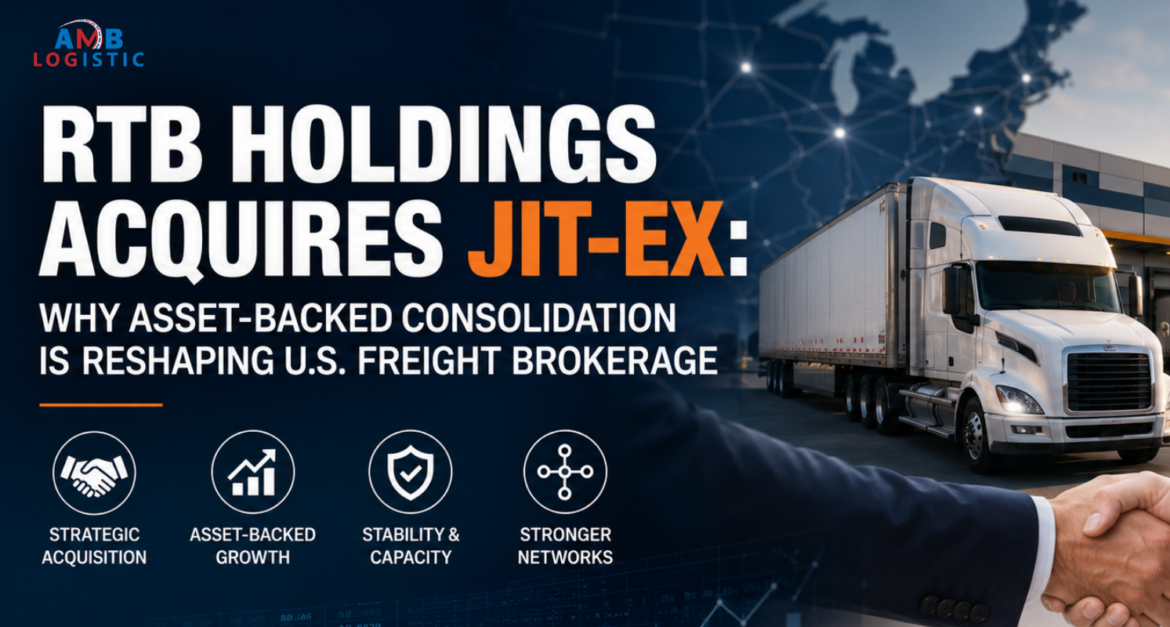
RTB Holdings has launched a new multimodal transportation platform anchored by Alabama Motor Express and supported by its first acquisition, JIT-Ex. The move combines physical trucking capacity, freight brokerage, expedited transportation, technology, and acquisition capital under one growth strategy—highlighting how consolidation is reshaping competition across the U.S. logistics industry.
Introduction
A new transportation platform has entered the U.S. logistics market with ambitions extending well beyond a single trucking operation or freight brokerage.
RTB Holdings has launched as a multimodal transportation and logistics platform anchored by Alabama Motor Express, commonly known as AMX. The platform has also completed its first acquisition, JIT-Ex, expanding its presence across important freight markets that include Memphis and Nashville.
Alabama Motor Express brings more than four decades of transportation experience, over 500 tractors, approximately 2,000 trailers, established customer relationships, and an existing combination of asset-based transportation and brokerage capabilities.
RTB Holdings has also launched AMX Expedited to support time-sensitive freight. Its stated expansion strategy includes potential partnerships and acquisitions across:
- Truckload transportation.
- Freight brokerage.
- Dedicated transportation.
- Expedited freight.
- Managed transportation services.
- Warehousing and distribution.
- Technology-enabled logistics services.
- Adjacent transportation sectors.
This is more than a routine acquisition announcement. It illustrates how the structure of U.S. freight brokerage is changing.
Brokerages are operating in a market shaped by tightening capacity, higher carrier costs, freight fraud, legal exposure, insurance pressure, technology investment, and demanding customer expectations. Under these conditions, companies with access to both physical assets and scalable brokerage capabilities may possess meaningful competitive advantages.
The industry is therefore seeing greater interest in hybrid transportation platforms—businesses that can use owned equipment for selected freight while accessing outside capacity through brokerage operations.
For shippers, carriers, and independent freight brokers, the important question is not simply whether RTB Holdings will acquire more companies. The broader question is what asset-backed consolidation means for transportation capacity, customer service, pricing, technology, carrier relationships, and competition across the market.
Why This Matters
RTB Holdings’ launch matters because it connects three major forces currently reshaping freight brokerage: capacity control, service diversification, and industry consolidation.
Traditional non-asset brokerages coordinate transportation through third-party motor carriers. This structure allows them to serve many lanes without maintaining large fleets, but it also makes them dependent on external capacity.
Asset-based carriers own or directly operate tractors, trailers, terminals, or other transportation infrastructure. They have greater control over a portion of their capacity, but their networks may be less flexible than those of brokerages when customers need coverage outside established operating areas.
A hybrid platform attempts to combine both strengths.
Owned assets can provide capacity, operational control, and service consistency on core lanes. Brokerage operations can extend geographic coverage, respond to volume surges, offer specialized equipment, and serve freight outside the company’s primary asset network.
This model becomes particularly valuable when truckload capacity tightens. A brokerage relying entirely on third-party carriers may face higher rates, more rejected tenders, and fewer dependable options. A platform with controlled assets may be able to protect priority freight through its fleet while using brokerage capacity to manage overflow and irregular lanes.
The JIT-Ex acquisition also adds geographic and operational significance. Memphis and Nashville are important transportation markets connecting the Southeast, Midwest, Southwest, and major national distribution corridors. Strengthening operations in these areas can improve regional density, equipment utilization, and customer access.
The expansion into expedited freight is equally important. Time-sensitive transportation can serve industries where production interruptions, emergency replenishment, critical components, or strict delivery commitments justify premium service.
By combining truckload, brokerage, and expedited capabilities, RTB Holdings is positioning itself to capture a larger share of each customer’s transportation spending.
This strategy reflects a wider shift from selling isolated freight services toward building integrated logistics relationships.
The Broader Picture
Consolidation is increasing because freight brokerage has become more expensive and complex to operate successfully.
During a prolonged soft market, brokerages often compete aggressively for limited freight. Gross margins become compressed, customer acquisition becomes expensive, and experienced employees may be difficult to retain. Smaller operators can survive these conditions, but they generally have less financial room to absorb losses, delayed customer payments, fraud incidents, claims, or major technology investments.
When the freight cycle begins tightening, a different set of pressures emerges. Carrier rates can increase faster than shipper pricing. Brokers must protect capacity while managing customer expectations and defending margins. Companies without strong carrier relationships or sufficient working capital can struggle even when demand improves.
Several forces are encouraging transportation businesses to pursue acquisitions and partnerships.
Technology requires continuous investment.
Modern freight operations increasingly depend on transportation management systems, automated pricing, digital tracking, carrier monitoring, fraud detection, document processing, customer portals, data analytics, and system integrations.
These tools can improve efficiency, but purchasing software alone does not create a technology strategy. Companies must integrate systems, secure data, train employees, monitor performance, and maintain reliable workflows.
A larger transportation platform can spread those investments across more freight, customers, carriers, and operating divisions.
Freight fraud is increasing operational risk.
Identity theft, double brokering, cargo theft, fictitious pickups, altered documents, compromised email accounts, and payment diversion have made carrier verification more demanding.
Smaller brokerages may find it difficult to maintain advanced fraud controls while also managing daily sales, operations, carrier relations, billing, collections, and claims.
Consolidated platforms can centralize security procedures, use dedicated compliance specialists, and invest in stronger monitoring systems. However, consolidation does not automatically eliminate fraud. A larger company still requires disciplined employees, verified data, clear escalation procedures, and shipment-level controls.
Broker liability requires stronger processes.
Legal scrutiny surrounding carrier selection has increased the importance of documented vetting and consistent decision-making.
Freight brokers must be prepared to explain how carriers were evaluated, what information was reviewed, whether warning signs appeared, and how the final carrier-selection decision was made.
Larger asset-backed platforms may have more resources for compliance, insurance, legal support, and claims management. This can create a competitive advantage, particularly when shippers demand evidence of formal carrier-selection standards.
Customers increasingly prefer broader capabilities.
Many shippers do not want to manage a different logistics provider for every transportation requirement. They may prefer one partner capable of coordinating truckload, brokerage, dedicated service, expedited freight, warehousing, and visibility.
This creates an incentive for transportation companies to expand horizontally. Rather than relying on one service line, they can pursue a larger portion of the customer’s logistics activity.
Regional density creates operating leverage.
Acquiring a business in an important freight market can add customers, employees, carrier relationships, terminal access, and lane knowledge at the same time.
If properly integrated, regional density can reduce empty miles, improve equipment balance, strengthen carrier relationships, and create more consistent freight opportunities.
The challenge is that successful acquisition requires more than purchasing revenue. The acquiring company must preserve customer trust, retain experienced employees, integrate technology, align compliance standards, and maintain service during the transition.
What This Means for Freight Brokers and Logistics Teams
The launch of RTB Holdings reinforces a fundamental market message: freight brokerage is becoming a scale-and-discipline business.
Scale can create advantages, but only when supported by operational quality. A large carrier list, extensive fleet, or broad service menu means little if loads are poorly managed, carriers are inadequately verified, customers receive inconsistent communication, or technology systems fail to connect.
For independent freight brokers, consolidation increases competitive pressure in several areas.
- Larger platforms may offer more transportation modes.
- Asset-backed competitors may protect capacity on critical lanes.
- Well-funded businesses may invest more heavily in technology.
- Centralized compliance teams may support stronger carrier verification.
- Broader networks may compete for larger shipper contracts.
- Acquirers may recruit experienced agents and brokerage teams.
However, smaller brokers are not automatically disadvantaged.
Independent brokerages can compete through specialization, responsiveness, customer knowledge, lane expertise, direct communication, and the ability to make decisions quickly. A focused brokerage that performs consistently can provide greater value than a large platform that treats freight as interchangeable volume.
The key is to avoid competing solely on price.
A brokerage that wins freight only by offering the lowest rate remains vulnerable to margin compression and customer turnover. A brokerage that solves complex transportation problems, communicates clearly, and protects service can build more durable relationships.
For logistics teams and shippers, consolidation creates both opportunities and risks.
A broader platform may provide access to more capacity, modes, technology, and geographic coverage. It may also simplify vendor management by combining several services under one relationship.
At the same time, shippers should avoid assuming that every acquisition automatically improves service. Integration can create temporary confusion involving contacts, billing, operating procedures, technology, pricing, and claims.
Shippers should evaluate whether the expanded provider is creating real operational value or merely assembling a larger collection of businesses.
The Freight Broker Playbook
Freight brokers do not need to acquire fleets or purchase competitors to respond effectively. They need a focused strategy that protects margins, strengthens execution, and makes their service difficult to replace.
1. Define a Defensible Market Position
Freight brokers should clearly identify where they provide exceptional value.
A defensible market position may be based on:
- Specific freight lanes.
- Regional expertise.
- Specialized equipment.
- Temperature-controlled transportation.
- High-value cargo management.
- Expedited freight.
- Cross-border coordination.
- Industry-specific experience.
- Complex appointment management.
- High-touch customer communication.
A brokerage that attempts to serve every shipper, lane, and equipment type without meaningful differentiation may struggle against larger platforms.
Specialization creates knowledge, carrier relationships, pricing confidence, and repeatable processes. It also gives customers a clear reason to choose the brokerage beyond the lowest available rate.
Brokerages should examine their most profitable customers and lanes. The goal is to identify where the company consistently delivers strong service and healthy margins, then build its growth strategy around those strengths.
2. Build Controlled Capacity Without Necessarily Buying Trucks
Asset ownership is one way to control capacity, but it is not the only method.
Non-asset brokerages can create dependable capacity through disciplined carrier relationships. This includes developing preferred-carrier programs, offering repeat freight, paying reliably, reducing detention, communicating accurately, and respecting driver time.
A broker’s carrier strategy should identify:
- Core carriers for priority lanes.
- Qualified backup capacity.
- Seasonal capacity partners.
- Specialized-equipment providers.
- Carriers with strong tracking performance.
- Carriers suitable for high-risk or high-value freight.
- Carriers with reliable emergency-response capabilities.
The goal is to move beyond transactional load posting. Carriers should understand the freight profile, operating expectations, communication requirements, and future opportunities available through the relationship.
A brokerage with trusted carrier depth on specific lanes may offer stronger practical capacity than a larger competitor with a wider but less engaged network.
3. Strengthen Carrier Verification and Compliance
As transportation platforms grow, carrier verification must become more systematic.
Brokerages should treat initial onboarding as the beginning of carrier monitoring rather than permanent approval.
Carrier information should be reviewed before assignment and whenever important details change. Verification should cover:
- Operating authority.
- Insurance status.
- Safety information.
- Company identity and ownership.
- Verified contact information.
- Driver identity.
- Tractor and trailer details.
- Dispatch authorization.
- Pickup information.
- Tracking compliance.
Acquisition activity can create additional risk because company names, email domains, payment instructions, personnel, and operating procedures may change.
Criminals may attempt to exploit confusion surrounding legitimate mergers or acquisitions. Any sudden request to change banking information, communication channels, carrier identity, or payment instructions should be independently verified.
Strong compliance is not merely defensive. It can become a selling advantage when customers compare logistics providers.
4. Invest in Connected Technology and Human Judgment
Technology should make freight decisions faster, clearer, and safer.
Useful brokerage technology may support:
- Carrier onboarding and monitoring.
- Shipment tracking.
- Rate analysis.
- Document processing.
- Fraud detection.
- Customer communication.
- Billing and collections.
- Performance reporting.
- Claims documentation.
- System integrations.
However, adding disconnected software can create more work rather than less. Employees may need to reenter information, switch between screens, or reconcile inconsistent data.
Brokerages should focus on connected workflows. Information captured once should support operations, compliance, visibility, accounting, and customer reporting wherever practical.
Automation should handle repetitive processes while experienced employees manage exceptions, relationships, negotiations, and risk decisions.
The objective is not to remove people from freight brokerage. It is to give people better information and more time to handle the situations where judgment matters most.
5. Protect Cash Flow, Margins, and Integration Discipline
Growth without financial control can weaken a brokerage.
Higher shipment volume may look positive while creating cash-flow pressure. Brokers may need to pay carriers before receiving payment from shippers. As volume increases, the working-capital requirement can grow rapidly.
Brokerages should monitor:
- Gross margin by customer and lane.
- Carrier payment timing.
- Customer payment history.
- Credit exposure.
- Claims and fraud losses.
- Technology costs.
- Employee productivity.
- Customer concentration.
- Unprofitable freight patterns.
Companies pursuing acquisitions must apply additional discipline. They need to understand whether the acquired revenue is profitable, recurring, and supported by reliable customers and carriers.
They must also determine whether the target company’s culture, compliance practices, technology, and customer promises can be integrated without damaging service.
The same principle applies to organic growth: profitable, controlled expansion is more valuable than volume that consumes working capital without creating sustainable returns.
AMB Logistic’s Role
AMB Logistic helps shippers navigate an increasingly consolidated and complex transportation market through responsive freight coordination, disciplined carrier relationships, and solutions aligned with each shipment’s requirements.
Our role is not defined by the number of services listed on a website or the size of a carrier database. It is defined by the quality of each transportation decision and the consistency of execution from pickup through delivery.
AMB Logistic focuses on:
- Understanding the customer’s freight before recommending a solution.
- Coordinating dependable capacity for critical lanes.
- Maintaining clear communication throughout the shipment.
- Supporting full truckload, less-than-truckload, expedited, and specialized freight needs.
- Evaluating transportation options according to cost, service, timing, and risk.
- Building long-term shipper and carrier relationships.
- Responding quickly when operating conditions change.
As larger logistics platforms continue acquiring regional businesses, customers still need accountability at the shipment level.
Technology, capital, and scale can support logistics performance, but they cannot replace attention, communication, and responsibility.
AMB Logistic remains focused on helping customers move freight confidently through a market where transportation networks, ownership structures, capacity conditions, and service options continue to evolve.
FAQ
What is RTB Holdings?
RTB Holdings is a newly launched multimodal transportation and logistics platform anchored by Alabama Motor Express. Its stated strategy includes organic growth, technology-enabled service expansion, partnerships, and acquisitions across multiple transportation sectors.
What company did RTB Holdings acquire?
RTB Holdings completed its first acquisition with JIT-Ex. The transaction expands the platform’s asset-based transportation network and strengthens its presence in freight markets that include Memphis and Nashville.
What does Alabama Motor Express contribute to the platform?
Alabama Motor Express contributes more than 40 years of transportation experience, an established customer base, over 500 tractors, approximately 2,000 trailers, and existing truckload and brokerage capabilities.
Is RTB Holdings only an asset-based trucking company?
No. The announced strategy combines asset-based transportation with non-asset, technology-enabled services. The platform intends to expand across truckload, brokerage, dedicated transportation, expedited freight, managed services, warehousing, and adjacent logistics sectors.
What is AMX Expedited?
AMX Expedited is a newly launched service intended to support time-sensitive freight requirements across multiple industries and commodity categories.
Why are freight companies combining assets and brokerage?
The hybrid model can provide more control over capacity on core lanes while retaining the flexibility to use qualified third-party carriers for overflow, specialized requirements, and broader geographic coverage.
Does owning trucks automatically make a brokerage more reliable?
No. Assets can improve capacity control, but reliability still depends on dispatching, maintenance, driver availability, communication, technology, safety, and operational discipline.
How can consolidation affect shippers?
Consolidation may give shippers access to broader capabilities, greater geographic coverage, more technology, and additional capacity. It can also create integration challenges involving pricing, systems, contacts, billing, and service procedures.
How can consolidation affect small freight brokers?
Independent brokers may face stronger competition from well-funded platforms. However, they can remain competitive through specialization, responsive service, lane expertise, trusted carrier relationships, and strong customer communication.
Will RTB Holdings make additional acquisitions?
The company has stated that it intends to pursue additional partnerships and acquisitions. These are forward-looking plans, and future transactions will depend on available opportunities, financing, integration capacity, and market conditions.
What should shippers evaluate after their logistics provider is acquired?
Shippers should confirm whether their contacts, rates, contracts, insurance, operating procedures, technology access, payment instructions, claims processes, and service commitments will change.
What should freight brokers learn from this development?
Brokerages should recognize that capacity control, technology, compliance, specialization, working capital, and service diversification are becoming increasingly important competitive factors.
Final Word From AMB Logistic
RTB Holdings’ launch and JIT-Ex acquisition represent more than the formation of another transportation company.
They reflect a freight market moving toward broader platforms, stronger financial backing, technology-enabled operations, and closer integration between physical capacity and non-asset brokerage services.
This structure may offer meaningful advantages. Owned equipment can protect capacity on selected lanes. Brokerage operations can extend geographic reach. Expedited service can capture urgent freight. Acquisitions can add regional density, experienced employees, customers, and specialized capabilities.
However, scale alone does not guarantee success.
Transportation businesses must integrate systems without losing information, combine cultures without losing talent, expand services without weakening execution, and acquire revenue without sacrificing financial discipline.
Shippers should evaluate whether consolidation creates measurable service improvements. Freight brokers should strengthen the capabilities that make them difficult to replace. Carriers should examine whether larger platforms create dependable freight opportunities and fair operating relationships.
The future of freight brokerage will not belong exclusively to the largest companies. It will belong to companies that combine reliable capacity, disciplined verification, connected technology, financial control, and human accountability.
Asset-backed consolidation is changing the competitive landscape—but consistent execution will still determine who earns long-term customer trust.
Talk To AMB Logistic Today
As the U.S. transportation market consolidates, your freight still requires direct attention, dependable coordination, and clear accountability.
Connect with AMB Logistic to discuss your truckload, less-than-truckload, expedited, specialized, and time-sensitive transportation requirements.
AMB Logistic
Email: info@amblogistic.us
Phone: +1 (888) 538-6433
Website: www.amblogistic.us
Tags
RTB Holdings, JIT-Ex Acquisition, Alabama Motor Express, AMX, Freight Brokerage Consolidation, Asset-Backed Brokerage, Transportation Acquisitions, U.S. Logistics, Truckload Transportation, Expedited Freight, Multimodal Logistics, Freight Technology, Carrier Capacity, Logistics Investment, Supply Chain Strategy, Freight Broker Growth, AMB Logistic