Cyber-Enabled Cargo Theft Is Now a Top Freight Brokerage Risk
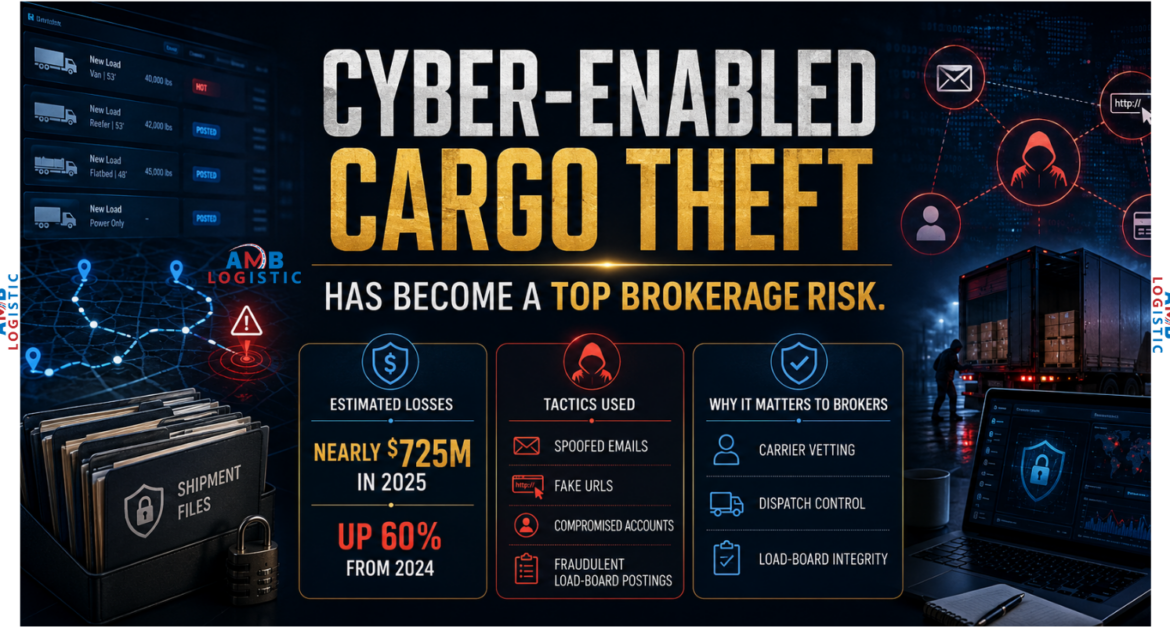
Cyber-enabled cargo theft is no longer a side issue for the freight industry. It has become a direct brokerage risk affecting carrier vetting, dispatch control, load-board integrity, shipper verification, and freight handoff security. The FBI/IC3 says estimated cargo theft losses in the U.S. and Canada reached nearly $725 million in 2025, up 60% from 2024, with criminals using spoofed emails, deceptive URLs, compromised accounts, and fraudulent load-board postings to impersonate legitimate companies and redirect freight. For freight brokers, this is not just a cybersecurity story. It is an operational control story.
Introduction
Cargo theft used to be understood mainly as a physical crime. A trailer disappeared from a yard. A load was stolen from a parking lot. A shipment was targeted at a vulnerable handoff point. Those risks still exist, but the freight industry is now facing a more sophisticated threat: cargo theft that begins behind a screen before anyone touches the freight.
Cyber-enabled cargo theft is changing the way freight brokers, shippers, and carriers need to think about security. Criminals are no longer relying only on physical access to trailers or warehouses. They are using digital impersonation, compromised email accounts, deceptive URLs, fraudulent postings, and manipulated communication chains to make unauthorized freight movement look legitimate.
That is what makes this risk so dangerous. The shipment may appear normal. The email may look professional. The carrier may appear to check out. The load-board conversation may follow a familiar pattern. The pickup request may look routine. But behind that routine process, a criminal may be redirecting freight, impersonating a real company, or exploiting a weak verification step.
The FBI/IC3 reported that estimated cargo theft losses in the U.S. and Canada reached nearly $725 million in 2025, up 60% from 2024. That number reflects more than a rise in stolen freight. It reflects a shift in how freight crime is being executed. Cargo theft is becoming more digital, more organized, and more difficult to detect through surface-level checks alone.
For freight brokers, this is a major operational warning. Cyber-enabled cargo theft is not only a technology issue. It is also a carrier-vetting issue, a shipper-authentication issue, a dispatch-control issue, a load-board-integrity issue, and a process-discipline issue. The companies that treat it only as an IT concern may miss the bigger risk: fraud can enter the freight transaction through ordinary brokerage workflows.
Why This Matters
Cyber-enabled cargo theft matters because freight brokerage depends on speed, trust, communication, and third-party coordination. Every day, brokers manage shipper requests, carrier sourcing, rate confirmations, pickup appointments, delivery instructions, documents, emails, phone calls, load boards, and status updates. That creates many points where a criminal can attempt to enter the process.
In traditional cargo theft, the criminal often needed physical access to freight. In cyber-enabled cargo theft, the criminal may first gain access to information. That information can be used to impersonate a shipper, carrier, broker, dispatcher, warehouse contact, or consignee. Once the criminal controls the communication chain, the freight can be redirected without looking suspicious at first glance.
The risk is especially serious because many fraudulent transactions look professional. Criminals may use a real company name, a real employee identity, a convincing email signature, a familiar shipment lane, a legitimate-looking phone number, or a carrier profile that appears clean on the surface. They may know enough about freight procedures to sound credible. They may ask the right questions, send the right forms, and create urgency at exactly the right moment.
For brokers, the danger is that normal verification steps may not be enough if they are performed only inside the same communication chain that initiated the transaction. If the original contact is compromised or impersonated, then confirming details through that same contact does not reduce the risk. It may actually reinforce the fraud.
This is why independent verification matters. The broker must verify critical details through trusted sources that are separate from the email, message, posting, or phone number provided in the original transaction. Without that separation, the broker may be validating information controlled by the criminal.
The Broader Picture
Freight fraud is becoming more sophisticated because the logistics market is highly connected and highly transactional. Freight often moves quickly. Brokers need to source carriers fast. Shippers need coverage. Carriers need loads. Load boards make freight visibility easier, but they also create a digital environment where fraudulent actors can attempt to imitate legitimate participants.
This does not mean load boards are the problem by themselves. Load boards are essential tools for the industry. The issue is that criminals are exploiting the speed and openness of digital freight matching. A posting can be copied. A company name can be impersonated. A contact can be spoofed. A carrier identity can be misused. A pickup location can be altered. A URL can be made to look legitimate. A compromised account can be used to communicate with a broker or carrier in a way that appears authentic.
The freight industry has always relied on documentation, reputation, and communication. Cyber-enabled theft attacks all three. Documents can be manipulated. Reputations can be borrowed through impersonation. Communication can be redirected through spoofed emails or compromised accounts. That means brokers need to strengthen the process behind every freight handoff, not just the surface appearance of the paperwork.
This is also why cargo theft is no longer only a security department issue. Operations teams, carrier sales teams, account managers, dispatchers, compliance teams, accounting teams, and leadership all play a role. A suspicious payment request, a changed pickup contact, a new email domain, a carrier demanding unusual communication rules, or a shipper pushing an unfamiliar process may all be part of the risk picture.
The broader market lesson is clear: freight security now has to cover the entire transaction lifecycle. It starts before the load is booked and continues until delivery is confirmed through trusted documentation and independent communication.
What This Means for Freight Brokers and Logistics Teams
For freight brokers, cyber-enabled cargo theft changes the meaning of operational control. It is no longer enough to confirm that a carrier has an active authority, insurance, and a clean-looking profile. Those checks are important, but they do not fully address impersonation, account compromise, communication manipulation, or fraudulent dispatch instructions.
The first major impact is carrier vetting. Brokers need stronger processes to confirm that the person communicating on behalf of a carrier is actually authorized to dispatch that carrier’s truck. A legitimate carrier profile can still be misused by an unauthorized actor. A clean record does not automatically prove that the current contact is legitimate.
The second impact is dispatch control. Once a load is assigned, the broker needs to control who receives pickup details, who is authorized to make changes, how updates are accepted, and how exceptions are escalated. If criminals can intercept or manipulate dispatch communication, they can redirect freight without physically attacking the shipment.
The third impact is shipper verification. Brokers must confirm that shipper requests are coming from legitimate contacts and trusted domains. A professional email is not enough. A complete customer packet is not enough. A familiar company name is not enough. High-value freight, new shipper relationships, unusual urgency, and changed instructions should trigger stronger verification.
The fourth impact is load-board integrity. Brokers should treat load-board activity as an important but controlled sourcing channel. Fraudulent postings, copied loads, impersonated companies, and suspicious contact behavior require close attention. Teams need to know what red flags look like and when to escalate.
The fifth impact is documentation control. Bills of lading, rate confirmations, pickup numbers, delivery appointments, and proof-of-delivery documents must be handled with discipline. Criminals may use document requests or document changes to create legitimacy. Brokers should verify unexpected changes through trusted, independent channels.
The Freight Broker Playbook
1) Verify Outside The Communication Chain
The most important rule in cyber-enabled cargo theft prevention is independent verification. If a shipper, carrier, warehouse contact, or dispatcher reaches out through email, phone, text, or a load-board message, the broker should not rely only on that same communication path to validate the transaction.
Independent verification means contacting the company through a trusted source, such as a known main line, an already verified contact record, an established relationship, or a previously validated system. The goal is to confirm that the request is real without using information provided by the suspicious or unverified party.
This matters because spoofed emails and compromised accounts can look legitimate. If a criminal controls the email thread, then asking that same email thread to confirm details does not protect the freight. It simply gives the criminal another opportunity to sound credible.
Brokers should build a culture where independent verification is normal, not optional. It should not be treated as a delay. It should be treated as a core part of freight execution.
2) Treat New Shipper Relationships With Extra Caution
New shipper relationships are especially vulnerable because there is no established communication baseline. A criminal impersonating a legitimate company may provide professional documents, accurate public information, and convincing shipment details. The broker may feel reassured because the company name is real and the paperwork looks complete.
But a real company name does not prove the person making the request is authorized. Before moving freight for a new shipper, brokers should verify the contact, domain, billing details, pickup locations, and internal approval chain. For large companies, brokers should be especially careful if the contact appears to bypass normal procurement, routing, or logistics channels.
A strong onboarding process should confirm not only that the company exists, but also that the specific freight request is legitimate. That includes validating who is authorized to tender loads, who controls payment, and who should be contacted if something changes.
3) Confirm Carrier Identity At The Person Level
Carrier vetting should not stop at company-level checks. A carrier may have active authority, valid insurance, and a clean operating profile, but the person contacting the broker may not be an authorized representative of that carrier.
Brokers should verify dispatcher identity, authorized contact information, email domains, phone numbers, and any sudden changes in communication. If a carrier contact uses a new email, asks to communicate only through a different number, avoids phone calls, or gives inconsistent details, that should trigger additional review.
The goal is not to slow down every load unnecessarily. The goal is to separate legitimate carrier operations from identity misuse. A strong broker protects both the shipper’s freight and legitimate carriers whose identities may be exploited by criminals.
4) Control Pickup Information Tightly
Pickup details are powerful. A pickup number, appointment time, BOL information, warehouse contact, or product description can help a criminal access or redirect freight. Brokers should treat pickup information as controlled operational data, not casual communication.
Pickup instructions should be released only to verified and authorized contacts. If a carrier contact changes after booking, that change should be validated. If a driver’s information changes at the last minute, the broker should confirm through trusted channels. If the pickup location receives different instructions than the broker expects, the issue should be escalated immediately.
Freight theft often succeeds when one part of the handoff process assumes another part has already verified the details. Brokers need to make sure the verification chain is clear, documented, and controlled.
5) Watch For Changed Instructions And Unusual Urgency
Cyber-enabled fraud often relies on pressure. A criminal may create urgency around carrier approval, pickup timing, payment, document release, or changed delivery instructions. Urgency is not automatically suspicious in freight, but unusual urgency combined with new contacts, changed emails, odd payment behavior, or communication avoidance should raise concern.
Changed instructions deserve special attention. A new pickup contact, a changed delivery location, a different consignee, a new dispatcher, an altered email address, or a request to bypass normal communication should not be accepted casually.
Brokers should create clear escalation rules for changes. The question should be simple: “Is this change verified independently through a trusted source?” If not, the load should not continue as if nothing changed.
6) Strengthen Load-Board Discipline
Load boards remain critical tools for freight brokerage, but they require disciplined use. Criminals may use fraudulent postings, copied load details, impersonated companies, or misleading contact information to create false legitimacy. Brokers should train teams to recognize patterns that do not fit normal carrier or shipper behavior.
Suspicious signs may include mismatched contact details, unusual communication preferences, pressure for quick pay, refusal to speak by phone, inconsistent company information, sudden rate behavior, or contact information that does not match trusted records.
Load-board speed should never replace verification. The faster the transaction, the more important the control points become.
7) Connect Operations, Compliance, And Accounting
Cyber-enabled cargo theft often touches multiple departments. Operations may see a changed pickup instruction. Compliance may see an unusual carrier contact. Accounting may see quick-pay pressure or payment details that do not match the file. Dispatch may see communication gaps. Each signal may seem small by itself, but together they can reveal a larger risk.
Brokers should create internal communication paths that allow these signals to be connected quickly. If accounting sees unusual payment pressure, operations should know. If dispatch sees changed contact behavior, compliance should know. If a shipper contact avoids normal verification, leadership should know.
Fraud prevention is strongest when teams share risk signals instead of treating them as isolated issues.
8) Document Verification Steps
Good verification should be documented. Brokers should record how shipper contacts were confirmed, how carrier contacts were validated, who approved changes, when pickup information was released, and how delivery instructions were verified.
Documentation helps in two ways. First, it creates accountability inside the process. Second, it helps the broker respond faster if something goes wrong. If a dispute, claim, theft event, or investigation occurs, clear records can show what was verified, when it was verified, and by whom.
In a high-risk environment, undocumented assumptions are dangerous. Verified process is protection.
What This Means for Shippers
For shippers, cyber-enabled cargo theft means freight security cannot be pushed entirely onto brokers or carriers. Shippers play a major role in preventing impersonation and freight redirection. Clear contact records, approved communication channels, verified pickup procedures, and consistent facility instructions can reduce risk across the shipment lifecycle.
Shippers should make it easy for brokers to verify legitimate contacts. That means maintaining accurate contact lists, using consistent domains, confirming who is authorized to tender freight, and communicating changes through trusted channels. If a broker cannot easily confirm whether a request is legitimate, the freight becomes more vulnerable.
Shippers should also review warehouse and pickup procedures. Facility teams should know which carriers are expected, what information must match before loading, and when to escalate suspicious changes. A criminal may exploit a gap between broker communication and dock-level execution. Strong facility controls help close that gap.
The best shipper-broker relationships will treat cargo security as a shared responsibility. Fraud prevention works best when both sides understand the verification process and support it.
What This Means for Carriers
For legitimate carriers, cyber-enabled cargo theft is also a serious threat. Carrier identities can be misused. Company names, MC numbers, contact details, and operating profiles can be exploited by criminals attempting to book or redirect freight.
Carriers should protect their own identity by controlling who is authorized to dispatch loads, monitoring unusual activity involving their company information, and maintaining accurate contact records with brokers and customers. If a carrier’s identity is misused, the damage can affect reputation, relationships, and future freight opportunities.
Carriers should also expect more verification from responsible brokers. Additional confirmation steps may feel inconvenient, but they protect legitimate carriers from being impersonated and protect the freight from being misdirected.
A stronger verification culture benefits the entire market. It helps separate professional carriers from fraudulent actors and improves trust across the brokerage ecosystem.
AMB Logistic’s Role
At AMB Logistic, we understand that freight security is no longer limited to physical movement. It now includes communication security, identity verification, carrier validation, dispatch control, and process discipline. Cyber-enabled cargo theft attacks the trust that keeps freight moving, which is why brokers must respond with stronger controls and clearer execution standards.
Our approach is built around practical freight protection. We believe that every load requires more than a rate and a truck. It requires verified communication, reliable carrier sourcing, clear documentation, and disciplined coordination from pickup through delivery.
AMB Logistic helps customers move freight with clarity, control, and confidence by focusing on the operational details that matter in a higher-risk market. That includes stronger verification habits, careful carrier-fit decisions, proactive communication, and a commitment to protecting shipment integrity.
- We treat carrier verification as a critical operating control.
- We support disciplined communication across the load lifecycle.
- We prioritize trusted carrier relationships and documented process.
- We understand that load-board speed must be balanced with security.
- We help customers reduce freight risk through clarity, control, and execution discipline.
In today’s market, freight security is not just about preventing theft after the truck arrives. It is about preventing the wrong person from controlling the shipment before the truck ever reaches the dock.
FAQ
What Is Cyber-Enabled Cargo Theft?
Cyber-enabled cargo theft is freight theft that uses digital methods such as spoofed emails, deceptive URLs, compromised accounts, fraudulent postings, impersonated company identities, or manipulated communication to access, redirect, or steal freight.
Why Is This A Major Risk For Freight Brokers?
Freight brokers manage the communication and coordination between shippers and carriers. If criminals can impersonate a legitimate party inside that process, they can influence carrier selection, pickup details, dispatch communication, or delivery instructions.
Why Are Surface-Level Checks No Longer Enough?
Surface checks may confirm that a company exists, a carrier authority is active, or paperwork looks complete. But they may not prove that the person communicating is authorized, that the email is legitimate, or that the load instructions have not been manipulated.
How Can Brokers Reduce Cyber-Enabled Cargo Theft Risk?
Brokers can reduce risk by verifying contacts independently, validating carrier representatives, controlling pickup information, reviewing changed instructions carefully, strengthening load-board discipline, connecting internal risk signals, and documenting verification steps.
What Should Shippers Do To Help Prevent This Type Of Theft?
Shippers should maintain accurate contact records, use consistent communication channels, confirm authorized freight contacts, support broker verification, and ensure warehouse teams know when to escalate suspicious pickup or delivery changes.
What Should Carriers Do To Protect Their Identity?
Carriers should control authorized dispatch contacts, monitor for misuse of their company information, keep contact details updated with trusted brokers, and cooperate with verification processes designed to prevent impersonation.
Is This Only A Cybersecurity Issue?
No. Cybersecurity is part of the problem, but for freight brokers this is also an operations issue. The risk affects carrier vetting, dispatch control, shipper verification, load-board use, documentation, payment behavior, and freight handoff procedures.
Why Does Independent Verification Matter?
Independent verification prevents brokers from relying only on the communication chain that may already be compromised. Confirming details through trusted sources helps separate legitimate freight activity from impersonation or manipulation.
Final Word From AMB Logistic
Cyber-enabled cargo theft is one of the most important freight brokerage risks in today’s market. The threat is not limited to stolen trailers or unsecured yards. It can begin with a spoofed email, a deceptive URL, a compromised account, a fraudulent load-board posting, or an impersonated company contact.
That is why brokers must treat freight security as a full transaction-control issue. Carrier vetting must go deeper. Dispatch communication must be controlled. Shipper contacts must be verified. Load-board activity must be reviewed with discipline. Pickup and delivery changes must be confirmed through trusted channels.
For shippers, the lesson is clear: the cheapest or fastest freight option is not always the safest. Security, verification, and communication discipline must be part of the freight decision.
For carriers, the lesson is equally important: identity protection matters. Legitimate carriers need strong relationships with brokers who verify carefully and protect the integrity of the transaction.
For brokers, the message is direct. Trust cannot be assumed. It has to be verified, documented, and controlled through the full lifecycle of the load.
Cyber-enabled cargo theft is evolving. The freight industry’s response must evolve with it.
Talk To AMB Logistic Today
If your business needs truckload, LTL, or freight brokerage support with disciplined carrier verification, secure communication, and reliable execution, AMB Logistic can help you move with clarity, control, and confidence.
Web: amblogistic.us
Phone: +1 (888) 538-6433
Email: info@amblogistic.us
Tags
cyber-enabled cargo theft, cargo theft, freight fraud, freight brokerage, carrier vetting, dispatch control, load-board integrity, shipper verification, carrier verification, spoofed emails, compromised accounts, freight security, logistics risk, U.S. freight, AMB Logistic