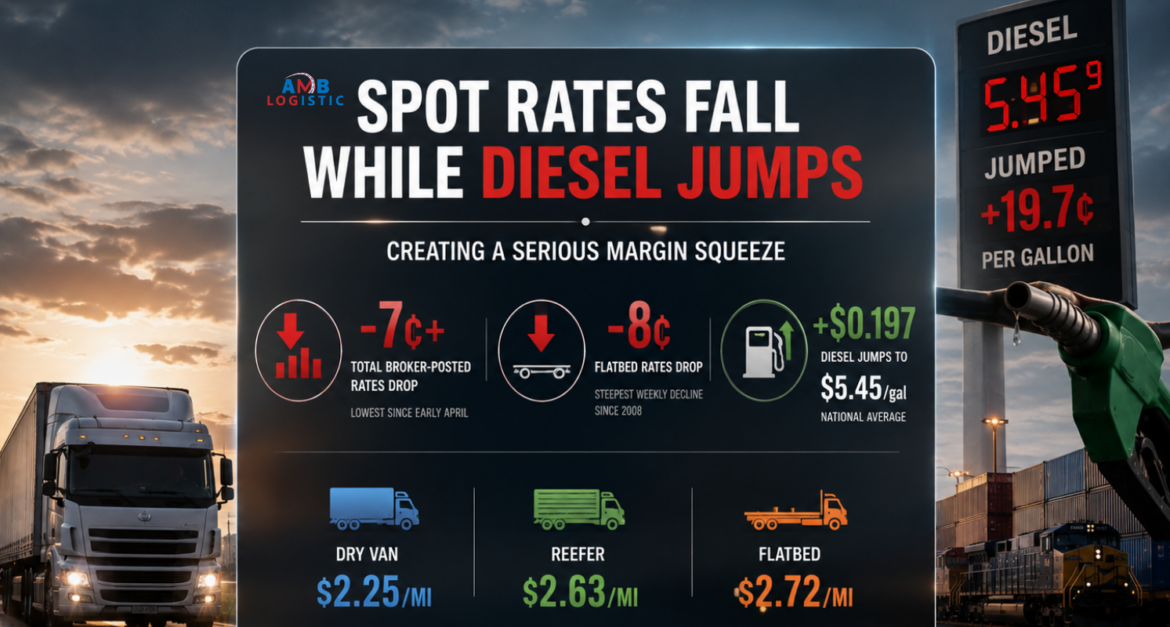
U.S. truckload spot rates declined across dry van, reefer, and flatbed while the national diesel average jumped nearly 20 cents in a single week. This creates one of freight brokerage’s most dangerous operating combinations: falling transportation prices, rising carrier costs, and rapidly compressing margins. Brokers must now refresh pricing faster, calculate fuel exposure correctly, control deadhead, and protect every load with lane-level cost intelligence.
Introduction
The U.S. spot freight market delivered a warning that every freight broker, carrier, dispatcher, and shipper should understand.
During the latest reported week, total broker-posted truckload rates declined by more than seven cents per mile, reaching their lowest level since early April. Dry van, refrigerated, and flatbed pricing all moved lower as freight volumes softened.
Flatbed experienced the most dramatic adjustment. Its weekly decline was the steepest comparable drop recorded since 2008. Yet the same market was hit by a sharp increase in diesel, with the national average reaching approximately $5.45 per gallon after rising nearly 20 cents in one week.
The latest national linehaul averages, excluding fuel and fuel surcharges, were approximately:
- Dry van: $2.25 per mile.
- Refrigerated: $2.63 per mile.
- Flatbed: $2.72 per mile.
These rate declines do not mean the freight market has completely collapsed. Spot pricing remains substantially higher than it was during the same period last year. Dry van and reefer rates are still approximately 35% higher year over year, while flatbed remains more than 40% above last year’s level.
The immediate concern is not simply that rates fell. The real issue is that freight revenue and operating costs moved in opposite directions.
When diesel rises while linehaul pricing falls, the total cost of moving a truck increases as the amount available to cover that cost decreases. A load that appeared profitable under last week’s fuel assumptions may produce a significantly smaller margin today.
This creates a difficult environment for freight brokers. Shippers may see falling spot rates and expect immediate savings. Carriers see higher fuel bills and need stronger compensation. The broker is positioned between those two pressures while still managing service, fraud exposure, claims, credit risk, and working capital.
In this market, accurate pricing is no longer a weekly administrative exercise. It is a daily operational responsibility.
Why This Matters
The current rate-and-fuel combination matters because small errors can quickly turn profitable freight into negative-margin freight.
A freight broker does not earn revenue simply by calculating the difference between the amount charged to the shipper and the amount offered to the carrier. The brokerage must also account for operational labor, technology, tracking, compliance, credit exposure, claims, payment timing, and the cost of recovering a shipment when the original plan fails.
A load may appear to provide a reasonable gross margin when first booked. That margin can disappear when the truck must travel additional empty miles, wait at a facility, reposition after delivery, or operate under an outdated fuel calculation.
Consider a carrier operating a truck that averages 6.5 miles per gallon. At approximately $5.45 per gallon, fuel alone costs close to 84 cents for every loaded or empty mile.
A carrier completing a 1,000-mile loaded movement with 200 total empty miles is not purchasing fuel for only the paid distance. The truck is consuming fuel across approximately 1,200 operational miles.
That additional deadhead can create close to $170 in fuel expense before accounting for driver time, maintenance, tires, insurance, equipment payments, and opportunity cost.
If the broker prices the shipment using only the loaded miles, the carrier may reject the load or demand a higher rate. If the broker accepts the higher carrier cost without updating the shipper’s price, the brokerage margin absorbs the difference.
This is why falling linehaul rates do not automatically mean transportation has become cheaper.
A lower linehaul price may be offset by:
- Higher diesel and fuel surcharges.
- Longer empty repositioning.
- Weak destination-market freight.
- Weekend or after-hours delays.
- Additional detention exposure.
- Equipment shortages on specific lanes.
- Specialized securement or handling requirements.
- Greater risk of service failure.
Freight brokers must therefore distinguish between a lower market rate and a lower total transportation cost. These are not always the same thing.
The current environment also creates a communication challenge. Shippers may focus on market headlines showing declining rates, while carriers focus on fuel prices, operating costs, and destination risk.
A broker must explain the complete lane economics clearly enough to maintain confidence on both sides.
The Broader Picture
The latest rate correction reflects a freight market moving through a complicated transition rather than a simple return to weak conditions.
Truckload pricing rose significantly earlier in the year as capacity tightened and carriers gained greater negotiating leverage. The latest pullback appears to reflect softer seasonal freight volumes and a cooling from elevated summer pricing.
However, one week of lower rates does not establish a long-term market direction.
Rates remain well above their year-ago levels, available capacity is still more limited than it was during the deepest part of the freight recession, and many carriers remain financially vulnerable.
The market is therefore sending mixed signals.
Spot rates are declining week over week.
All three primary truckload segments experienced lower pricing. Broker-posted rates also declined, suggesting brokers are testing whether carriers will accept lower compensation as freight volumes soften.
Rates remain elevated year over year.
The pullback occurred from a comparatively strong level. Dry van, reefer, and flatbed pricing remains substantially higher than during the same period last year.
Diesel is placing immediate pressure on operating costs.
A nearly 20-cent weekly increase affects every loaded and empty mile. Carriers operating in weak reload markets feel the impact most sharply because they may travel farther without revenue-producing freight.
Equipment types are behaving differently.
Flatbed experienced the strongest weekly rate correction, but it remains the highest-priced major truckload segment and continues to show substantial year-over-year strength.
Reefer declined more modestly, while dry van maintained the lowest national linehaul average of the three categories.
Regional conditions remain more important than national averages.
A national average cannot tell a broker whether a truck will be available in a particular market at a specific time. Capacity may be loose in one region and extremely tight in another.
Project freight, agricultural demand, weather, construction, manufacturing activity, receiver schedules, and weekend timing can all produce lane-level conditions that differ greatly from the national trend.
Carrier financial pressure remains significant.
Many small carriers operate with limited cash reserves. Fuel must often be purchased immediately, while payment for the shipment may not arrive for several weeks.
A rapid increase in diesel therefore creates both a profitability problem and a cash-flow problem.
When a carrier cannot finance the fuel required to complete a load, the theoretical market rate becomes irrelevant. The truck may simply be unavailable.
These competing forces mean freight brokers should not react to the latest numbers by lowering every rate. They should respond by improving the speed and precision of their pricing decisions.
What This Means for Freight Brokers and Logistics Teams
Freight brokers and logistics teams must stop treating rate intelligence, fuel calculations, and lane planning as separate activities.
Every quote should reflect the complete operational movement—not simply the distance between the pickup and delivery locations.
Before confirming a price, the broker should understand:
- The current linehaul range for the specific lane.
- The most recent diesel benchmark.
- Whether the quote includes or excludes fuel.
- Expected origin deadhead.
- Destination reload availability.
- Pickup and delivery appointment risk.
- Weekend or holiday exposure.
- Equipment-specific demand.
- Potential detention and layover costs.
- Weather and traffic conditions.
- The carrier’s actual operating requirements.
This information should be reviewed before the broker makes a pricing commitment to the shipper.
If the broker quotes first and investigates later, the business is exposed to margin loss. The carrier may require more money than anticipated, or the only available truck may be located too far from the pickup.
The recent flatbed decline provides a clear example. A national average of $2.72 per mile does not mean every flatbed shipment should be priced at that level.
The actual rate may vary based on:
- Tarps and securement requirements.
- Commodity dimensions and weight.
- Loading and unloading methods.
- Permit requirements.
- Weather exposure.
- Origin equipment availability.
- Destination reload strength.
- Project-freight demand.
The same principle applies to dry van and reefer transportation. A national average is a market reference—not a guaranteed buying rate.
Brokerages should also prepare for more difficult negotiations. Shippers may expect immediate rate reductions, while carriers may require fuel protection. The broker must demonstrate why the final transportation price reflects the complete movement.
Transparency becomes especially important. Fuel should not be treated as a vague adjustment. The broker should know which index is being used, which period it represents, and whether the surcharge formula accurately reflects the shipment.
When this information is unclear, both trust and margin become vulnerable.
The Freight Broker Playbook
1. Refresh Pricing Before Every Important Quote
Rapid market movement can make yesterday’s pricing unreliable.
A lane priced during the previous week may no longer reflect today’s carrier costs, available equipment, diesel conditions, or destination-market strength.
Brokerages should establish clear rules for refreshing rates. High-volume lanes may require daily review, while volatile or specialized lanes may need confirmation immediately before the shipper receives the quote.
A pricing refresh should include:
- Current linehaul market data.
- Recent carrier conversations.
- Available truck counts.
- Current diesel pricing.
- Fuel-surcharge treatment.
- Origin and destination conditions.
- Day-of-week effects.
- Appointment restrictions.
- Known weather or disruption risk.
The broker should also define how long a quote remains valid. A rate issued during a volatile market should not remain open indefinitely.
Quote validity protects both the brokerage and the shipper by establishing when the transportation plan must be reviewed again.
Pricing speed is important, but speed without current information is simply fast guessing.
2. Separate Linehaul, Fuel, and Total Operational Cost
Freight professionals must clearly distinguish among linehaul pricing, fuel surcharges, and the total all-in rate.
The latest national averages of approximately $2.25 for dry van, $2.63 for reefer, and $2.72 for flatbed represent linehaul pricing that excludes fuel.
Comparing those figures directly with an all-in carrier quote can produce incorrect conclusions.
Every rate comparison should confirm:
- Whether fuel is included.
- Which diesel index is being used.
- The fuel-price base.
- The assumed truck efficiency.
- Whether the surcharge applies to loaded miles only.
- Whether accessorial charges are included.
- Whether tolls or permits are separate.
Brokerages should use one clear pricing structure across sales, operations, accounting, and carrier communication.
If sales quotes an all-in rate while operations evaluates a linehaul-only benchmark, the brokerage may unknowingly accept an unprofitable load.
Fuel calculations should also be refreshed frequently during periods of rapid price movement. A monthly adjustment may be inadequate when diesel increases nearly 20 cents in one week.
Every employee involved in pricing should understand how the company calculates and communicates fuel.
3. Price the Entire Truck Movement—Including Deadhead
Deadhead is one of the fastest ways for rising diesel to destroy a load’s economics.
Carriers evaluate the total journey required to serve the shipment. That includes the distance to pickup, the loaded movement, and the distance required to reach the next usable freight market.
A broker may see a 600-mile shipment. The carrier may see:
- 100 miles to the pickup.
- 600 loaded miles.
- 150 miles to the next practical reload.
The carrier is operating across 850 total miles while receiving direct compensation for only 600 loaded miles.
At elevated diesel prices, the empty portions of the trip become increasingly expensive.
Brokerages should evaluate:
- Where the truck is currently located.
- Whether another suitable truck is closer.
- The freight strength at the destination.
- Receiver hours and unloading reliability.
- Weekend reload availability.
- Whether a round-trip or triangle route is possible.
A carrier may accept a lower loaded-mile rate when the shipment fits an efficient operating pattern. The same carrier may require a significant premium when the destination creates long empty repositioning.
Matching freight to the carrier’s network can protect both carrier economics and brokerage margin.
4. Defend Margin With Operational Control
Margin protection does not begin and end with negotiation. It also depends on execution.
A well-priced load can still become unprofitable when operational details are poorly managed.
Common margin leaks include:
- Incorrect pickup numbers.
- Missed appointments.
- Long facility detention.
- Unplanned driver-assist work.
- Rejected cargo.
- Uncommunicated equipment requirements.
- Layovers and redelivery charges.
- Last-minute destination changes.
- Claims and cargo damage.
- Fraudulent carrier assignments.
The broker should verify the shipment’s operational details before dispatch and communicate them clearly to the carrier.
The load record should confirm the commodity, weight, equipment, pickup appointment, delivery appointment, facility contacts, special instructions, tracking requirements, and accessorial policies.
Carrier verification remains essential even when capacity is difficult to secure. A lower rate from an unverified carrier is not a margin opportunity. It is a potential fraud, cargo, service, and liability exposure.
Operational control protects profit by preventing avoidable exceptions.
5. Use Scenario-Based Pricing Instead of One Fixed Number
During a volatile market, one fixed price may not adequately represent the shipment’s risk.
Brokerages can improve pricing by developing several scenarios before committing to the customer.
For example:
- Preferred-carrier price with sufficient lead time.
- Short-notice spot-market price.
- Weekend or after-hours premium.
- Alternative pickup-day price.
- Expedited-service price.
- Intermodal or multimodal alternative where practical.
This approach helps the shipper understand how scheduling decisions affect cost.
A flexible pickup window may allow the broker to use a preferred carrier already moving through the market. An inflexible same-day request may require expensive repositioning.
Scenario-based pricing also allows the broker to identify the point at which the load becomes too risky or unprofitable to accept.
Not every shipment should be booked. Walking away from freight that cannot be moved safely and profitably is an important form of financial discipline.
AMB Logistic’s Role
AMB Logistic helps shippers navigate changing transportation costs through current lane analysis, dependable capacity coordination, and clear communication from quotation through delivery.
Our approach considers more than the headline rate. We evaluate the shipment’s complete operating requirements, including:
- Origin and destination conditions.
- Equipment availability.
- Current linehaul pricing.
- Fuel exposure.
- Pickup and delivery schedules.
- Potential deadhead and repositioning.
- Commodity and handling requirements.
- Weather and service risks.
- Carrier qualification.
- Contingency options.
AMB Logistic works to provide transportation solutions that balance competitive pricing with service reliability.
When market rates move quickly, customers need more than a static quote. They need a logistics partner capable of interpreting the market, explaining cost changes, and adjusting the transportation plan before a small issue becomes an expensive disruption.
Our focus remains straightforward: secure appropriate capacity, communicate clearly, protect the shipment, and move freight with accountability.
FAQ
Are U.S. truckload spot rates falling?
Spot rates declined during the latest reported week across dry van, refrigerated, and flatbed transportation. However, rates remain substantially higher than during the same period last year, so the weekly decline should be viewed as a correction from elevated levels rather than proof of a complete market collapse.
Which truckload segment experienced the largest decline?
Flatbed experienced the largest weekly adjustment, falling approximately seven to eight cents per mile depending on the market measurement. It was the steepest comparable weekly flatbed decline since 2008.
What are the latest national linehaul averages?
The latest averages were approximately $2.25 per mile for dry van, $2.63 for reefer, and $2.72 for flatbed. These figures represent linehaul only and exclude fuel and related surcharges.
How high is the national diesel average?
The national diesel average reached approximately $5.45 per gallon after increasing nearly 20 cents in one week.
Why can freight costs rise when linehaul rates fall?
Fuel, deadhead, detention, tolls, equipment requirements, accessorials, and destination-market conditions can offset a lower linehaul rate. The complete truck movement must be evaluated before determining whether the shipment has actually become cheaper.
Does a lower broker-posted rate guarantee that a truck is available?
No. A posted rate represents an offer or market test. Actual carrier availability and acceptance depend on the lane, timing, equipment, deadhead, destination, and reload opportunity.
What is the difference between linehaul and an all-in rate?
Linehaul covers the transportation movement before fuel and other separate charges. An all-in rate combines linehaul, fuel, and any included charges into one total amount.
How often should freight brokers update fuel surcharges?
The frequency should reflect market volatility. When diesel changes rapidly, weekly or even shipment-specific adjustments may be more appropriate than a monthly schedule.
How does deadhead affect carrier pricing?
Deadhead miles consume fuel, driver hours, maintenance capacity, and equipment time without producing direct freight revenue. Carriers often incorporate this cost into the rate they require for the loaded movement.
Should brokers immediately reduce customer rates?
Not automatically. Brokers should evaluate current lane data, fuel, carrier availability, equipment, scheduling, and total operational cost before adjusting customer pricing.
How can shippers reduce transportation costs in this environment?
Shippers can provide longer lead times, offer flexible pickup windows, reduce facility dwell, communicate accurate freight information, develop predictable volume patterns, and allow brokers to evaluate alternative schedules or modes.
What should brokers watch next?
Brokers should monitor whether rates stabilize or decline for another consecutive week, whether diesel continues rising, how truck availability changes by region, and whether late-summer freight demand strengthens.
Final Word From AMB Logistic
The latest market movement proves that freight brokerage cannot be managed through headline rates alone.
Spot prices declined, but diesel moved sharply higher. Flatbed experienced its steepest comparable weekly drop since 2008, yet its pricing remains substantially above last year. Dry van and reefer also moved lower while continuing to show year-over-year strength.
This is not a simple up market or down market. It is a selective market where profitability depends on the specific lane, truck, schedule, fuel calculation, destination, and reload plan.
Freight brokers must refresh pricing quickly, separate linehaul from fuel, calculate total truck miles, and protect margins through stronger operational control.
Carriers must understand their true cost per mile and avoid accepting attractive-looking loads that create excessive deadhead or weak destination positioning.
Shippers must evaluate complete transportation value rather than expecting every weekly rate decline to produce an identical reduction in total cost.
The companies that manage this environment successfully will not be those reacting fastest to a single market headline. They will be those connecting pricing, fuel, capacity, service, and risk into one informed decision.
When rates fall and diesel rises, control is margin.
Talk To AMB Logistic Today
Do not let changing rates, rising fuel costs, or weak lane planning reduce the reliability of your transportation strategy.
AMB Logistic can help you evaluate current truckload conditions, secure dependable capacity, and build transportation plans around the complete economics of your freight.
AMB Logistic
Email: info@amblogistic.us
Phone: +1 (888) 538-6433
Website: www.amblogistic.us
Tags
U.S. Freight Market, Freight Brokerage, Spot Rates, Diesel Prices, Freight Broker Margins, Dry Van Rates, Reefer Rates, Flatbed Rates, Fuel Surcharge, Truckload Pricing, Carrier Costs, Deadhead Management, Freight Rate Strategy, Transportation Costs, Lane Pricing, Logistics Market Update, AMB Logistic