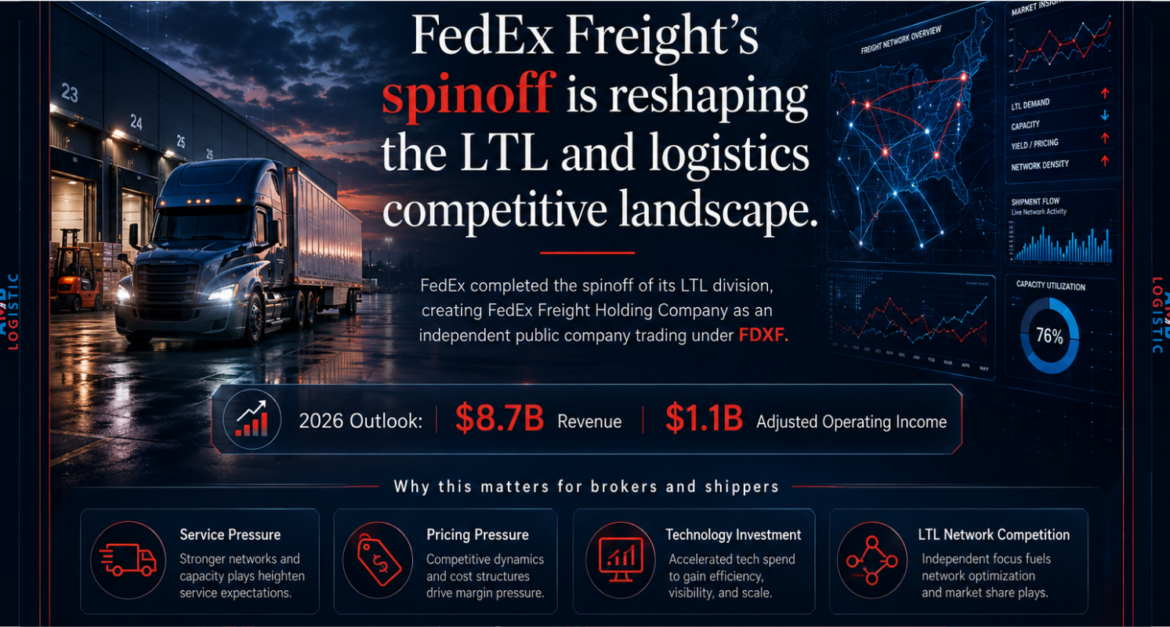
FedEx Freight Is Now Independent: What the LTL Spinoff Means for Brokers, Shippers, and U.S. Logistics Strategy
FedEx Freight’s move into the market as a standalone LTL company is one of the most important logistics developments for brokers, shippers, and carriers right now. The separation creates a dedicated less-than-truckload operator with its own public-market identity, its own growth targets, and its own pressure to compete directly against major LTL names like Old Dominion, XPO, and Saia. For freight brokers and shippers, this is not just a stock-market event. It is a network, pricing, service, and capacity story that can influence how LTL freight is bought, routed, and negotiated across the U.S.
Introduction
FedEx Freight becoming an independent public company changes the competitive map in less-than-truckload transportation. LTL has always been a critical layer of U.S. logistics because it serves freight that does not require a full trailer but still needs structured pickup, consolidation, linehaul movement, terminal handling, and final delivery. That makes LTL especially important for industrial shippers, manufacturers, distributors, retailers, and supply chains that move frequent smaller shipments through regional and national networks.
As part of the separation, FedEx Freight is now positioned to operate with sharper focus on LTL performance, pricing discipline, network utilization, and service execution. That matters because standalone operators are often judged more directly on their ability to improve margins, grow revenue, and compete with specialist peers. In practical logistics terms, this can influence how the company approaches lane density, terminal efficiency, technology investment, service commitments, and customer segmentation.
For brokers, this is a major signal. When a large LTL player separates from a broader parcel and logistics parent, the market should expect a more focused competitive posture. That does not automatically mean lower rates or higher rates everywhere. It means the LTL market may become more disciplined, more performance-driven, and more sensitive to execution quality. Brokers and shippers that rely on LTL capacity should pay close attention to what changes next.
Why This Matters
This matters because LTL is not interchangeable with truckload. In truckload, one shipment often controls the trailer. In LTL, freight from multiple customers is combined through a network. That makes terminal efficiency, freight classification, pickup reliability, claims control, dock operations, linehaul planning, and regional coverage extremely important. A major company becoming more focused on this segment can reshape competitive behavior across the market.
FedEx Freight has significant scale as a standalone business. That size gives it market relevance immediately. It is not entering the LTL space as a small new challenger. It is entering as a major established network now operating under a more focused structure. That is why brokers and shippers should treat this as a strategic market event, not just a corporate finance move.
- LTL competition could become sharper as FedEx Freight operates with its own public-market identity and performance targets.
- Broker routing decisions may become more strategic as service, pricing, coverage, and claims performance become even more important in carrier selection.
- Shippers may see stronger segmentation as LTL carriers focus on profitable freight profiles, disciplined pricing, and network-friendly shipment patterns.
- Technology and network efficiency could become bigger differentiators as LTL operators compete on visibility, transit reliability, and operational control.
- Regional and industrial freight lanes may get more attention because LTL carriers depend heavily on density, terminal balance, and shipment consistency.
The Broader Picture
The broader picture is that U.S. logistics is becoming more specialized. Parcel, truckload, LTL, warehousing, last-mile, intermodal, and managed transportation all have different economics. A company that tries to manage all of those businesses under one corporate umbrella can sometimes bury the true value, performance, and strategic needs of each segment. By separating FedEx Freight, the market can now evaluate the LTL business more directly on its own fundamentals.
That matters because LTL rewards operating precision. The strongest LTL networks are not only large. They are disciplined. They understand freight mix, density, pricing, claims exposure, terminal productivity, labor efficiency, and shipment flow. A standalone FedEx Freight now has more reason to prove that it can compete with best-in-class LTL operators on those measures, not simply rely on the broader FedEx brand.
The move also comes at a time when shippers are already becoming more careful about transportation spend and service reliability. If costs are rising, capacity is tightening in parts of the market, and supply chains are more sensitive to disruption, LTL performance becomes more important. A delayed pallet, damaged shipment, poor visibility event, or missed delivery window can create real operational pain for customers. That raises the value of dependable LTL execution.
What This Means for Freight Brokers and Logistics Teams
For freight brokers, the independent FedEx Freight story should trigger a closer review of LTL strategy. Brokers that treat LTL as a simple rate-table function may miss the bigger shift. In a more competitive and performance-focused LTL market, brokers need to understand which carriers are strongest by region, which freight profiles fit which network, where claims risk is higher, and how service expectations should be set with customers.
For shippers, this creates a moment to review LTL procurement and routing guides. The cheapest LTL option is not always the best option if it creates delays, reclass issues, damage risk, poor tracking, or inconsistent pickup performance. As major LTL providers compete harder for profitable freight, shippers may need to bring more discipline to packaging, labeling, appointment windows, density, classification accuracy, and carrier mix.
For carriers and regional LTL operators, the separation adds another layer of competitive pressure. A focused FedEx Freight may push harder on service quality, technology, pricing structure, and industrial account growth. That can raise the performance bar for the whole segment. Smaller and regional carriers may still win with relationship depth, local service, flexibility, and niche coverage, but they will need to be clear about where they outperform.
The Freight Broker Playbook
1) Reassess your LTL carrier mix
Brokers should not treat the LTL market as static after this move. Review which carriers are strongest in your highest-volume lanes, which ones have the best claims history, which perform best on pickups, and which networks are most reliable for your customers’ freight profiles.
2) Stop selling LTL only on price
LTL is too complex to sell only as a lowest-rate decision. Classification accuracy, transit reliability, damage control, accessorial transparency, tracking, and pickup performance all matter. A cheaper shipment can become more expensive if it creates rework, delays, claims, or customer dissatisfaction.
3) Watch how FedEx Freight positions itself post-spinoff
The key question is not just that FedEx Freight is independent. The key question is how it behaves now. Brokers and shippers should watch for changes in pricing discipline, account strategy, service focus, technology offerings, regional strengths, and how aggressively the company competes against specialist LTL carriers.
4) Strengthen customer conversations around freight profile quality
LTL performance depends heavily on the quality of the freight entering the network. Poor packaging, unclear labels, wrong classifications, limited delivery information, and weak appointment planning create cost and service problems. Brokers can add value by helping customers prepare freight in ways that improve execution.
5) Use LTL strategy as a margin-protection tool
In a tighter transportation environment, better LTL planning can protect margin. The right carrier selection, cleaner shipment data, better accessorial management, and more accurate expectations can reduce surprise costs and improve customer trust.
AMB Logistic’s Role
At AMB Logistic, we see the FedEx Freight spinoff as a reminder that transportation strategy is becoming more specialized. Shippers cannot treat every freight mode the same. Truckload, LTL, expedited, warehousing, and final-mile all require different planning logic. The companies that understand those differences will make better decisions than those relying only on surface-level rates.
Our role is to help customers move freight with more clarity and control. In LTL, that means paying close attention to carrier fit, lane structure, shipment profile, service expectations, and cost transparency. A strong LTL strategy is not just about finding a carrier. It is about matching freight to the right network and building a process that reduces avoidable friction.
- Better LTL carrier alignment,
- clearer shipment planning,
- stronger cost and accessorial awareness,
- and freight execution built around the right network for the right shipment.
FAQ
Why does the FedEx Freight spinoff matter for freight brokers?
Because it creates a more focused LTL competitor with its own performance expectations. Brokers may need to adjust how they evaluate LTL carrier options, pricing behavior, and service performance.
What is LTL freight?
LTL stands for less-than-truckload. It is used when a shipment does not require a full trailer. Multiple customers’ freight is consolidated through a terminal network, making service quality, classification, density, and handling discipline very important.
Will this automatically lower LTL rates?
Not necessarily. A standalone LTL carrier may compete more aggressively in some areas, but it may also become more disciplined about pricing, freight mix, and profitable network usage. The result will likely vary by lane, customer profile, and freight type.
What should shippers do now?
Shippers should review their LTL routing guides, claims history, service performance, freight classifications, accessorial exposure, and carrier mix. This is a good time to make sure LTL decisions are based on total performance, not only base rate.
How should brokers respond?
Brokers should strengthen LTL expertise, monitor carrier behavior after the spinoff, and help customers understand how service, cost, claims, and network fit affect total logistics performance.
Final Word From AMB Logistic
FedEx Freight becoming independent is more than a corporate separation. It is a signal that LTL is important enough to stand on its own as a major transportation story. That should get the attention of brokers, shippers, and logistics teams across the country.
The companies that benefit most from this shift will not be the ones that simply watch the headlines. They will be the ones that review their LTL strategy, understand how networks are changing, and make better decisions around carrier fit, cost control, and service reliability.
In logistics, the right network matters. And in LTL, the right network can make the difference between a shipment that simply moves and a shipment that performs.
Talk To AMB Logistic Today
If your team needs stronger LTL planning, clearer freight strategy, or better transportation execution, AMB Logistic can help you move with more confidence and control.
Call: +1 (888) 538-6433
Email: info@amblogistic.us
Web: amblogistic.us
Tags
FedEx Freight, LTL shipping, freight brokerage, freight strategy, logistics network, AMB Logistic