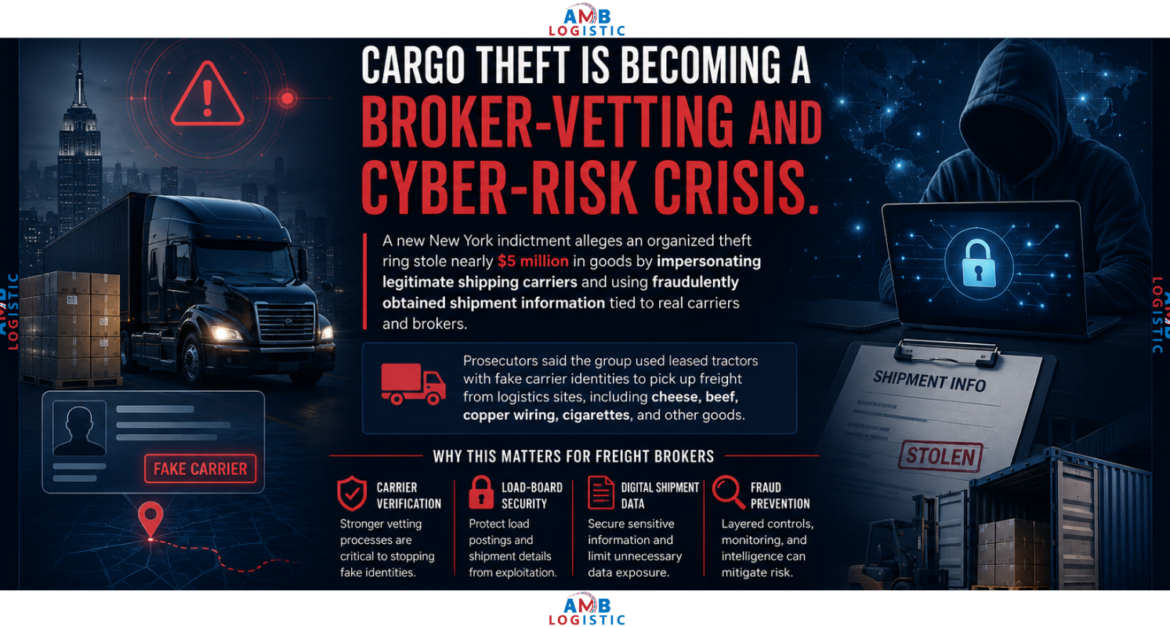
Cargo Theft Is Becoming a Broker-Vetting and Cyber-Risk Crisis: What the Latest Northeast Theft Ring Means for U.S. Freight
Cargo theft is no longer just a physical security problem. It is becoming a broker-vetting, shipment-data, and cyber-risk problem at the same time. A recent Northeast theft case involving nearly $5 million in stolen goods shows how organized fraud groups are using carrier impersonation, stolen shipment details, and false identities to move freight that appears legitimate until it is already gone. For freight brokers, shippers, and carriers, the message is clear: fraud is getting more coordinated, more digital, and more dangerous to the freight ecosystem.
Introduction
For years, cargo theft was often pictured as a truck disappearing, a trailer being stolen from a yard, or freight being taken during a weak handoff. That still happens. But the newer threat is more sophisticated. Bad actors are not only targeting cargo after it moves. They are targeting the information that allows cargo to move in the first place. Shipment details, broker communications, carrier identities, pickup instructions, and load-board activity are now part of the risk surface.
That is what makes the latest Northeast cargo theft case so important. The alleged operation did not rely only on force or opportunity. It involved impersonating real shipping carriers, using fraudulently obtained shipment information, leasing tractors, applying false carrier identities, and picking up freight from logistics sites before diverting the goods for resale. The stolen freight reportedly included cheese, beef, lamb, copper wiring, cigarettes, and other high-value goods.
This is not just a crime story. It is a freight-market warning. When criminals can use real shipment information and carrier impersonation to move stolen freight, the entire chain of trust is under pressure. Brokers must verify harder. Shippers must protect data better. Carriers must defend their identity more actively. And the industry has to stop treating cargo theft as something that happens only at the dock door.
Why This Matters
This matters because the theft method attacks the exact trust structure freight brokerage depends on. A broker posts or manages a load. A carrier is selected. Shipment details are released. Pickup happens. Delivery follows. That process works only when each party is who they say they are. Once identity fraud enters that flow, the freight can be stolen before anyone realizes the wrong party has inserted itself into the transaction.
The scale of the alleged theft is also a serious signal. Nearly $5 million in stolen goods is not a minor operational loss. It reflects a level of coordination that should concern every logistics team handling high-value, food, retail, consumer goods, metal, tobacco, or time-sensitive freight. The products targeted were not random. They were goods with resale value, market demand, and enough volume to make the theft worth organizing.
- Carrier impersonation is becoming more dangerous because criminals can use real company identities to appear legitimate.
- Shipment information is now a security asset because the wrong access can enable a fraudulent pickup.
- Broker vetting must go beyond basic setup checks because fraud groups are becoming more coordinated.
- High-value freight needs stronger verification controls before pickup details are released.
- Cargo theft is now linked to cyber exposure because stolen or hacked shipment information can trigger real-world losses.
The Broader Picture
The broader picture is that freight fraud is evolving faster than many operating processes. A few years ago, many companies treated fraud prevention as a compliance function or a carrier-setup task. That is no longer enough. The modern threat sits across multiple points: digital shipment access, identity verification, email compromise, load-board behavior, carrier authority monitoring, dispatch communication, pickup authentication, and post-pickup tracking.
This kind of theft also shows why the line between cybercrime and cargo crime is getting thinner. If bad actors can obtain shipment information before the legitimate carrier does, they do not need to break into a yard. They can walk into the freight process wearing a false identity and leave with the cargo. That is why data access, carrier identity, and operational verification now belong in the same risk conversation.
The freight market has already been dealing with double brokering, identity theft, fake carriers, stolen MC identities, fraudulent rate confirmations, and suspicious contact data. This latest case fits into that larger pattern. The industry is not facing one isolated fraud tactic. It is facing an ecosystem of deception built around the fact that freight moves quickly and information often moves even faster.
What This Means for Freight Brokers and Logistics Teams
For freight brokers, the biggest takeaway is that carrier selection and pickup release can no longer be treated as routine steps. Every handoff has risk. Every load detail has value. Every carrier identity must be verified before sensitive pickup information is released. The cost of a weak process is no longer just a service failure. It can become a multi-party cargo theft event.
For shippers, this is a reminder that logistics security starts before freight leaves the facility. If a fraudulent carrier arrives with convincing information, facility teams need a process strong enough to catch the mismatch. That means pickup verification, driver identity checks, carrier confirmation, appointment validation, and real-time communication with the broker or transportation team.
For carriers, the risk is also direct. Legitimate carrier identities can be used by bad actors to steal freight, damage reputation, create disputes, and trigger investigations. Carriers need to monitor how their authority, name, contact information, and identity are being used across the market. In this environment, protecting carrier identity is part of protecting the business.
The Freight Broker Playbook
1) Treat shipment details like sensitive data
Pickup numbers, facility addresses, appointment details, product information, and delivery instructions should not be treated casually. The more valuable the freight, the more controlled the information release should be. A broker should know exactly who is receiving load details and why.
2) Verify the carrier beyond the MC number
Basic carrier information is not enough in a market where identity theft is rising. Brokers should verify contact details, dispatch behavior, insurance consistency, authority history, email domains, phone numbers, recent changes, and whether the person booking the load is actually connected to the carrier of record.
3) Strengthen pickup authentication
The handoff at the pickup location is one of the most vulnerable points in the shipment. Shippers, brokers, and facilities should align on driver name, tractor details, trailer information, appointment number, carrier confirmation, and escalation procedure if anything looks wrong.
4) Watch high-risk freight categories more closely
Food, beverages, tobacco, electronics, copper, metals, consumer goods, and other resale-friendly freight should receive stronger controls. If a commodity is easy to liquidate, it is more attractive to organized theft groups.
5) Build fraud checks into daily operations, not after-the-fact investigations
Fraud prevention cannot live only in a claims meeting after a loss happens. It has to be built into carrier onboarding, load assignment, pickup release, tracking, communication, and exception management. The goal is to stop the wrong party before they get the freight.
What This Means for Freight Brokers and Logistics Teams
The most important shift is mindset. Cargo theft is not only a claims problem. It is an operating discipline problem. Brokers that build stronger verification steps will be better positioned than those relying on speed alone. Shippers that tighten pickup controls will reduce exposure. Carriers that monitor identity misuse will protect their market reputation.
This also changes how teams should think about service. Fast coverage is valuable, but fast coverage without verification can become dangerous. In a market where bad actors are using real data, stolen identities, and coordinated tactics, the strongest logistics partners are not simply the ones who move quickly. They are the ones who move quickly with control.
AMB Logistic’s Role
At AMB Logistic, we see this as a serious industry signal. Freight security is no longer just about moving the load from point A to point B. It is about knowing who is involved, how the load is being handled, when risk appears, and whether the process can stand up under pressure. That is the level of discipline the market now demands.
Our role is to help customers move freight with clarity, accountability, and stronger operating awareness. That means treating carrier alignment, communication, verification, and execution as connected parts of the same service standard. In a market where fraud is becoming more sophisticated, process discipline is not extra work. It is protection.
- Stronger carrier communication,
- more disciplined shipment coordination,
- clearer visibility around pickup and delivery execution,
- and freight movement built around trust that can be verified.
FAQ
Why is cargo theft becoming more dangerous for freight brokers?
Because criminals are increasingly using carrier impersonation, stolen shipment details, and identity fraud to insert themselves into the freight process before the legitimate carrier completes the pickup.
What makes this different from traditional cargo theft?
Traditional theft often happened after freight was already moving or sitting in a vulnerable location. This type of theft can begin earlier, when fraudulent parties gain access to shipment details and use false identities to pick up freight directly.
What should brokers do first?
Brokers should tighten carrier verification, control shipment-detail release, validate dispatch contacts, monitor suspicious carrier changes, and build stronger pickup authentication processes with shippers.
How does this affect shippers?
Shippers need stronger facility-level verification. A pickup should not be released only because a driver has some correct information. The facility should confirm carrier identity, driver details, appointment data, and any suspicious mismatch before loading freight.
Why does this matter to carriers?
Legitimate carriers can have their identity misused by fraud groups. That can create reputational damage, investigation risk, and confusion with brokers and shippers. Carrier identity protection is becoming part of operational security.
Final Word From AMB Logistic
Cargo theft is changing. The industry is no longer dealing only with stolen trailers or unsecured yards. It is dealing with stolen identities, compromised shipment information, fake carrier appearances, and coordinated fraud that can look legitimate until the freight is gone.
That is why this moment matters. The brokers, shippers, and carriers who take verification seriously now will be better prepared for the next wave of freight fraud. The ones who treat this as an isolated headline may find themselves exposed when a bad actor enters the process looking professional, prepared, and convincing.
In modern freight, trust is no longer enough by itself. Trust has to be verified.
Talk To AMB Logistic Today
If your team is concerned about freight fraud, carrier verification, cargo security, or stronger shipment execution, AMB Logistic can help you move with more clarity and control.
Call: +1 (888) 538-6433
Email: info@amblogistic.us
Web: amblogistic.us
Tags
cargo theft, freight fraud, carrier verification, freight brokerage, logistics security, AMB Logistic