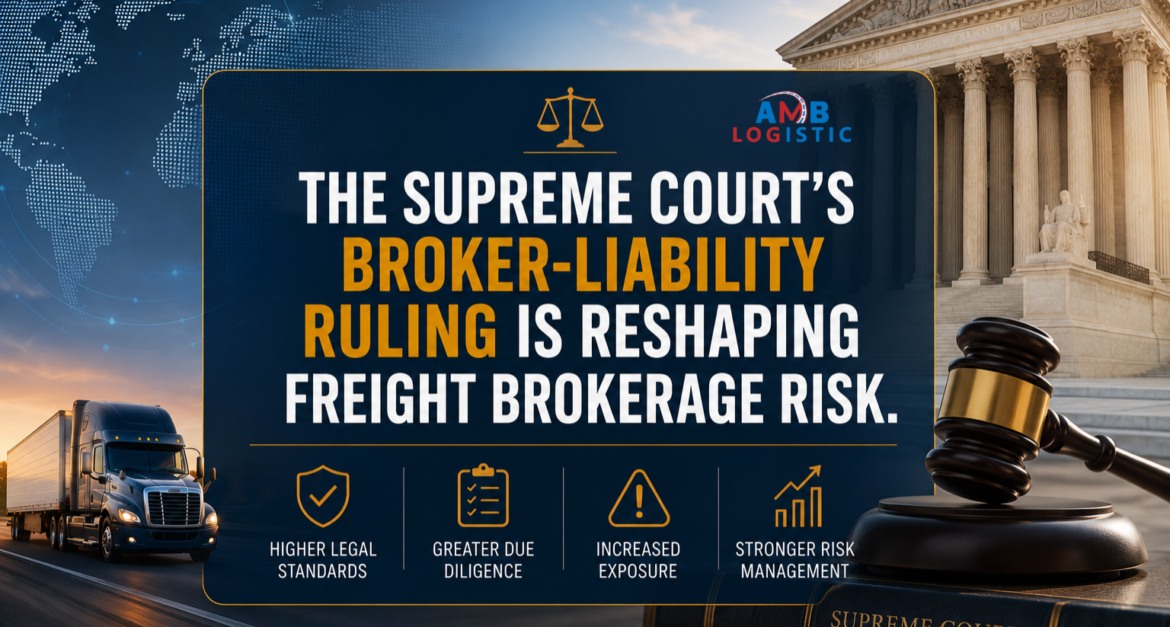
The Supreme Court Just Changed the Broker Liability Conversation: What the C.H. Robinson Ruling Means for U.S. Freight Brokerage
The U.S. freight brokerage industry just received one of its most important legal signals in years. The Supreme Court allowed a negligence suit against C.H. Robinson to move forward, holding that the plaintiff’s claims can proceed under the safety exception to federal law. The decision does not mean brokers are automatically liable in every case, and it does not mean C.H. Robinson has lost the underlying lawsuit. But it does mean the industry can no longer treat broker liability exposure as a remote legal theory. For brokers, shippers, and carriers, this is a real market event with real operating consequences.
Introduction
Freight brokerage has always lived in a complicated space between coordination and accountability. Brokers do not own the trucks, do not employ the drivers, and do not operate as motor carriers. But they do make carrier-selection decisions that can shape real-world risk. For years, one of the central legal and business assumptions in the sector was that federal law offered a broad shield against many state-law claims tied to those decisions. That assumption has now been weakened in a way the industry cannot ignore.
The case arose from a 2017 crash in Illinois in which Shawn Montgomery’s parked vehicle was hit by a speeding truck, resulting in a partial leg amputation. Montgomery argued that C.H. Robinson should share liability because it hired a carrier despite what he described as serious safety red flags, including prior careless-driving history and multiple crashes involving the carrier in a short period. The Supreme Court ruled that his claims can proceed because they fall within the safety exception, reversing the lower-court result that had favored the broker.
That legal distinction matters far beyond one case. The ruling opens the door to more scrutiny of how brokers evaluate carriers, document diligence, and defend their selection process when an accident occurs. In practical terms, this is not just a courtroom issue. It is a risk-management issue, a procurement issue, and potentially a pricing issue across the brokerage market.
Why This Matters
This matters because the ruling increases the importance of broker process discipline at exactly the time when the market is already under pressure from capacity shifts, compliance tightening, and changing customer expectations. The core takeaway is not that brokers suddenly become insurers of every carrier they touch. The more immediate takeaway is that broker carrier-selection practices now sit under a brighter and more dangerous legal spotlight. When courts, plaintiffs, and customers start looking more closely at how a broker selected a carrier, documentation and diligence stop being internal hygiene items and become frontline business defenses.
It also matters because the ruling could alter how shippers think about broker value. If legal exposure and safety-selection scrutiny increase, then carrier-vetting depth, compliance controls, and documented decision-making become commercially more important. In other words, this decision may accelerate a shift away from “who can cover it cheapest” toward “who can defend how it was covered.” That does not remove rate pressure from the market, but it changes the value of operational credibility.
- The Supreme Court allowed the negligence suit to proceed, which changes the legal conversation around broker exposure.
- The ruling relied on the safety exception, meaning certain state-law claims are not automatically blocked by federal preemption.
- The brokerage industry now faces a more serious carrier-selection spotlight, especially around safety-related diligence.
- Market participants are likely to place greater value on documented process discipline, not just transactional coverage.
The Broader Picture
The broader picture is that this case lands at a time when broker operating models are already being tested from multiple directions. Regulatory enforcement has been tightening in other parts of the trucking ecosystem. Capacity discipline is becoming more important in procurement. Shippers are becoming more sensitive to service quality and carrier dependability in certain lanes. Against that backdrop, the Supreme Court’s ruling adds another layer: legal scrutiny of broker carrier-selection practices may now carry more practical weight than many firms had assumed.
The decision also reinforces a long-building split inside logistics. On one side is the argument that safety responsibility should stay mainly with federal regulators and motor carriers. On the other side is the argument that brokers should not be insulated when they choose carriers despite visible warning signs. The Court did not resolve every future question. But by allowing the suit to proceed, it made clear that the brokerage layer is not automatically outside the reach of safety-related negligence claims. That is a meaningful shift in posture, even before any final liability is decided in this case.
There is also a financial dimension. Immediate market reactions suggested that larger carriers with stronger safety programs may gain an advantage if brokers are pushed toward more defensible carrier choices. Whether that fully plays out remains to be seen, but the signal is important: the ruling is being interpreted as something with commercial consequences, not just legal symbolism.
What This Means for Freight Brokers and Logistics Teams
For freight brokers, the message is simple but serious: carrier selection can no longer be treated as a mostly transactional function. The broker that survives this shift best will be the one that can show a disciplined process, explain why a carrier was selected, demonstrate what information was reviewed, and prove that safety diligence was not an afterthought. That does not mean brokers can eliminate risk. It means they now need to manage risk in a way that can stand up under legal scrutiny.
For shippers, this could change the way brokerage partnerships are evaluated. If legal exposure tied to carrier selection rises, then shipper procurement teams may start asking harder questions about onboarding, monitoring, documentation, and carrier qualification standards. Cost will still matter, but process integrity may begin carrying more weight, especially for sensitive freight, critical lanes, or high-visibility customer programs.
For carriers, especially larger and more established fleets with stronger safety records, the ruling may create an advantage. If brokers feel compelled to emphasize safer, more defensible carrier choices, those carriers may become more commercially attractive. In a market where trust and defensibility matter more, dependable carriers with cleaner operating profiles may gain leverage faster.
The Freight Broker Playbook
1) Treat carrier vetting as a business defense, not just a setup task
The first adjustment is cultural. Carrier onboarding and carrier selection should no longer be treated as paperwork that sits quietly in the background. In this environment, those processes are part of the brokerage’s legal and commercial defense structure.
2) Tighten documentation around why carriers are selected
It is no longer enough for teams to say a carrier was available and covered the load. A stronger operating model asks: what was reviewed, what risk indicators were considered, and how was the selection decision justified at that time? The firms that can answer those questions clearly will be better positioned than the firms that rely on vague operational memory.
3) Reassess the real cost of cheap coverage
The ruling increases the danger of treating low price as the primary organizing principle in carrier selection. Cheap coverage that cannot be defended later may carry a much higher total cost than it appears to in the moment.
4) Expect shipper questions to get sharper
Customers that understand the significance of this ruling are likely to become more interested in broker process. That means broker sales and operations teams should be aligned now on how they explain qualification discipline, monitoring, and service standards.
5) Build for a market where credibility matters more
In a less forgiving legal environment, credibility becomes a real competitive advantage. Brokers that can show disciplined operations, clearer controls, and stronger safety-minded carrier strategy may be better positioned than those still competing mainly on price and speed alone.
AMB Logistic’s Role
At AMB Logistic, we view this ruling as a reminder that strong brokerage is built on more than freight movement. It is built on judgment, process, and accountability. The market is always changing, but certain moments make it obvious that operational discipline is not optional. This is one of those moments.
Our role is to help customers move with clarity in a market that is getting more complex. That means not just covering freight, but doing so with stronger process discipline, more thoughtful carrier alignment, and a sharper understanding of how risk now moves through the brokerage function. In an industry where trust matters, execution and defensibility matter too.
- Stronger process discipline,
- clearer carrier strategy,
- better communication around operational risk,
- and freight execution built to hold up under pressure.
FAQ
Did the Supreme Court rule that brokers are automatically liable?
No. The Court allowed the negligence claim to proceed. It did not decide that C.H. Robinson is automatically liable in the underlying case.
Why is this ruling such a big deal for freight brokers?
Because it shows that safety-related negligence claims against brokers are not automatically blocked by federal law in the way many in the industry had hoped. That raises the importance of carrier-selection process and documentation.
Could this affect how shippers buy brokerage services?
Yes, potentially. If brokers face more scrutiny around carrier selection, shippers may place greater value on process credibility, qualification standards, and documented diligence rather than focusing only on the cheapest available coverage.
What should brokers do now?
Review vetting procedures, tighten documentation, align legal and operations teams, and make sure carrier selection can be explained as a disciplined process rather than a purely transactional one.
Final Word From AMB Logistic
The biggest freight stories are not always about rates. Sometimes they are about the rules underneath the market. This Supreme Court ruling is one of those stories. It does not instantly rewrite the entire brokerage model, but it does change the level of seriousness with which the industry needs to treat carrier selection, safety diligence, and defensible process.
That is why this moment matters. The brokers who treat it as a signal to get sharper will be better positioned than the ones who dismiss it as someone else’s legal problem. In 2026, credibility is becoming more valuable in freight. This decision may end up being one of the reasons why.
Talk To AMB Logistic Today
If your team is navigating a freight market where process discipline, carrier strategy, and execution credibility matter more than ever, AMB Logistic is ready to help.
Call: +1 (888) 538-6433
Email: info@amblogistic.us
Web: amblogistic.us
Tags
freight brokerage, broker liability, carrier selection, transportation law, C.H. Robinson, AMB Logistic