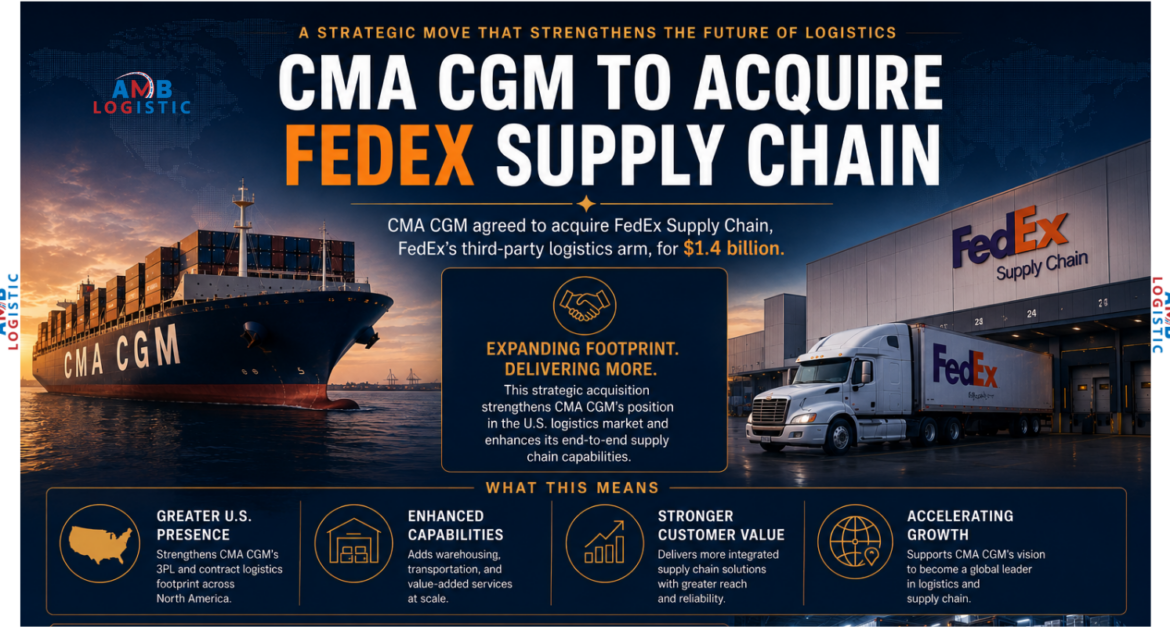
CMA CGM’s $1.4B FedEx Supply Chain Deal Shows The Future Of Freight Brokerage Is Integrated Logistics
CMA CGM’s agreement to acquire FedEx Supply Chain for $1.4 billion is more than a large logistics acquisition. It is another signal that the freight market is moving toward integrated supply chain control. Ocean carriers, 3PLs, warehousing providers, fulfillment networks, airfreight partners, and inland transportation providers are becoming more connected. For freight brokers and shippers, this deal reinforces a major market shift: the future of freight brokerage is not only about quoting trucks. It is about connecting transportation, warehousing, visibility, inventory flow, returns, fulfillment, and execution into a stronger supply chain strategy.
Introduction
The freight brokerage and logistics market is changing quickly. CMA CGM’s planned acquisition of FedEx Supply Chain marks another major step in the move toward end-to-end logistics. The deal expands CMA CGM’s logistics arm, CEVA Logistics, deeper into North American warehousing, fulfillment, returns, and contract logistics.
For shippers, this matters because transportation decisions are no longer separate from inventory, warehousing, fulfillment, customer delivery, returns, and supply chain visibility. A shipment is not just a truckload moving from one location to another. It is part of a larger operating system that connects product availability, warehouse capacity, transportation execution, customer expectations, and cost control.
For freight brokers, this is an important signal. Large global logistics companies are building deeper inland networks and stronger contract logistics capabilities. Ocean carriers are no longer limiting themselves to port-to-port movement. They are investing in warehousing, distribution, air cargo, fulfillment, and inland transportation to serve customers across the full supply chain.
That creates a more competitive environment for traditional freight brokers. Customers are increasingly asking for more than a rate. They want visibility, flexibility, routing strategy, carrier management, warehouse coordination, exception control, and freight decisions that support the full business.
The core takeaway is clear: freight brokerage is becoming more strategic. The broker’s role is expanding from finding available capacity to helping customers manage freight as part of a broader logistics ecosystem.
Why This Matters
CMA CGM’s FedEx Supply Chain deal matters because it shows where logistics competition is heading. The strongest logistics providers are trying to control more of the shipment lifecycle. That includes ocean freight, airfreight, warehousing, inventory handling, fulfillment, returns, domestic transportation, and final delivery coordination.
For years, many shippers treated transportation, warehousing, and fulfillment as separate decisions. A company might use one provider for international freight, another for warehouse storage, another for truckload, another for LTL, and another for returns. That model can work, but it also creates gaps.
Those gaps become expensive when the market is volatile. If inventory arrives late at the port, warehouse space may not be ready. If warehouse processing is delayed, outbound freight may miss pickup windows. If transportation capacity tightens, customer delivery dates may slip. If returns are not managed properly, inventory visibility can suffer.
Integrated logistics is designed to reduce those gaps. The goal is to connect the movement of goods across each stage instead of managing every stage in isolation.
For freight brokers, this changes the competitive landscape. A broker that only provides a truck quote may be seen as transactional. A broker that understands how freight fits into the customer’s larger supply chain becomes more valuable.
This is why the CMA CGM deal is important for the brokerage industry. It reflects a market where logistics providers are competing on network depth, visibility, execution control, warehousing access, and customer experience.
The Broader Picture
The logistics industry has been moving toward integration for years. Ocean carriers have invested in terminals, air cargo, warehousing, freight forwarding, contract logistics, and inland transportation. Large 3PLs have expanded their technology platforms and fulfillment networks. Retailers and manufacturers are demanding better coordination between inventory, transportation, and customer delivery.
The reason is simple: supply chains are more connected than ever. A transportation problem can become an inventory problem. An inventory problem can become a sales problem. A warehouse delay can become a customer-service problem. A lack of visibility can create cost, confusion, and poor planning.
Shippers do not want isolated services that do not communicate with each other. They want logistics partners who can help them understand what is happening, where risk exists, and how to respond when conditions change.
The CMA CGM and FedEx Supply Chain deal fits directly into that larger movement. It combines global shipping scale with more U.S. logistics infrastructure. It strengthens CEVA Logistics’ North American footprint and gives CMA CGM more ability to support customers beyond ocean freight.
For traditional freight brokers, the message is not that brokerage is disappearing. The message is that brokerage must evolve. Freight brokers still play a critical role because shippers need flexible capacity, carrier relationships, lane knowledge, market intelligence, and problem-solving. But the best brokers will connect those strengths to broader supply chain needs.
The market is rewarding logistics partners who can help customers manage complexity. That means transportation strategy, warehouse coordination, inventory flow, visibility, compliance, risk control, and cost discipline are all becoming part of the same conversation.
What This Means For Freight Brokers
For freight brokers, the CMA CGM deal reinforces the need to move beyond basic rate shopping. The broker’s value cannot be limited to sending quotes and booking trucks. Digital platforms, large 3PLs, asset-based carriers, and integrated logistics providers can all compete for freight if the only requirement is price.
Brokers need to become more consultative. That means understanding why the shipment is moving, how it connects to inventory, what delivery timing means for the customer, where warehouse constraints exist, what mode makes sense, and how exceptions should be managed.
The first broker impact is customer expectation. Shippers are becoming more used to integrated logistics solutions. They expect better visibility, faster communication, cleaner execution, and more strategic guidance. A broker that cannot explain market conditions, carrier fit, service tradeoffs, or cost drivers may struggle to stand out.
The second impact is mode strategy. Integrated logistics providers can offer ocean, air, warehouse, truckload, LTL, and contract logistics options. Brokers need to help customers think beyond one mode and understand when truckload, LTL, intermodal, expedited, warehousing support, or staged delivery may be the better solution.
The third impact is visibility. If freight is part of a larger supply chain, customers need accurate shipment updates and proactive communication. Visibility is no longer a bonus. It is a baseline requirement.
The fourth impact is execution control. Customers want fewer surprises. Brokers must manage pickup discipline, carrier communication, appointment windows, documentation, accessorial exposure, delivery performance, and exception response.
The fifth impact is partnership quality. As large logistics companies build more integrated offerings, independent and mid-market brokers need to compete through service, agility, carrier relationships, responsiveness, and customer-specific freight knowledge.
The Freight Broker Playbook
1) Stop Selling Only The Truck Quote
A freight quote is important, but it is not the full value of brokerage. If the customer only sees the broker as a price provider, the broker becomes easy to compare and easier to replace.
Brokers should position themselves around freight strategy. That means helping the customer understand lane conditions, capacity risk, service expectations, timing constraints, carrier quality, and the best transportation option for the shipment.
The conversation should move from “Here is the cheapest rate” to “Here is the safest, most reliable, and most cost-effective way to move this freight based on the full situation.”
2) Connect Freight Decisions To Inventory Flow
Transportation does not operate in isolation. A late inbound shipment can delay production, warehouse processing, retail availability, or customer delivery. A poorly planned outbound shipment can create missed appointments, storage costs, and customer-service problems.
Brokers should ask better questions about inventory timing. When does the product need to arrive? Is warehouse labor available? Is there a receiving appointment? Does the consignee have delivery restrictions? Is this shipment tied to a production schedule or customer launch?
When brokers understand inventory flow, they make better freight decisions.
3) Strengthen Warehouse And Fulfillment Awareness
CMA CGM’s acquisition of FedEx Supply Chain highlights the importance of warehousing and fulfillment in modern logistics. Freight brokers do not need to own warehouses to add value, but they do need to understand how warehouse operations affect transportation.
Warehouse hours, dock capacity, loading speed, appointment rules, pallet quality, labeling, storage constraints, and order cutoffs all influence freight execution.
Brokers who understand these details can help prevent detention, missed pickups, failed deliveries, accessorials, and poor customer experiences.
4) Build Modal Flexibility Into Freight Planning
Integrated logistics providers compete by offering multiple options. Brokers should also help customers think across modes instead of defaulting to one solution.
A shipment may need full truckload if speed and control matter. LTL may be better for smaller shipments. Intermodal may help reduce cost on longer hauls. Expedited service may be necessary for urgent freight. Warehousing or staged delivery may be the better solution when timing does not align.
The broker’s role is to help the shipper understand the tradeoffs between cost, speed, visibility, reliability, and risk.
5) Make Visibility A Core Service Standard
As logistics becomes more integrated, visibility becomes more important. Shippers need to know where freight is, whether it is on schedule, and what actions are needed when something changes.
Brokers should provide proactive updates, not only reactive answers. Customers should not have to chase basic shipment information. When a delay, missed appointment, carrier issue, or delivery exception occurs, communication should be fast and clear.
Visibility helps customers manage inventory, labor, customer expectations, and downstream planning.
6) Improve Exception Management
Every logistics network faces exceptions. The difference between weak service and strong service is how quickly those exceptions are identified, communicated, and resolved.
Brokers should have a clear process for late pickups, missed appointments, carrier breakdowns, weather delays, warehouse delays, rejected freight, accessorial issues, and delivery changes.
The customer does not expect every shipment to be perfect. But the customer does expect the broker to take control when something goes wrong.
7) Protect Customers From Hidden Cost
Integrated logistics is not only about more services. It is also about better cost control. Freight cost can increase because of detention, layover, re-delivery, storage, accessorials, poor appointment planning, inaccurate shipment details, and weak communication.
Brokers should help customers identify preventable cost before it appears on the invoice. That means confirming pickup and delivery details, clarifying accessorial requirements, reviewing shipment specifications, and communicating realistic timing.
Strong freight planning reduces avoidable cost.
8) Use Carrier Relationships As A Strategic Advantage
Large integrated logistics providers have scale, but strong brokers have relationships. Carrier relationships still matter, especially when the market tightens, service requirements become complex, or a customer needs reliable coverage on difficult lanes.
Brokers should build carrier networks around quality, communication, safety, reliability, and lane fit. The best carriers are not always the cheapest. They are the carriers that execute consistently and protect the customer relationship.
In a market moving toward integration, carrier quality becomes even more important.
9) Help Shippers Prepare For More Consolidation
Large acquisitions can change customer expectations, service models, and competitive pressure. As global logistics companies expand their reach, smaller and mid-sized shippers may wonder whether they need one large provider or a mix of specialized partners.
Brokers can help customers think through that decision. Some shippers may benefit from integrated services. Others may need flexibility, personalized support, or a more responsive brokerage partner.
The right answer depends on the shipper’s freight profile, volume, service needs, warehouse model, and customer expectations.
10) Compete Through Agility And Service
Large logistics networks can offer scale, but they may not always offer speed, flexibility, or personalized attention. This is where strong freight brokers can compete.
Brokers should focus on responsiveness, clear communication, fast problem-solving, carrier-fit decisions, and customer-specific planning. Customers still value a logistics partner who understands their freight and acts quickly when conditions change.
Agility is a competitive advantage when the market becomes more complex.
What This Means For Shippers
For shippers, the CMA CGM and FedEx Supply Chain deal is a reminder to look at logistics more holistically. Transportation, warehousing, fulfillment, inventory, returns, and customer delivery are connected. Decisions in one area affect performance in another.
Shippers should evaluate whether their freight partners understand the full picture. A transportation provider should not only ask for origin, destination, and weight. They should understand timing, receiving rules, warehouse constraints, inventory impact, service expectations, and risk.
Shippers should also be careful not to assume that the largest provider is always the best fit. Large integrated providers can offer scale and network depth, but smaller and mid-sized brokers may offer stronger responsiveness, flexibility, and customer-specific attention.
The best logistics strategy may involve a combination of partners. The key is choosing providers who communicate clearly, understand the freight, and can support the shipper’s business goals.
What This Means For Carriers
For carriers, the shift toward integrated logistics creates both opportunity and pressure. Large logistics providers need reliable carriers to support inland freight movement. Brokers need carriers who can execute consistently, communicate clearly, and support shipper expectations.
Carriers that provide strong service, accurate updates, safety discipline, clean documentation, and reliable capacity may become more valuable in this environment.
At the same time, carriers may face higher expectations around technology, tracking, appointment compliance, insurance, safety, and communication. As shippers demand more visibility and control, carriers will need to support that standard.
Strong carriers can use this market shift as a commercial advantage.
AMB Logistic’s Role
At AMB Logistic, we understand that modern freight brokerage requires more than a rate quote. Customers need freight partners who understand market conditions, carrier fit, service requirements, shipment visibility, and execution control.
As logistics becomes more integrated, our role is to help shippers move freight with more clarity and confidence. That means connecting transportation decisions to business realities such as delivery timelines, inventory flow, warehouse coordination, customer expectations, and cost control.
AMB Logistic supports customers with truckload, LTL, and freight brokerage solutions built around communication, reliability, and practical freight strategy. Whether a shipment requires standard coverage, time-sensitive coordination, better visibility, or a more thoughtful freight plan, our focus remains the same: move freight the right way.
- We help customers evaluate transportation options beyond price alone.
- We support freight planning with visibility, communication, and carrier-fit discipline.
- We help connect shipment execution to broader supply chain needs.
- We focus on service reliability, exception control, and practical logistics solutions.
- We help shippers move with clarity, control, and confidence in a changing market.
FAQ
Why Does CMA CGM’s FedEx Supply Chain Deal Matter?
The deal matters because it shows how major logistics companies are expanding beyond single-service transportation into integrated supply chain solutions that include warehousing, fulfillment, freight management, and broader execution control.
What Is Integrated Logistics?
Integrated logistics connects multiple parts of the supply chain, including transportation, warehousing, inventory flow, fulfillment, returns, visibility, and delivery coordination. The goal is to manage freight as part of a larger operating system rather than as isolated shipments.
Does This Deal Affect Freight Brokers?
Yes. It increases competitive pressure on traditional brokers by showing that customers are increasingly looking for logistics partners who can provide strategy, visibility, coordination, and execution support beyond basic truckload quotes.
Does This Mean Traditional Freight Brokerage Is Going Away?
No. Freight brokerage remains important because shippers need flexible capacity, carrier relationships, lane expertise, market knowledge, and fast problem-solving. But brokers need to provide more value than rate shopping alone.
What Should Shippers Look For In A Freight Partner?
Shippers should look for a freight partner that understands carrier selection, shipment visibility, communication, warehouse timing, delivery requirements, cost control, and exception management.
How Can Brokers Compete With Larger Integrated Providers?
Brokers can compete by offering agility, responsiveness, strong carrier relationships, personalized service, proactive communication, and customer-specific freight planning.
Final Word From AMB Logistic
CMA CGM’s $1.4 billion FedEx Supply Chain deal is a major signal for the logistics industry. Large providers are building deeper networks across warehousing, fulfillment, airfreight, ocean freight, contract logistics, and inland transportation.
For freight brokers, the message is clear. The future of brokerage is not only about finding a truck. It is about helping customers move freight within a broader supply chain strategy. That requires better visibility, stronger communication, carrier-fit discipline, modal flexibility, and execution control.
For shippers, this is a reminder that freight decisions affect more than transportation cost. They affect inventory, warehouse operations, customer delivery, service reliability, and business performance.
The freight market is becoming more integrated and more competitive. In this environment, the strongest logistics partners will be the ones who combine practical freight execution with a clear understanding of the customer’s full supply chain.
Talk To AMB Logistic Today
If your business needs truckload, LTL, or freight brokerage support in a changing logistics market, AMB Logistic can help you move with clarity, control, and confidence.
Web: amblogistic.us
Phone: +1 (888) 538-6433
Email: info@amblogistic.us
Tags
CMA CGM, FedEx Supply Chain, CEVA Logistics, freight brokerage, integrated logistics, contract logistics, warehousing, fulfillment, 3PL, U.S. logistics, supply chain strategy, freight brokers, truckload, LTL, transportation strategy, AMB Logistic