America’s Trucking Slump Is Finally Turning: What a Supply-Driven Recovery Means for Freight Brokers
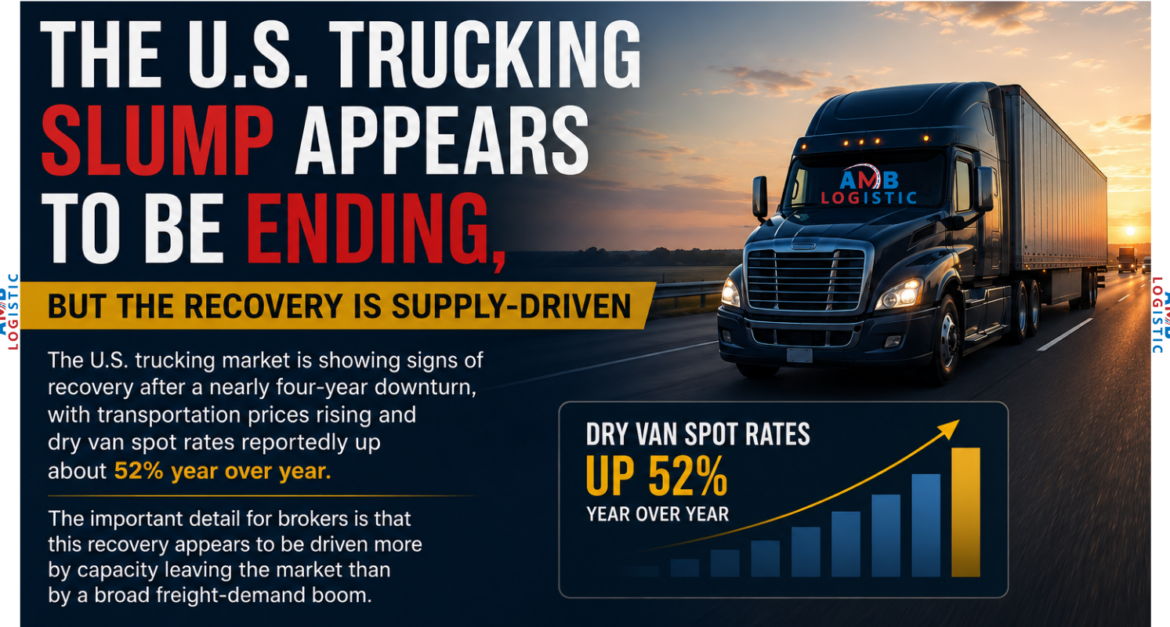
The U.S. trucking market is showing real signs of recovery after one of the longest freight downturns in recent memory. But this is not a simple “freight is booming again” story. The most important signal for freight brokers is that the recovery appears to be driven more by capacity leaving the market than by a major demand surge. That difference matters. A demand-led recovery and a supply-driven tightening require two very different brokerage strategies. In this phase, brokers, shippers, and carriers need sharper lane intelligence, stronger carrier relationships, and more disciplined pricing conversations.
Introduction
For almost four years, the U.S. trucking market has been working through a painful freight recession. After the pandemic-era boom, too much capacity entered the market. Rates fell, margins compressed, and many small carriers were forced to operate in survival mode. For freight brokers, the downturn created a market where trucks were often easier to find, but pricing pressure, service inconsistency, and carrier quality risks still made execution difficult.
That environment is now changing. Trucking rates are moving back toward more sustainable levels, dry van spot rates have strengthened sharply year over year in several market readings, and transportation pricing pressure is building again after a long period of softness. The market is not suddenly booming across every lane, but the balance between freight and available trucks is clearly shifting.
The key point is why this is happening. This does not appear to be a clean demand boom. It appears to be a market correction after years of too much trucking capacity. Carriers have exited. Some fleets have reduced operations. Operating costs remain high. Regulatory enforcement and driver-qualification pressures have tightened the available carrier base. That means the same freight volume can suddenly become harder to cover because there are fewer trucks positioned correctly and willing to move at old-market prices.
For brokers, that is the real story. When freight becomes more expensive because demand is exploding, the market requires one kind of response. When freight becomes more expensive because capacity has left the system, it requires another. This recovery is less about chasing a boom and more about protecting access to reliable capacity before coverage gets harder.
Why This Matters
Freight brokers sit directly between shipper expectations and carrier reality. During a loose market, brokers can often cover freight quickly and use competitive capacity to support aggressive pricing. During a tightening market, the job changes. Coverage becomes more strategic. Pricing needs more explanation. Carrier relationships matter more. Weak lane assumptions get exposed faster.
A supply-driven recovery is especially important because it can confuse shippers. A shipper may look at their own volumes and say, “Our freight is not up that much, so why are rates rising?” The answer is that rates can rise when the supply of trucks falls, even if demand is only flat or modestly higher. That is the exact market dynamic brokers need to explain clearly.
- For brokers, this market raises the value of carrier relationships, lane-level pricing, and realistic quote discipline.
- For shippers, it means last-minute spot buying may become more expensive and less reliable.
- For carriers, it creates an opportunity to regain pricing power after years of margin pressure.
- For logistics teams, it signals that the easy-capacity environment may be fading.
The takeaway is straightforward: the market is improving, but it is not improving evenly. Some lanes will tighten quickly. Some regions may remain manageable. Some equipment types will respond differently than others. This is not a market for broad assumptions. It is a market for precision.
The Broader Picture
The current shift follows a deep capacity correction. The pandemic freight boom pulled many new carriers and owner-operators into trucking. Freight was plentiful, spot rates were high, and the market rewarded capacity growth. When demand normalized and rates fell, the system was left with too many trucks chasing too little freight.
That imbalance lasted long enough to push many operators out of the market. Carriers faced low rates while insurance, equipment, maintenance, labor, compliance, and financing costs remained high. Some continued operating at weak margins just to keep trucks moving. Over time, that became unsustainable.
As capacity exits, the market begins to rebalance. But rebalancing does not always feel smooth. It can show up first as inconsistent coverage, sudden lane-level price movement, more selective carriers, higher spot exposure, and faster changes in replacement cost. Brokers may see some lanes remain soft while others tighten sharply.
That is why the current recovery should be described carefully. It is not a universal freight boom. It is a correction toward a healthier market after years of oversupply. Industrial freight, flatbed, data-center-related freight, and certain manufacturing-linked lanes may feel stronger, while consumer-driven freight can remain uneven. National headlines help frame the market, but lane-level execution determines the outcome.
What This Means for Freight Brokers
For freight brokers, the operating environment is becoming less forgiving. During the downturn, brokers could often find available capacity with less lead time. In the next phase, capacity may still exist, but it may be more selective, more expensive, and less willing to accept freight that does not fit the carrier’s network.
The first major impact is pricing. Brokers need to explain rate movement without oversimplifying it. If a shipper hears “the trucking slump is over,” they may assume freight demand is surging everywhere. That is not the right interpretation. The stronger explanation is that available capacity has tightened enough to change buy-side conditions, even where shipment growth is modest.
The second impact is coverage. Brokers that maintained strong carrier relationships during the downturn will be in a better position now. Carriers remember which brokers communicated clearly, paid fairly, provided accurate load details, and respected their time. When capacity tightens, those details become a real advantage.
The third impact is margin control. A turning market can punish underpriced freight quickly. A broker who quotes based on yesterday’s loose-market conditions may discover that replacement capacity has already moved. In a tightening environment, old pricing assumptions can turn into margin loss fast.
The Freight Broker Playbook
1) Stop reading the market as one national average
Freight does not move as a national average. It moves by lane, region, equipment type, commodity, appointment window, and carrier positioning. Brokers need to read this market lane by lane. A national recovery headline may be useful context, but it cannot replace local execution intelligence.
Dry van, reefer, flatbed, cross-border, dedicated, and specialized freight can all behave differently inside the same cycle. The strongest brokers will separate the headline from the lane reality.
2) Explain supply-driven tightening clearly
Shippers need to understand that rates can rise even when their own freight volumes are not surging. If carrier supply has left the market, available truck options shrink. That creates price pressure because access becomes harder, not necessarily because demand is booming.
This distinction is one of the most important conversations brokers can have right now. It helps customers understand why planning, lead time, carrier relationships, and realistic pricing matter more in the current market.
3) Protect core carrier relationships before pressure gets worse
Carrier relationships are easiest to neglect when capacity is loose and easiest to value when capacity tightens. Brokers should know which carriers are reliable in their key lanes, which ones communicate well, which ones handle service issues professionally, and which ones fit specific customer freight.
Strong carrier relationships are not just about having names in a database. They are built through accurate details, fair treatment, quick issue resolution, and consistent communication. In a supply-driven recovery, that trust can become the difference between reliable coverage and last-minute scrambling.
4) Price around replacement cost, not old-market memory
A turning market makes historical pricing dangerous if it is not updated quickly. Brokers need to think about what it will cost to replace capacity today, not what the lane cost during the softest part of the downturn.
Pricing should account for available capacity, fuel, lead time, lane balance, appointment constraints, equipment requirements, and carrier selectivity. A low quote that cannot secure reliable capacity is not a competitive advantage. It is an operational risk.
5) Push for better shipper lead times
Lead time becomes more valuable as the market tightens. A shipper that provides load details earlier gives the broker more room to source quality capacity, compare options, and prevent last-minute rate spikes. A shipper that waits may face fewer options and higher costs.
Brokers should encourage better forecasting, earlier tendering, accurate pickup information, realistic delivery windows, and faster communication when freight changes. These basic improvements become powerful in a tighter market.
6) Watch spot and contract pressure carefully
Spot rates often move before contract rates. If spot pricing continues to rise in key lanes, contract routing guides may begin to feel pressure. Carriers may become more selective about freight that no longer matches market conditions.
Brokers should help shippers monitor this relationship. If spot rates rise above contract levels on sensitive lanes, tender rejections and service failures can become more likely.
7) Avoid panic messaging
This is not a market that needs alarmist language. It needs precision. Telling customers “everything is tight” is usually less useful than explaining exactly where pressure is rising and why.
The strongest broker message is calm, specific, and evidence-based: this lane is tightening, this lead time is risky, this equipment type is becoming more selective, this market needs earlier planning. Customers respect precision more than broad warnings.
What This Means for Shippers
For shippers, the market turn means loose-market habits may become costly. Waiting until the last minute, forcing old pricing into new conditions, or assuming the spot market will always provide a cheap recovery option can create service and cost risk.
Shippers should review their high-risk lanes, facilities with long dwell, markets with limited backhaul, seasonal freight patterns, and lanes heavily exposed to spot movement. They should also evaluate whether their logistics partners are providing real market interpretation or simply quoting transactions.
The right response is not panic. It is better planning. Stronger communication. Earlier visibility. More disciplined procurement. And a better understanding of how carrier supply has changed.
What This Means for Carriers
For carriers, the recovery brings needed relief after years of pressure. Higher rates can help repair margins, support reinvestment, and make operations more sustainable. But the market is still not simple. Costs remain high, and not every lane will support strong pricing.
Carriers that survived the downturn through discipline should keep that discipline. The goal is not chasing every higher-paying load. The goal is building freight that supports sustainable operations, better utilization, and stronger service.
Good brokers can help carriers by providing accurate information, reducing wasted time, communicating clearly, and respecting the economics of the truck. A healthier market should support a more balanced broker-carrier relationship.
AMB Logistic’s Role
At AMB Logistic, we see the trucking market recovery as a signal that freight strategy needs to become more disciplined again. A market turn is not the time for assumptions. It is the time for better planning, clearer communication, and stronger execution.
Our role is to help customers understand what the market is actually saying. Higher rates do not always mean demand is booming. Tighter coverage does not always mean every lane is strong. A changing market requires careful interpretation, lane-level visibility, and a brokerage partner that understands both shipper pressure and carrier economics.
AMB Logistic helps customers move with clarity by focusing on reliable carrier sourcing, proactive communication, realistic pricing, lane-specific planning, and service discipline. In a market where capacity may become more selective, those fundamentals matter more than ever.
- Clearer market interpretation,
- stronger carrier-fit decisions,
- more disciplined pricing conversations,
- and freight execution built around reliability, transparency, and control.
FAQ
Is the U.S. trucking slump really over?
Market signals suggest the trucking sector is improving after a long downturn, with rates moving toward more sustainable levels in several areas. However, the recovery appears uneven and should not be interpreted as a universal freight boom across every lane or segment.
Why are freight rates rising if shipment volumes are not exploding?
Rates can rise when available capacity decreases. If carriers leave the market, reduce trucks, or become more selective, the supply of available equipment tightens. That can push rates higher even when freight volumes are flat or only modestly higher.
What does a supply-driven recovery mean for freight brokers?
It means brokers need stronger carrier relationships, better pricing discipline, earlier coverage planning, and clearer customer communication. The challenge is not only finding freight. It is finding reliable capacity at a sustainable price.
How should shippers respond to a tightening trucking market?
Shippers should improve lead times, share accurate load details, review high-risk lanes, protect reliable carrier relationships, and avoid assuming that last-minute spot coverage will remain easy or cheap.
Will contract rates increase next?
Contract rates often follow spot-market movement with a delay. If spot rates continue rising in key lanes, shippers may see pressure during bids, mini-bids, renewals, and routing guide performance reviews.
Final Word From AMB Logistic
The end of the trucking slump is an important moment for the freight market, but it should be read carefully. This is not a simple return to boom conditions. It is a market correction after years of oversupply, weak rates, and carrier exits. The recovery is real enough to matter, but uneven enough to require discipline.
For freight brokers, the next phase will reward those who understand the difference between rate movement and true demand strength. It will reward brokers who can explain the market clearly, protect carrier relationships, price realistically, and help shippers plan before pressure turns into disruption.
For shippers, the lesson is equally clear. The loose market may be ending, but panic is not the answer. Better planning is. Stronger communication is. Reliable freight partnerships are.
In a tightening market, the best logistics strategy is not just chasing the lowest rate. It is building a freight process that can hold up when capacity becomes harder to secure.
Talk To AMB Logistic Today
If your business needs truckload, LTL, or freight brokerage support in a changing market, AMB Logistic can help you move with clarity, control, and confidence.
Web: amblogistic.us
Phone: +1 (888) 538-6433
Email: info@amblogistic.us
Tags
trucking market recovery, freight brokerage, U.S. logistics, freight brokers, truckload rates, dry van rates, spot market, carrier capacity, freight recession, transportation pricing, supply chain strategy, AMB Logistic