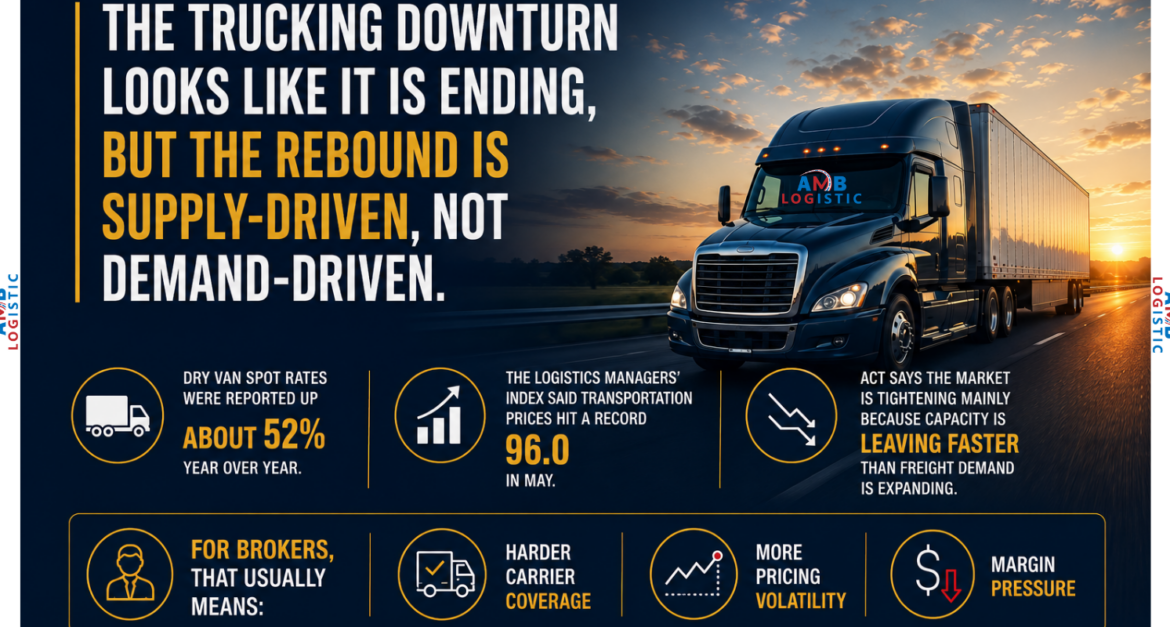
The Trucking Downturn Is Ending, But the Rebound Is Not Demand-Driven
The U.S. trucking market is showing signs that the long downturn may finally be ending. Dry van spot rates were reported up about 52% year over year, the Logistics Managers’ Index said transportation prices hit a record 96.0 in May, and ACT has pointed to a market tightening mainly because capacity is leaving faster than freight demand is expanding. For freight brokers, this is the key distinction. A supply-driven rebound does not behave like a broad freight-demand boom. It usually means harder carrier coverage, faster pricing volatility, tighter broker margins, and more pressure to educate shippers before the market moves against them.
Introduction
The trucking market is beginning to send a different signal. After a long downturn defined by soft spot rates, excess truck capacity, aggressive shipper pricing expectations, and compressed carrier margins, conditions are starting to shift. Rates are no longer behaving like the bottom of the cycle. Transportation pricing pressure is building. Available capacity is becoming more selective. The loose-truck environment that shaped much of the freight market over the past few years may be fading.
But this rebound needs to be read carefully. It is not simply a story of freight demand roaring back across the economy. It is not a clean demand-led expansion where shipment volumes are suddenly exploding across every lane, region, and customer segment. The more important story is on the supply side. Capacity is leaving the market faster than freight demand is expanding, and that is changing the operating environment for brokers, shippers, and carriers.
That distinction matters. A demand-driven boom and a supply-driven rebound may both produce higher rates, but they do not create the same operating conditions. In a demand-driven boom, shippers are pushing more freight into the system and competing aggressively for trucks. In a supply-driven rebound, there may not be a massive surge in freight, but there are fewer trucks available to move it. The result can still be higher rates, tighter coverage, and more volatility.
For freight brokers, this is where the market becomes more complex. A broker may not see a huge increase in load volume, but may still face harder carrier coverage. A shipper may not see a major increase in orders, but may still face higher transportation costs. A carrier may regain pricing leverage, but may remain cautious because costs are still high and freight consistency is still uneven.
This is not a market for old assumptions. It is a market for lane-level intelligence, disciplined pricing, strong carrier relationships, and clear customer communication.
Why This Matters
A supply-driven rebound matters because it can confuse the market. When demand is clearly booming, the pressure is easy to understand. More freight enters the system. Trucks become harder to find. Rates rise. Shippers can see the market getting busier.
A supply-driven rebound is different. Freight demand may only be stable or modestly improving, but the available carrier base may be shrinking underneath the market. Carriers exit. Owner-operators park equipment. Fleets reduce exposure. Marginal operators leave the system. Remaining carriers become more selective about which freight they accept.
That creates a situation where rates can rise even if shipment volumes are not dramatically higher. For shippers, this can feel frustrating. They may look at their own freight volume and ask why costs are increasing if they are not shipping much more than before. The answer is simple: freight rates are shaped by both demand and supply. If available truck capacity falls faster than freight demand grows, the market tightens.
For brokers, the issue is even more direct. A supply-driven rebound usually creates harder carrier coverage, more volatile buy rates, and tighter margins. The broker has to explain the market to shippers while also securing reliable trucks from a carrier base that may be more selective and more expensive than it was during the downturn.
That is why this market requires precision. Brokers cannot simply say, “Rates are going up.” They need to explain why rates are moving, where capacity is tightening, which lanes are exposed, and what shippers can do to avoid surprise costs and service failures.
The Broader Picture
The trucking market has been correcting from the excess capacity created during the pandemic-era freight boom. During that period, strong spot rates encouraged new operators to enter the market. New authorities were created. Equipment demand increased. Many carriers expanded because freight was plentiful and rates supported growth.
Then the market changed. Freight demand normalized. Retail inventories shifted. Consumer spending patterns changed. Industrial demand became uneven. Import cycles became less predictable. The market was left with too many trucks chasing freight that was no longer moving at boom-cycle levels.
That imbalance pushed rates down and created a long period of pressure for carriers. While linehaul rates softened, operating costs remained high. Insurance, equipment, maintenance, labor, compliance, financing, and fuel-related exposure continued to challenge fleets and owner-operators. Many carriers could not operate sustainably at the lower rate environment.
Over time, that pressure forced capacity out of the market. Some carriers closed. Some parked trucks. Some reduced operations. Some became more selective about the freight they would haul. That supply-side correction is now one of the main reasons the market appears to be tightening.
This is important because the recovery is not evenly distributed. Dry van may be strengthening in some areas. Flatbed may behave differently depending on construction, infrastructure, manufacturing, and project freight. Reefer may move according to produce cycles and food demand. Contract pricing may lag spot movement. Some lanes may tighten quickly while others remain manageable.
The national signal matters, but freight still moves lane by lane. That is why brokers and shippers should avoid broad assumptions. The question is not only whether the market is recovering. The real question is where the recovery is showing up, why it is happening, and how it changes execution.
What This Means for Freight Brokers and Logistics Teams
For freight brokers, a supply-driven rebound can be difficult because it pressures both sides of the business at the same time. On the shipper side, customers may still expect soft-market pricing because they do not see a major demand boom in their own freight. On the carrier side, buy rates may already be increasing because available capacity has tightened.
That gap creates margin pressure. If the broker quotes too low, the load may become difficult or unprofitable to cover. If the broker quotes too high without clear explanation, the customer may push back or move the freight elsewhere. The broker has to bridge that gap with market intelligence, carrier feedback, lane-level pricing, and strong communication.
Carrier coverage also becomes more difficult. When capacity exits the market, the remaining carriers have more options. They may avoid difficult facilities, poor appointment windows, slow-loading locations, weak payment terms, high dwell risk, or freight that does not fit their network. A carrier that accepted a marginal lane during the downturn may reject that same lane in a tightening market.
Pricing volatility is another challenge. During the soft market, brokers could often quote with more confidence because trucks were widely available. In a tightening market, buy rates can move quickly. A lane that looked manageable last week may become more expensive this week because capacity has shifted, a region has tightened, or carriers have repriced their expectations.
Logistics teams must also align internally. Sales, operations, carrier reps, account managers, and leadership cannot operate from different market assumptions. If the buy side is tightening while the sell side still quotes like the downturn is fully intact, margin compression becomes almost unavoidable.
This is where brokerage discipline matters. Winning freight at the wrong rate is not growth. It is risk. The strongest brokers will be those who help shippers understand market conditions early, protect carrier relationships, price realistically, and keep service quality intact.
The Freight Broker Playbook
1) Separate Supply Pressure From Demand Strength
The first responsibility for brokers is to explain the market correctly. Rising rates do not always mean freight demand is booming. Rates can rise because available capacity is shrinking, carrier costs remain elevated, certain regions are losing trucks, or remaining carriers are becoming more selective.
This matters in shipper conversations. If a shipper hears that rates are increasing but their own volume is stable, they may question the logic. Brokers need to explain that the capacity side of the market can tighten even when demand is not exploding.
A simple message works best: “Your freight volume may be stable, but fewer trucks are available at the rates we saw during the downturn. That is why coverage and pricing are changing.”
This type of explanation is practical, honest, and easier for customers to understand. It avoids panic while still communicating urgency.
2) Review Exposed Lanes Before They Fail
A supply-driven rebound can expose weak lane pricing quickly. Brokers should review recurring lanes, contract commitments, spot-heavy lanes, and freight priced during the softest part of the downturn. The goal is to identify where old pricing no longer matches current replacement cost.
Lanes with limited carrier density, poor backhaul options, strict appointment windows, long dwell, difficult pickup locations, or inconsistent volume should be reviewed first. These are often the lanes that reprice fastest when capacity tightens.
Brokers should also monitor the relationship between spot and contract rates. If spot rates continue moving higher, contract routing guides may begin to weaken. Carriers may reject freight that no longer pays enough compared with other available opportunities.
The best time to discuss pricing is before a load fails. Once freight is already uncovered, the conversation becomes reactive. Proactive lane reviews help protect the shipper, broker, and carrier network.
3) Strengthen Carrier Relationships Now
Carrier relationships become more valuable as capacity tightens. During a loose market, brokers can often rely on broad truck availability. During a tighter market, relationship quality can determine whether freight gets covered smoothly or becomes difficult.
Carriers remember which brokers communicate clearly, provide accurate load details, pay reliably, handle problems professionally, and respect their time. When carriers have more choices, those factors matter. A carrier may choose freight from a broker they trust over a load that appears slightly better on paper but carries more execution risk.
Brokers should know their core carriers by lane, region, equipment type, and service profile. They should understand which carriers handle appointment freight well, which carriers perform in difficult regions, which carriers communicate consistently, and which carriers are best suited for specific customer requirements.
A large carrier database is not the same as a strong capacity network. The value is not in how many carrier records exist. The value is in knowing which carriers can actually execute when the market gets tighter.
4) Quote With Replacement Cost In Mind
In a supply-driven rebound, brokers cannot quote from memory. The rate that worked during the downturn may not work today. The carrier that accepted a lane last quarter may not accept it now. The market that looked loose for months may shift faster than expected.
Replacement cost should become a central pricing discipline. Brokers need to ask what it will actually cost to cover the load today with a reliable carrier. That answer may be different from the historical average, the shipper’s target rate, or last month’s cost.
Pricing should account for lead time, pickup location, delivery window, dwell risk, lane balance, equipment availability, carrier selectivity, and service requirements. It should also preserve enough margin for the broker to support communication, visibility, exception management, and recovery if something goes wrong.
Low pricing that cannot secure reliable capacity is not a competitive advantage. It creates operational risk.
5) Push Shippers Toward Better Lead Time
Lead time becomes one of the simplest and most effective tools in a tightening market. When shippers provide freight details early, brokers have more time to source reliable carriers, compare options, and avoid last-minute premiums. When freight is tendered late, the broker has fewer choices and less leverage.
Better lead time can reduce volatility. It can improve carrier fit. It can help avoid service failures. It can also make the shipper’s freight more attractive because carriers can plan it into their network instead of reacting to a last-minute need.
Brokers should frame lead time as a cost-control and service-protection strategy. Earlier planning helps protect the shipper’s budget and improves execution quality.
In this market, planning is not administrative. Planning is leverage.
6) Watch Facility Performance Closely
Facility performance becomes more important when carriers have more choice. A shipper with slow loading, long wait times, poor communication, unclear pickup instructions, or difficult appointment processes may struggle to attract reliable capacity without paying more.
In a loose market, carriers may tolerate inefficient facilities because they need freight. In a tighter market, they can be more selective. That means dock behavior can directly affect freight cost and carrier coverage.
Brokers should help shippers understand this connection. Dwell time, detention risk, missed appointments, and poor documentation are not small issues. They shape carrier interest and pricing.
Freight strategy does not begin only when the truck is booked. It begins with how the freight is prepared, scheduled, loaded, documented, and communicated.
7) Protect Margin Without Damaging Trust
Margin protection will be one of the biggest brokerage challenges in a supply-driven rebound. If carrier buy rates rise faster than shipper sell rates, broker margin gets squeezed. This can happen quickly when the market turns.
The answer is not to surprise customers with unexplained increases. The answer is to communicate early, explain lane-level conditions, and show why old pricing may no longer support reliable service.
Brokers should also tighten internal quote discipline. Volatile lanes may need shorter quote expiration windows. Recurring lanes may need review cycles. Spot opportunities may require faster carrier feedback before commitments are made. Account teams should know when to escalate pricing concerns before margin damage occurs.
Protecting margin is not just about broker profitability. It is also about service quality. A broker with no margin has less room to solve problems, recover service, and maintain a reliable carrier network.
8) Communicate With Precision, Not Panic
A tightening market does not require dramatic messaging. It requires precise messaging. Telling a shipper that “everything is tight” is not useful if only certain lanes, regions, or equipment types are under pressure. Customers need specific guidance.
A better message is: “This lane is tightening because carrier availability has dropped. This pickup window is creating a premium. This region needs more lead time. This facility issue is affecting carrier interest. This contract rate may need review because replacement cost has moved.”
Precision builds trust. Panic damages it. The strongest brokers will be the ones who can translate market movement into practical shipper decisions.
What This Means for Shippers
For shippers, the biggest mistake is assuming the soft-market playbook will keep working. During the downturn, many shippers became used to aggressive pricing, easy spot coverage, and multiple carrier options. As capacity tightens, those assumptions may become less reliable.
Shippers do not need to panic, but they do need to plan better. They should review their most important lanes, understand where coverage is becoming harder, and identify where pricing may need to be refreshed.
Shippers should also look closely at their own operations. Facility performance matters more when carriers become selective. Clear freight details, realistic appointment windows, accurate pickup information, fast loading, and reasonable lead time can all make freight easier to cover.
The right broker becomes more important in this environment. Shippers need partners who can explain the market, protect service, understand carrier behavior, and help avoid surprise cost spikes.
What This Means for Carriers
For carriers, a supply-driven rebound can bring relief after years of pressure. If capacity has left the market and rates are strengthening, surviving carriers may regain pricing power and become more selective about the freight they accept.
But carriers still need discipline. Higher rates do not automatically make every load profitable. Carriers still need to evaluate lane fit, backhaul options, dwell risk, facility performance, broker reliability, and payment quality.
A disciplined carrier should use this environment to rebuild stability, not chase every short-term premium. Sustainable freight matters more than one-off wins. Strong relationships with reliable brokers and shippers can support better utilization, more predictable operations, and healthier margins.
AMB Logistic’s Role
At AMB Logistic, we understand that a changing freight market requires more than quick quoting. It requires interpretation, planning, communication, and execution discipline. The trucking downturn may be ending, but the rebound is not simple. It is supply-driven, uneven, and sensitive to lane-level conditions.
Our role is to help customers move through this environment with clarity, control, and confidence. That means helping shippers understand why rates may be changing, where capacity may be tightening, and how to plan freight before volatility creates service or budget pressure.
AMB Logistic focuses on practical freight execution. We work to match freight with reliable carrier capacity, communicate market realities clearly, and support customers with planning that reflects current conditions rather than outdated assumptions.
- We help customers understand lane-level market pressure.
- We support realistic pricing conversations before coverage becomes difficult.
- We focus on reliable carrier sourcing and relationship-based execution.
- We help shippers improve planning, lead time, and communication.
- We prioritize freight movement built around clarity, control, and confidence.
In a supply-driven rebound, the value of a freight broker is not measured only by the lowest rate. It is measured by the ability to secure capacity, protect service, communicate clearly, and help the customer make better logistics decisions before the market forces them to react.
FAQ
Is the trucking downturn really ending?
The market is showing signs that the long downturn is easing. Rates are strengthening, transportation pricing pressure is rising, and available capacity appears to be tightening. However, the recovery is uneven and should not be mistaken for a broad freight boom across every lane or segment.
What does supply-driven rebound mean?
A supply-driven rebound means the market is tightening mainly because trucking capacity is leaving faster than freight demand is growing. In simple terms, fewer available trucks can push rates higher even if shipment volumes are not surging.
Why can rates rise without a demand boom?
Freight rates are shaped by both demand and capacity. If the number of available trucks decreases, the market can tighten even when freight volume is only stable or modestly stronger. That creates upward pressure on rates because capacity becomes harder to secure.
Why does this create pressure for freight brokers?
Brokers may face higher carrier buy rates while shippers still expect soft-market pricing. That creates margin pressure. Brokers also have to work harder to cover freight, educate customers, and price lanes accurately as the market becomes more volatile.
What should shippers do in this market?
Shippers should improve lead time, review exposed lanes, provide accurate freight details, address facility delays, and work with brokers who can explain market changes clearly. Better planning can help reduce service risk and cost volatility.
Will contract rates increase next?
Contract rates often follow spot-market changes with a delay. If spot rates continue rising and capacity becomes more selective, contract pricing may face pressure during bids, mini-bids, renewals, and routing-guide reviews.
Does this mean all freight markets are tight?
No. Freight markets move by lane, region, equipment type, commodity, seasonality, and carrier network balance. Some lanes may tighten quickly while others remain manageable. That is why lane-level analysis is essential.
What is the biggest broker risk right now?
The biggest risk is pricing freight based on old soft-market assumptions while carrier costs are already moving higher. That can lead to margin compression, service failures, and reactive customer conversations.
Final Word From AMB Logistic
The trucking downturn may be ending, but the market is not returning in a simple, demand-led way. The rebound is being shaped by capacity leaving the system faster than freight demand is expanding. That is why rates can rise, coverage can get harder, and broker margins can tighten even without a broad freight boom.
For brokers, this is a market that rewards discipline. The strongest brokers will not rely on old pricing memories or broad national assumptions. They will read the market lane by lane, protect carrier relationships, educate shippers, and price freight based on current replacement cost.
For shippers, this is a reminder that capacity should not be treated as unlimited. Better lead time, clearer communication, stronger facility performance, and realistic pricing conversations will matter more as the market tightens.
For carriers, the improving market may offer relief, but disciplined network decisions still matter. Higher rates are only valuable when they support sustainable operations.
A supply-driven rebound is still a rebound. But it is not a green light for careless strategy. It is a signal that freight planning needs to become sharper, pricing needs to become more realistic, and logistics partnerships need to become more operationally grounded.
In the next freight cycle, success will belong to companies that understand the difference between demand growth and capacity tightening. The market is changing. The right response is not panic. It is precision.
Talk To AMB Logistic Today
If your business needs truckload, LTL, or freight brokerage support in a changing market, AMB Logistic can help you move with clarity, control, and confidence.
Web: amblogistic.us
Phone: +1 (888) 538-6433
Email: info@amblogistic.us
Tags
trucking downturn, trucking market recovery, freight brokerage, supply-driven rebound, dry van spot rates, truckload rates, carrier capacity, freight brokers, U.S. logistics, transportation prices, Logistics Managers Index, ACT Research, spot market volatility, broker margin pressure, shipper strategy, AMB Logistic