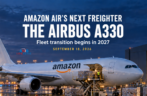
Amazon is preparing for an important fleet transition as the Airbus A330 emerges as the next major freighter platform supporting its air-cargo network. The first converted A330 aircraft are expected to begin operating for Amazon during the first quarter of 2027.
The initial commitment covers four aircraft, but the significance extends beyond fleet size. Amazon’s decision reflects a broader challenge facing the air-cargo industry: the supply of Boeing 767 passenger aircraft suitable for freighter conversion is becoming increasingly limited.
For freight brokers and logistics providers, this is not simply an aviation story. Changes in aircraft capacity, gateway activity and flight scheduling can directly affect airport recovery, ground transportation, warehouse operations and time-critical truck demand.
Introduction
Amazon has built one of the largest private air-cargo networks in the United States, connecting fulfillment centers, regional gateways and final-mile distribution facilities across the country.
The Boeing 767 has been one of the network’s most important aircraft. However, as suitable 767 conversion candidates become harder to secure, Amazon and its operating partners must prepare for the next generation of freighter capacity.
ABX Air, a subsidiary of Air Transport Services Group, is preparing to operate converted Airbus A330 freighters for Amazon beginning in the first quarter of 2027. Amazon has committed to multiyear operating leases for four A330 aircraft.
What Is Changing?
The planned introduction of the A330 establishes a new aircraft type within Amazon’s air network. The transition will require coordination across multiple operational areas, including:
- Pilot training and aircraft certification
- Maintenance programs and spare-parts inventories
- Ground-handling procedures
- Cargo-loading equipment
- Airport parking and ramp planning
- Flight scheduling and route assignment
- Coordination with supporting ground carriers
The first four aircraft will give Amazon and its operating partners an opportunity to evaluate how the A330 performs within the company’s existing logistics network.
Key Facts Behind the Transition
- Q1 2027: Expected beginning of A330 operations for Amazon
- Four aircraft: Initial A330 commitment under multiyear operating leases
- More than 100 aircraft: Approximate size of Amazon’s broader air network
- 56 aircraft: Amazon freighters reportedly operated by ATSG companies
- ABX Air: The ATSG subsidiary preparing to operate the converted A330 freighters
Why Boeing 767 Availability Matters
The Boeing 767 has served as a dependable platform for cargo operators because of its range, payload capacity and established conversion programs. It has supported express-delivery networks, e-commerce operations and scheduled cargo services for years.
However, cargo conversions depend on passenger aircraft becoming available at the right age, condition and price. As the pool of suitable 767 aircraft declines, conversion companies and cargo operators must identify another platform capable of supporting future demand.
The issue is not necessarily that the 767 has suddenly become unsuitable. The larger challenge is maintaining access to enough aircraft to support long-term fleet replacement and network growth.
Why the Airbus A330 Is Emerging as the Alternative
The Airbus A330 provides a larger and newer wide-body platform with a broader potential supply of passenger aircraft available for future conversion.
Its introduction could help Amazon establish a more sustainable replacement strategy as older freighters approach retirement and suitable 767 feedstock becomes more difficult to find.
The A330 also offers different payload and cargo-volume characteristics. Those differences could influence how Amazon assigns aircraft to specific lanes, how individual flights are loaded and how much freight arrives at regional gateways during each operating window.
Why This Matters to U.S. Logistics
Aircraft changes can create operational effects throughout the wider supply chain. When a larger aircraft arrives at an airport, the impact can extend to every provider responsible for moving freight away from that gateway.
Potential ground-level effects include:
- Higher cargo volumes arriving within shorter recovery windows
- Additional airport pickup and drayage requirements
- Greater demand for time-sensitive truck capacity
- Increased cross-dock and warehouse activity
- More trailers staged near major air-cargo gateways
- Changes to fulfillment-center appointment schedules
- Additional contingency demand during flight disruptions
For logistics providers, the important question is not only how much freight the aircraft can carry. It is also how quickly that freight must be recovered, transferred and delivered once the aircraft reaches the airport.
What Freight Brokers Should Watch
Gateway selection: Brokers should monitor which airports receive the first A330 flights. Concentrated activity at specific gateways could create localized demand for trucks, drivers and warehouse capacity.
Flight schedules: New arrival and departure schedules can change the timing of airport pickups. Brokers may need to secure capacity during overnight, early-morning or weekend operating windows.
Recovery requirements: Air freight often operates under strict recovery deadlines. Delays at the airport can quickly affect warehouse appointments and final delivery commitments.
Equipment demand: Depending on the cargo and destination, supporting transportation may require dry vans, straight trucks, team drivers or expedited services.
Contingency freight: Weather, mechanical problems and flight cancellations can shift urgent cargo from air to ground transportation with very little notice.
Regional distribution changes: Aircraft capacity can influence which gateways handle specific lanes and how freight moves between airports, fulfillment centers and sortation facilities.
The Freight Broker Playbook
Freight brokers serving air-cargo gateways should prepare before the A330 transition begins. A practical operating plan should include:
- Map the gateways: Identify airports, cargo facilities and nearby fulfillment centers that could support the new aircraft.
- Build local capacity: Establish relationships with dependable carriers operating near major air-cargo hubs.
- Verify every pickup: Confirm the driver, tractor, trailer, pickup number and authorized contact channel before releasing freight.
- Prepare backup coverage: Maintain secondary carriers for flight delays, rejected pickups and sudden recovery demand.
- Monitor operating windows: Track airport hours, warehouse schedules, cutoff times and detention exposure.
- Price time-sensitive freight correctly: Include waiting time, airport access, after-hours requirements and recovery risk.
- Communicate early: Alert customers immediately when flight disruptions could affect ground transportation.
The Broader Air-Cargo Picture
Amazon’s planned transition reflects a wider industry shift. Cargo operators worldwide must decide how to replace aging freighters while managing conversion availability, operating costs and long-term network requirements.
The A330 is increasingly being positioned as a future wide-body freighter platform. If Amazon’s initial aircraft perform successfully, the company could expand its use of the aircraft over time.
That would create consequences beyond Amazon. A successful transition could influence aircraft lessors, cargo-conversion providers, contract operators and competing logistics networks evaluating their own fleet strategies.
What This Means for Shippers
For shippers, newer aircraft capacity could support greater network flexibility and more stable long-term air-cargo operations. However, aircraft capacity alone does not guarantee a successful shipment.
The complete transportation chain still depends on accurate scheduling, secure airport recovery, dependable trucking capacity and effective communication between every participating provider.
A shipment can move successfully through the air and still encounter delays if the ground carrier is not prepared when the aircraft arrives.
AMB Logistic’s Role
AMB Logistic helps businesses coordinate the ground transportation surrounding time-sensitive and complex freight movements.
Our logistics approach focuses on:
- Dependable carrier coverage
- Accurate pickup coordination
- Active shipment communication
- Responsive contingency planning
- Time-sensitive freight management
- Secure carrier and equipment verification
- Practical transportation solutions across the United States
As air-cargo networks evolve, customers need logistics partners capable of responding to changing schedules, gateway pressure and urgent transportation requirements.
Frequently Asked Questions
When will Amazon’s Airbus A330 freighters begin operating?
The first converted A330 freighters are expected to begin operating for Amazon during the first quarter of 2027.
How many A330 freighters has Amazon initially committed to?
Amazon has reportedly committed to multiyear operating leases for four converted Airbus A330 freighters.
Who is expected to operate the aircraft?
ABX Air, a subsidiary of Air Transport Services Group, is preparing to operate the aircraft for Amazon.
Will the A330 immediately replace Amazon’s entire Boeing 767 fleet?
No. The initial four-aircraft commitment represents the beginning of a transition rather than an immediate replacement of the complete 767 fleet.
Why is Amazon moving toward the A330?
The availability of suitable Boeing 767 aircraft for freighter conversion is declining. The A330 offers a newer platform with a potentially broader future supply.
Why should freight brokers pay attention?
Changes in aircraft capacity and gateway activity can influence airport recovery, trucking demand, warehouse schedules, equipment requirements and expedited freight opportunities.
Final Word From AMB Logistic
Amazon’s move toward the Airbus A330 is an early signal of how major logistics networks are preparing for the next generation of air-cargo operations.
The transition may begin with four aircraft, but its impact could reach far beyond the airport. Every additional flight affects cargo handlers, warehouses, truck capacity, delivery schedules and the brokers responsible for connecting those operations.
For freight brokers, the opportunity belongs to those who prepare before capacity shifts occur. Monitor the gateways, build dependable carrier relationships and remain ready for the ground transportation requirements created by changes in the air.
Talk To AMB Logistic Today
Need dependable transportation coverage for your next shipment? Connect with AMB Logistic for responsive freight support and practical logistics solutions.
Call: +1 (888) 538-6433
Email: info@amblogistic.us
Web: www.amblogistic.us
Tags: Amazon Air, Airbus A330, Air Cargo, Freight Brokerage, Airport Logistics, Expedited Freight, Cargo Aircraft, U.S. Logistics, Supply Chain, AMB Logistic