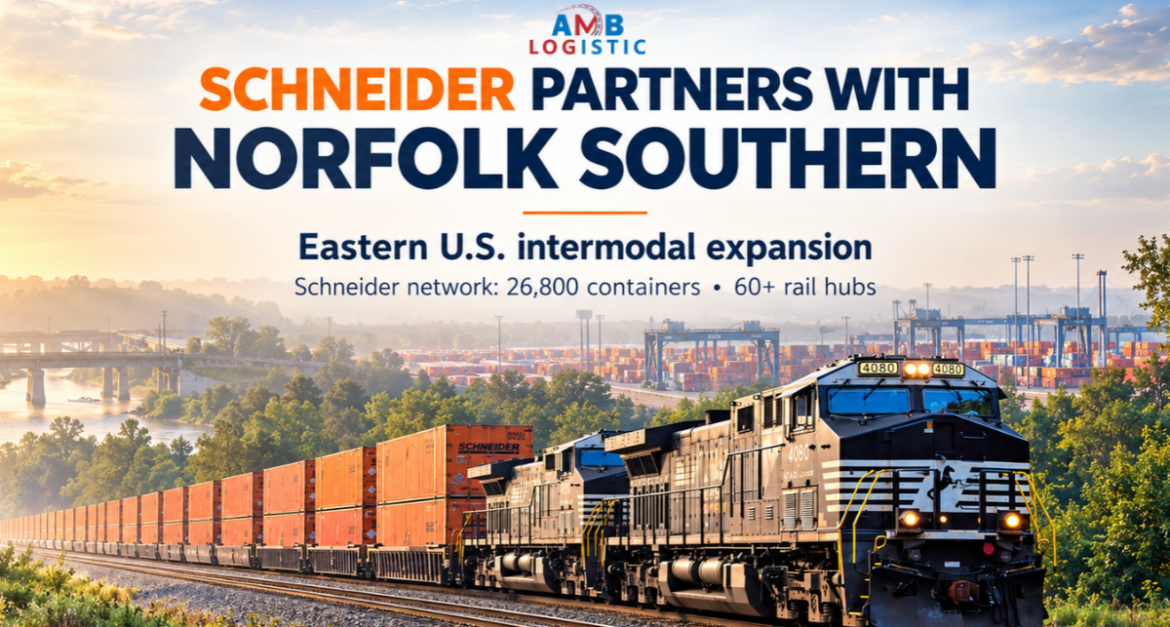
Schneider Selects Norfolk Southern for Eastern U.S. Intermodal Expansion
Schneider is changing its primary eastern rail provider from CSX to Norfolk Southern, creating a new development for businesses evaluating domestic intermodal transportation.
Announced on October 29, 2026, the strategic agreement combines Schneider’s company-owned equipment, drayage operations, and logistics capabilities with Norfolk Southern’s eastern U.S. rail network and infrastructure investments.
For freight brokers and shippers, the practical significance will depend on how the partnership translates into available lanes, terminal connections, equipment access, and dependable door-to-door service.
What the Partnership Is Intended to Change
The companies describe the agreement as a way to broaden market access, increase network flexibility, and support the conversion of suitable truckload shipments to intermodal service.
That creates an opportunity to review transportation options on relevant eastern U.S. lanes. However, a network announcement is the starting point for that assessment. Customers still need to establish which services are available for their specific origins, destinations, and shipping schedules.
The companies have not quantified the additional capacity expected from the partnership or guaranteed shipment-level cost savings.
The Existing Network Behind the Announcement
Schneider brings an established intermodal operation to the partnership, including:
- Approximately 26,800 containers.
- Approximately 23,900 chassis.
- More than 60 intermodal rail hubs across North America.
- Company drayage drivers who complete more than 90% of Schneider’s domestic drayage moves.
These figures describe Schneider’s existing operation. They provide context for the scale of the partnership and should not be interpreted as newly added equipment or newly opened locations.
Norfolk Southern contributes a 22-state intermodal network. Its announced infrastructure work includes Cincinnati–Atlanta service, double-stack clearance improvements connecting the Midwest and New England through the East Edge route, and terminal expansions in Ohio, Michigan, North Carolina, and Illinois.
Why the Truck-to-Rail Connection Matters
A domestic intermodal shipment typically combines truck transportation at each end with a rail movement between terminals. The customer’s delivery requirement must be supported across that complete journey.
For a typical terminal-based movement, planning needs to account for origin pickup, the rail terminal’s receiving cutoff, the scheduled rail movement, destination availability, and final delivery.
Each connection affects the next. A pickup that misses its intended terminal cutoff can change the shipment’s onward schedule. A container becoming available at the destination does not, by itself, confirm that final delivery has been arranged.
This makes the coordination between equipment, facilities, rail schedules, and drayage particularly important. Brokers and shippers should evaluate the complete service plan when comparing an intermodal option with an over-the-road movement.
Which Shipments Deserve a Fresh Lane Review?
A partnership of this kind gives transportation teams a reason to revisit suitable freight flows.
Consider a hypothetical manufacturer sending consistent replenishment loads between the same two facilities each week. If the available terminals, equipment, and service schedule align with those movements, an intermodal option could be worth evaluating.
A shipment with changing destinations, multiple delivery stops, or an unusually narrow delivery window would require a different assessment.
The relevant decision starts with the customer’s operating requirements. Commodity eligibility, cargo handling, shipment frequency, facility access, and delivery flexibility all belong in that discussion.
A useful lane review should identify where an additional transportation option could fit and where the existing service arrangement remains better aligned with the freight.
What Freight Brokers Should Confirm Before Quoting
Before incorporating a service into a customer proposal, brokers should establish the details that determine whether the movement is executable:
- Terminal connections: Confirm the actual origin and destination terminal pair serving the shipment.
- Drayage coverage: Verify pickup and delivery availability at the customer’s facilities, including appointment requirements and operating hours.
- Equipment suitability: Check container and chassis availability, cargo eligibility, loading requirements, and applicable weight restrictions.
- Transit planning: Review terminal cutoffs, departure schedules, destination availability, and the final delivery arrangement.
- Complete pricing: Understand the quoted transportation service and any applicable drayage, storage, waiting-time, or other accessorial charges.
- Exception handling: Establish who communicates delays, manages missed connections, and coordinates any required recovery movement.
These checks help turn a broad network announcement into a clear service proposal. They also give the customer a consistent basis for comparing transportation options.
Shippers Should Evaluate the Complete Delivery Requirement
A transportation option may appear suitable when viewed only as a movement between two terminals. The customer’s receiving operation may introduce additional requirements.
A retailer may need freight available before a distribution-center replenishment cycle. A manufacturer may need components delivered within an established production window. A warehouse may have limited receiving hours or specific unloading procedures.
Those requirements should be shared at the beginning of the planning process. They influence the assessment of transit schedules, appointments, equipment, and contingency arrangements.
The most useful comparison is the complete shipment plan: how the freight leaves the origin, moves through the network, and reaches the receiving facility under the agreed conditions.
What to Watch as the Transition Develops
The next operational details will help determine how relevant the partnership becomes to individual freight networks.
Confirmed terminal connections, available schedules, equipment access, and customer transition arrangements will be particularly useful. These details can show where the partnership overlaps with existing shipping requirements and where a new option deserves closer consideration.
Transportation teams can prepare by identifying potentially relevant lanes and assembling the shipment information needed for a service review.
That approach supports an informed response as additional operating details become available, while keeping customer commitments grounded in confirmed service capabilities.
What This Means for Freight Planning
Schneider’s selection of Norfolk Southern introduces a meaningful network change for eastern U.S. intermodal transportation.
Its value to an individual customer will depend on the fit between the available service and the shipment’s requirements. Equipment suitability, terminal access, pickup coordination, visibility, and final delivery all remain central to that decision.
For brokers and shippers, the immediate opportunity is to review relevant freight flows, follow confirmed service information, and evaluate the complete transportation arrangement before making a commitment.
Discuss Your Freight Requirements With AMB Logistic
A clear freight plan starts with understanding the shipment, the facilities involved, and the delivery obligation.
Contact AMB Logistic to discuss your upcoming freight, equipment needs, lane priorities, and shipping schedules. Share the details of your operation so the conversation can focus on transportation options that match your business requirements.
AMB Logistic
Website: www.amblogistic.us
Email: info@amblogistic.us
Phone: +1 (888) 538-6433
Tags
Schneider, Norfolk Southern, Intermodal Transportation, U.S. Freight, Freight Brokerage, Eastern U.S. Logistics, Rail Freight, Drayage, Truckload Transportation, Freight Capacity, Supply Chain Planning, AMB Logistic