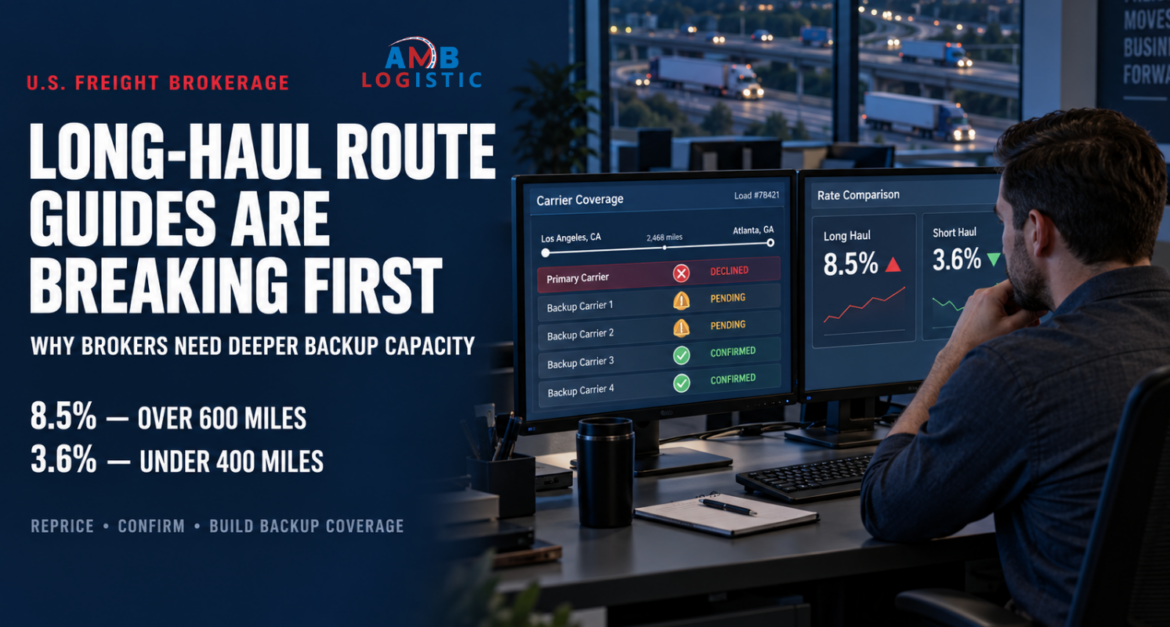
Long-Haul Route Guides Are Breaking First
Long-haul freight is exposing a growing weakness in carrier coverage. In August 2026, U.S. shipments traveling more than 600 miles recorded an average weekly route-guide failure rate of 8.5%, compared with 3.6% for shipments moving less than 400 miles. For freight brokers, this gap makes deeper backup capacity, earlier confirmation and lane-specific pricing increasingly important.
The Long-Haul Coverage Gap
A route guide identifies the preferred carriers assigned to a shipment or lane. When the primary carrier rejects the load, the tender moves to the next available option. A route-guide failure occurs when every preferred option is exhausted and the shipment must be covered through the spot market.
Long-haul shipments are currently more than twice as likely to exhaust their preferred carrier options as shorter shipments. This does not mean every long-distance load will become difficult to cover. It does mean brokers face a greater possibility of late carrier rejection, higher replacement costs and reduced control over service.
- Shipments over 600 miles: 8.5% average weekly route-guide failure rate.
- Shipments under 400 miles: 3.6% average weekly route-guide failure rate.
- Average route-guide depth: 1.35 carrier options across North America.
Why Long-Haul Freight Is More Vulnerable
Long-haul loads require carriers to commit equipment, drivers and operating hours across several markets. A carrier may accept the outbound movement but struggle to find a profitable return load. Fuel exposure, driver availability, appointment requirements and regional capacity imbalances can also make longer lanes less attractive.
These pressures give carriers more reasons to reject or reprice a shipment. When a broker relies on only one preferred carrier and one backup option, a small change in capacity can quickly force the load into the spot market.
What Route-Guide Failure Means for Freight Brokers
Route-guide failure creates more than a coverage problem. It can affect the entire economics of a shipment.
- Replacement capacity may cost more than the original carrier rate.
- Spot-market searches can reduce the broker’s available response time.
- Late coverage can place pickup appointments and delivery commitments at risk.
- Carrier changes may require additional verification and documentation.
- Unexpected buy-rate increases can reduce or eliminate the planned margin.
The risk is especially significant when a broker provides a customer rate before confirming the depth of available capacity. If the preferred carrier rejects the tender later, the broker may have to absorb the difference between the quoted rate and the replacement carrier’s price.
The Market Has Improved, but the Risk Remains
Overall route-guide failures improved after reaching approximately 7.5% around the Fourth of July period. However, failure levels remain elevated compared with previous years, and long-haul lanes continue to experience greater coverage pressure than short-haul freight.
This creates a market in which national averages may appear stable while specific lanes remain difficult. Brokers should therefore evaluate capacity at the lane level instead of relying only on broad market conditions.
Why One Backup Carrier Is No Longer Enough
An average route-guide depth of 1.35 indicates that many loads do not have a substantial bench of alternative carriers. If the first carrier declines, the remaining options may be limited or nonexistent.
For priority long-haul lanes, brokers should develop multiple qualified carrier options before the load becomes urgent. Backup capacity should include carriers that understand the lane, meet the equipment requirements and can consistently satisfy pickup and delivery expectations.
A Five-Step Long-Haul Coverage Playbook
1. Identify vulnerable lanes.
Review rejection history, replacement costs, lead times and service failures by origin, destination and mileage band. Give special attention to lanes exceeding 600 miles.
2. Build deeper carrier coverage.
Maintain several qualified options for critical long-haul lanes. Record each carrier’s preferred regions, equipment types, operating days and rate expectations.
3. Confirm capacity earlier.
Do not treat a previous acceptance as confirmation for the next shipment. Reconfirm the truck, driver, equipment and pickup schedule before the load becomes time-sensitive.
4. Shorten quote validity.
Long quote-validity periods expose brokers to changing capacity and carrier pricing. Use shorter validity windows when lane conditions are uncertain, and clearly state when rates require reconfirmation.
5. Prepare a recovery plan.
Determine which carriers will be contacted if the primary option rejects the load. Establish the maximum acceptable replacement rate and define when the customer must be informed.
Price Long-Haul Freight for Coverage Risk
Long-haul pricing should reflect more than mileage. Brokers should evaluate the probability of carrier rejection, the availability of replacement trucks and the likely cost of emergency coverage.
A lane with limited carrier depth may require a wider pricing buffer than a shorter, balanced lane with several dependable options. Brokers should also avoid extending fixed rates for long periods without confirming whether the underlying carrier market has changed.
Confirm Capacity Before the Pickup Window Tightens
Early confirmation gives brokers time to solve problems before they affect the customer. A practical process should verify:
- The carrier remains committed to the load.
- The assigned driver is available and properly identified.
- The tractor and trailer meet the shipment requirements.
- The pickup and delivery appointments are understood.
- The carrier can meet the expected transit time.
- A qualified backup carrier is available if the primary option fails.
Metrics Every Freight Brokerage Should Track
Freight brokers can improve long-haul planning by monitoring a focused set of operational metrics.
- Route-guide failure rate by mileage band.
- Primary carrier acceptance rate by lane.
- Average number of qualified backup carriers per lane.
- Difference between quoted buy rate and final carrier cost.
- Time required to recover a rejected tender.
- Percentage of loads confirmed before the pickup date.
- On-time pickup and delivery performance by carrier.
These measurements help brokers identify where their carrier network is dependable and where additional coverage is required.
Frequently Asked Questions
What is a route-guide failure?
A route-guide failure occurs when the preferred carriers assigned to a shipment reject or cannot cover the load, forcing the broker or shipper to search for capacity outside the established guide.
Why are long-haul loads experiencing higher failure rates?
Long-haul shipments require greater commitments involving equipment, driver hours, fuel and return-load planning. These variables can make carriers more selective about accepting longer lanes.
Does a higher failure rate mean capacity is unavailable?
No. Capacity may still be available, but the broker may need to search beyond the preferred carrier list, pay a different rate or accept less scheduling flexibility.
How many backup carriers should a broker maintain?
The appropriate number depends on the lane and shipment requirements. Priority long-haul lanes should have multiple qualified alternatives instead of relying on a single backup carrier.
How can brokers protect their margins?
Brokers can protect margins by confirming capacity earlier, shortening quote-validity periods, monitoring replacement costs and including lane-specific coverage risk in customer pricing.
Final Word
Long-haul route-guide failures show that freight coverage cannot be judged only by national averages. A market may look balanced overall while individual lanes have limited carrier depth and significant replacement risk.
Freight brokers that build deeper backup capacity, confirm carriers earlier and price each lane according to its coverage risk will be better prepared to protect service, control costs and preserve margins.
Talk to AMB Logistic
Need dependable freight brokerage support for your long-haul shipments? AMB Logistic helps businesses secure qualified capacity, coordinate pickups and maintain shipment visibility across the United States.
Call: +1 (888) 538-6433
Email: info@amblogistic.us
Web: www.amblogistic.us
Tags
Freight Brokerage, Long-Haul Freight, Carrier Capacity, Route-Guide Failure, Freight Rates, Spot Market, Carrier Management, Load Coverage, Transportation Management, AMB Logistic