Global Chokepoint Disruption Hits Inland Freight: Why Brokers Need Contingency Planning Before Cargo Reaches The U.S.
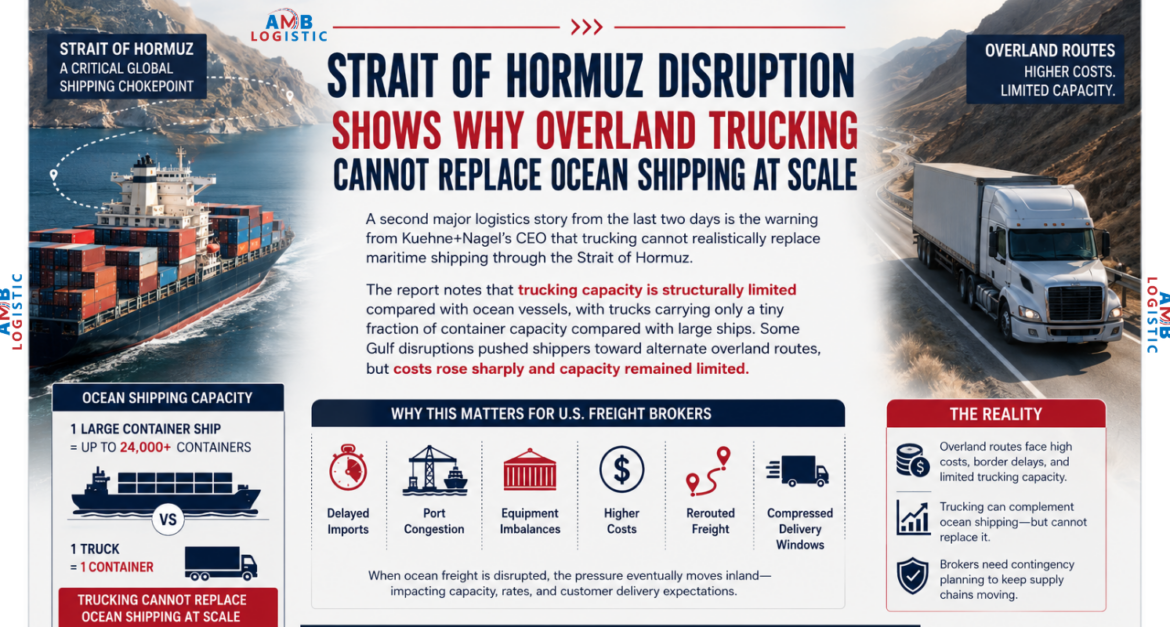
Recent disruption around the Strait of Hormuz has made one point clear: overland trucking cannot replace ocean shipping at scale. When maritime chokepoints are threatened, shippers may look for alternate routes, but road transport has limited capacity, higher cost, and major execution constraints compared with container vessels. For U.S. freight brokers and shippers, the impact may not begin at the port. It often shows up later through delayed imports, port congestion, equipment imbalances, compressed delivery windows, higher inland costs, warehouse timing problems, and spot-market pressure. This is why brokers need contingency planning before global disruption reaches the domestic freight network.
Introduction
Freight disruption does not always start inside the United States. Sometimes it begins thousands of miles away, at a maritime chokepoint that most domestic shippers rarely think about until their containers are late, their warehouse appointments are missed, and their inland freight plan starts falling apart.
The Strait of Hormuz is one of those chokepoints. When tension or disruption affects vessel movement through a critical shipping lane, the first impact may be felt by ocean carriers, freight forwarders, energy markets, importers, exporters, and port operators. But the pressure does not stop there. Eventually, the disruption moves inland.
Recent warnings from global logistics leaders have reinforced a basic reality: trucking cannot simply replace maritime shipping at scale. A large container vessel can carry thousands of containers. A truck can move only a tiny fraction of that volume. Even when overland alternatives are available, they are usually more expensive, capacity-limited, and difficult to scale quickly.
For freight brokers, this matters because global disruption eventually becomes a domestic execution problem. A delayed container may create a last-minute truckload need. A missed vessel arrival may disrupt warehouse labor planning. A port backlog may compress delivery windows. A rerouted shipment may create equipment imbalances. A customer that expected normal inbound flow may suddenly need expedited, transload, drayage, or short-notice capacity.
The lesson is clear: brokers cannot wait until cargo reaches the U.S. port to begin planning. In a volatile global freight environment, contingency planning must start earlier.
Why This Matters
Global chokepoint disruption matters to U.S. freight brokers because ocean delays rarely stay on the water. They create timing problems across the entire supply chain.
When a vessel is delayed, the receiving warehouse may not have the right labor scheduled. When a container arrives later than expected, the shipper may need fast drayage or transloading to recover time. When cargo is rerouted, the inland delivery plan may need to change. When equipment is stuck in the wrong region, truck and chassis availability can tighten. When multiple delayed containers arrive at once, warehouse and carrier networks can become overloaded.
This is where the freight broker’s role becomes more strategic. The broker is no longer only responding to a load request. The broker is helping the customer manage risk before freight becomes urgent.
The Strait of Hormuz situation also shows the limits of simple modal substitution. Shippers sometimes assume that if ocean freight is disrupted, trucking or rail can fill the gap. In reality, alternate routes may help specific shipments, but they usually cannot absorb the full volume of maritime trade. Capacity is limited, costs rise quickly, and transit reliability can become uncertain.
For brokers, the takeaway is important: when global routes are disrupted, customers need honest planning, not false confidence. The right answer may include earlier booking, alternate port planning, transload options, warehouse flexibility, drayage readiness, intermodal evaluation, or staged delivery. But it must be based on realistic capacity.
Shippers that wait until disruption becomes visible in the domestic market may face fewer options and higher costs. Brokers that monitor global risk early can help customers protect service before the pressure reaches inland freight.
The Broader Picture
Maritime chokepoints are critical because global trade depends on predictable routing. When a chokepoint is restricted, threatened, or congested, freight does not simply disappear. It reroutes, waits, stacks up, or moves through more expensive alternatives.
That creates a chain reaction. Ocean carriers may adjust schedules. Ports may see uneven arrivals. Importers may face longer lead times. Exporters may struggle with equipment availability. Warehouses may receive freight in unpredictable waves. Domestic transportation networks may see sudden demand spikes after a period of delay.
The problem is not only the initial disruption. The second-order effects can be just as important. If a vessel arrives late, the container may still need to be unloaded, cleared, drayed, transloaded, stored, sorted, and delivered. Each step depends on available labor, equipment, appointments, carrier capacity, and communication.
This is why global disruption often becomes a domestic logistics problem. A shipper may not control the maritime chokepoint, but they still have to manage customer commitments, retail replenishment, production schedules, inventory levels, and final delivery.
Freight brokers sit in the middle of that pressure. They may be asked to find trucks at the last minute, rescue delayed freight, arrange short-term storage, coordinate transload moves, cover urgent inland delivery, or explain why rates have moved suddenly.
The broader lesson is that freight markets are connected. Ocean disruption can affect port operations. Port disruption can affect drayage. Drayage disruption can affect warehouses. Warehouse disruption can affect truckload and LTL. Truckload disruption can affect customer delivery.
In a market like this, the strongest logistics partners are not the ones that react the fastest after the problem arrives. They are the ones that help customers prepare before it lands.
What This Means For Freight Brokers
For freight brokers, global chokepoint disruption should be treated as an early warning signal. Even if the disruption is overseas, the broker should ask which customers may be exposed, which inbound lanes may be affected, which ports may see congestion, and which domestic markets may experience delayed volume.
The first impact is planning. Brokers should talk to customers about inbound freight earlier. Which shipments are ocean-dependent? Which containers are tied to strict delivery windows? Which customers have low inventory buffers? Which freight needs to move immediately after arrival?
The second impact is capacity readiness. If containers arrive late and in clusters, customers may need more trucks over a shorter period. Brokers should identify carrier partners, drayage providers, transload options, warehouse support, and backup routing before the freight arrives.
The third impact is cost communication. Disruption can increase cost even if the shipment is not directly delayed. Storage, demurrage, detention, transload charges, expedited trucking, spot-market premiums, chassis constraints, and warehouse overtime can all affect total landed cost.
The fourth impact is visibility. Customers need accurate status updates and clear risk communication. Brokers should not wait for a crisis call. They should help customers understand where delays may appear and what options exist.
The fifth impact is execution discipline. When delayed freight finally becomes available, speed matters. But speed without coordination creates mistakes. Pickup appointments, container availability, warehouse receiving hours, carrier instructions, delivery windows, and documentation must be controlled.
In this environment, freight brokerage becomes less about quoting a single load and more about protecting the supply chain from timing shocks.
The Freight Broker Playbook
1) Monitor Global Disruption Before It Becomes A Domestic Problem
Brokers should not wait until a customer asks for emergency capacity. Maritime disruption provides early warning signals. If a major chokepoint is under pressure, brokers should assume inland consequences may follow.
That does not mean every shipment will be affected. It means brokers should identify which customers, commodities, ports, and lanes are most exposed.
The earlier the broker understands the risk, the more options the customer has.
2) Identify Ocean-Dependent Customers And Critical SKUs
Not every customer has the same exposure. Some shippers rely heavily on imported inventory, seasonal merchandise, manufacturing components, retail replenishment, or project cargo. Others may have more domestic sourcing or inventory buffer.
Brokers should ask customers which shipments are critical. Which containers are tied to production? Which goods are needed for customer launches? Which items cannot miss a retail window? Which freight will trigger downstream delays if it arrives late?
Critical freight deserves earlier planning and tighter monitoring.
3) Build Backup Plans For Drayage And Transload
When containers arrive after disruption, drayage and transload operations can become pressure points. If many delayed containers arrive together, available trucks, chassis, warehouse labor, and appointment slots may tighten quickly.
Brokers should prepare backup drayage providers, transload warehouses, cross-dock options, and short-term storage solutions before the customer needs them.
A strong backup plan can turn a late container into a controlled recovery instead of a service failure.
4) Communicate Realistic Capacity Limits
One of the most important lessons from chokepoint disruption is that alternate modes cannot always replace ocean freight at scale. Trucks can help in specific situations, but they cannot absorb the volume of large container vessels across major trade lanes.
Brokers should be honest with customers about what is realistic. Overpromising capacity can damage trust and create bigger problems later.
The best brokers provide clear options, practical tradeoffs, and realistic expectations.
5) Prepare For Compressed Delivery Windows
When ocean freight is delayed, customers often still expect delivery deadlines to be met. That compresses the inland timeline. A shipment that originally had several days for recovery may suddenly need same-day pickup, expedited linehaul, or weekend delivery.
Brokers should identify which shipments may need urgent inland movement and prepare carrier options accordingly.
Compressed delivery windows reward brokers who already have carrier relationships and lane knowledge in place.
6) Watch For Warehouse Timing Problems
Warehouses are often overlooked during global disruption, but they are critical to recovery. If freight arrives outside the planned window, the warehouse may not have labor, dock space, storage capacity, or receiving appointments available.
Brokers should confirm warehouse readiness before moving delayed freight inland. Pickup availability does not matter if the receiving location cannot handle the product.
Coordinating warehouse timing can prevent detention, missed delivery, storage cost, and rework.
7) Use Visibility To Reduce Surprise
Visibility is one of the strongest tools during disruption. Customers need to know what is delayed, what is moving, what has changed, and what decisions need to be made.
Brokers should provide proactive updates and exception alerts. If a container is delayed, if a port appointment changes, if a drayage provider is unavailable, or if delivery timing is at risk, the customer should know early.
Better visibility does not eliminate disruption, but it gives the customer more control.
8) Protect Customers From Avoidable Cost
Disruption can create hidden cost. Demurrage, detention, storage, re-delivery, layover, warehouse overtime, accessorials, expedited premiums, and missed appointments can all increase the total cost of freight.
Brokers should help customers identify preventable cost before it appears. That means coordinating appointment windows, confirming documentation, planning warehouse receiving, and avoiding last-minute carrier changes where possible.
Cost control during disruption depends on disciplined execution.
9) Build Carrier Relationships Before The Market Tightens
When disruption reaches inland freight, brokers with strong carrier relationships have an advantage. The spot market may become more expensive, but trusted carrier partners can help protect service and provide more reliable options.
Brokers should not wait for disruption to build relationships. They should develop lane-specific carrier depth before the customer needs emergency coverage.
Capacity access is built before the market gets tight, not after.
10) Turn Global Risk Into Customer Strategy
Freight brokers can add value by helping customers understand how global risk affects domestic execution. A customer may not need a full global supply chain model, but they do need practical guidance.
That guidance may include earlier booking, alternate ports, transload planning, flexible delivery appointments, inventory buffers, carrier backup options, and realistic cost expectations.
The broker who helps customers think ahead becomes more than a transportation vendor. That broker becomes a logistics advisor.
What This Means For Shippers
For shippers, the Strait of Hormuz disruption is a reminder that global freight risk can become a domestic delivery issue quickly. Even if a company does not ship directly through the affected region, market disruption can still affect lead times, rates, equipment availability, and port performance.
Shippers should work with logistics partners who monitor risk early and communicate clearly. The right partner should help identify which shipments are exposed, which timelines are vulnerable, and which backup options are available.
Shippers should also avoid assuming that overland alternatives can replace ocean freight at scale. In many cases, alternate transport may be useful for priority shipments, but it cannot solve the entire capacity problem.
The strongest shipper response is preparation: better visibility, earlier planning, flexible routing, backup warehouse options, and realistic communication with customers.
What This Means For Carriers
For carriers, global disruption can create sudden inland opportunities and pressure. Delayed containers may need urgent movement. Warehouses may require flexible appointment support. Shippers may look for reliable carriers that can help recover lost time.
Carriers with strong communication, appointment discipline, flexible capacity, and good service records may become more valuable during disruption.
At the same time, carriers should expect more urgency, more schedule changes, and more customer pressure. Clear updates and realistic ETAs become especially important when freight is already delayed.
What This Means For 3PLs And Logistics Teams
For 3PLs and logistics teams, chokepoint disruption reinforces the need for integrated planning. Ocean freight, port operations, drayage, warehouse receiving, truckload, LTL, and final delivery cannot be managed separately when disruption hits.
Each step depends on the next. A container release delay can affect truck scheduling. A missed drayage appointment can affect warehouse labor. A warehouse delay can affect outbound customer delivery. A truckload shortage can affect final-mile performance.
Logistics teams need connected visibility and clear decision-making. The goal is not to eliminate every disruption. The goal is to respond faster, reduce avoidable cost, and protect customer commitments.
AMB Logistic’s Role
At AMB Logistic, we understand that freight brokerage is not limited to what happens after a load is posted. Strong logistics support begins with planning, communication, visibility, and carrier readiness.
Global disruption can create real domestic freight pressure. Delayed imports, port congestion, compressed delivery windows, equipment constraints, and urgent inland movement all require a disciplined freight response.
AMB Logistic supports customers with truckload, LTL, and freight brokerage solutions built around clarity, control, and confidence. We help shippers evaluate freight options, coordinate carrier support, manage shipment communication, and respond when market conditions change.
- We help customers plan freight with realistic capacity expectations.
- We support truckload and LTL movement with reliable carrier coordination.
- We focus on visibility, updates, and proactive exception management.
- We help shippers respond to changing freight conditions with practical options.
- We help businesses move with clarity, control, and confidence.
FAQ
Why Does The Strait Of Hormuz Matter To U.S. Freight Brokers?
The Strait of Hormuz matters because disruption at global maritime chokepoints can eventually affect U.S. freight through delayed imports, port congestion, equipment imbalances, warehouse timing problems, and compressed inland delivery windows.
Can Trucking Replace Ocean Shipping During Chokepoint Disruption?
Trucking can help move specific shipments, but it cannot replace ocean shipping at scale. Ocean vessels carry far more container volume than road transport can realistically absorb.
How Can Global Disruption Affect Domestic Truckload Markets?
Global disruption can delay cargo and then release freight in uneven waves. That can create sudden demand for drayage, transload, truckload, LTL, warehouse support, and expedited movement.
What Should Shippers Do When Ocean Routes Are Disrupted?
Shippers should identify critical shipments, monitor arrival changes, prepare backup transport options, coordinate warehouse readiness, and communicate with logistics partners before freight becomes urgent.
What Should Brokers Do During Chokepoint Disruption?
Brokers should monitor global risk, identify exposed customers, prepare carrier options, coordinate drayage and warehouse support, communicate capacity limits, and manage exceptions proactively.
Does Global Disruption Always Raise Domestic Freight Rates?
Not always. The impact depends on timing, port exposure, equipment availability, inventory levels, customer urgency, and local market conditions. But disruption can create rate pressure when many delayed shipments need inland movement at the same time.
Final Word From AMB Logistic
The Strait of Hormuz disruption is a reminder that freight markets are connected. A global chokepoint issue can become a domestic freight problem through delayed containers, port congestion, warehouse pressure, and compressed delivery windows.
For freight brokers, the lesson is clear. Waiting until the freight reaches the U.S. port is too late. Brokers need to monitor risk earlier, communicate with customers sooner, and prepare practical inland options before the market tightens.
For shippers, the message is equally important. Alternate transport options can help, but they cannot always replace maritime capacity at scale. The best protection is planning, visibility, flexibility, and strong logistics communication.
For carriers, disruption can create opportunity, but it also raises the need for reliable service, clear updates, and appointment discipline.
In a freight market shaped by global disruption, the strongest logistics partners are the ones who understand how international risk becomes domestic execution pressure — and who help customers respond before the problem reaches the dock.
Talk To AMB Logistic Today
If your business needs truckload, LTL, or freight brokerage support in a changing logistics market, AMB Logistic can help you move with clarity, control, and confidence.
Web: amblogistic.us
Phone: +1 (888) 538-6433
Email: info@amblogistic.us
Tags
Strait of Hormuz, maritime disruption, freight brokerage, U.S. logistics, supply chain disruption, chokepoint risk, truckload, LTL, drayage, transload, port congestion, global logistics, freight brokers, inland freight, AMB Logistic