AI Data-Center Construction Is Reshaping Freight Demand: Why High-Value Logistics Requires More Than A Standard Quote
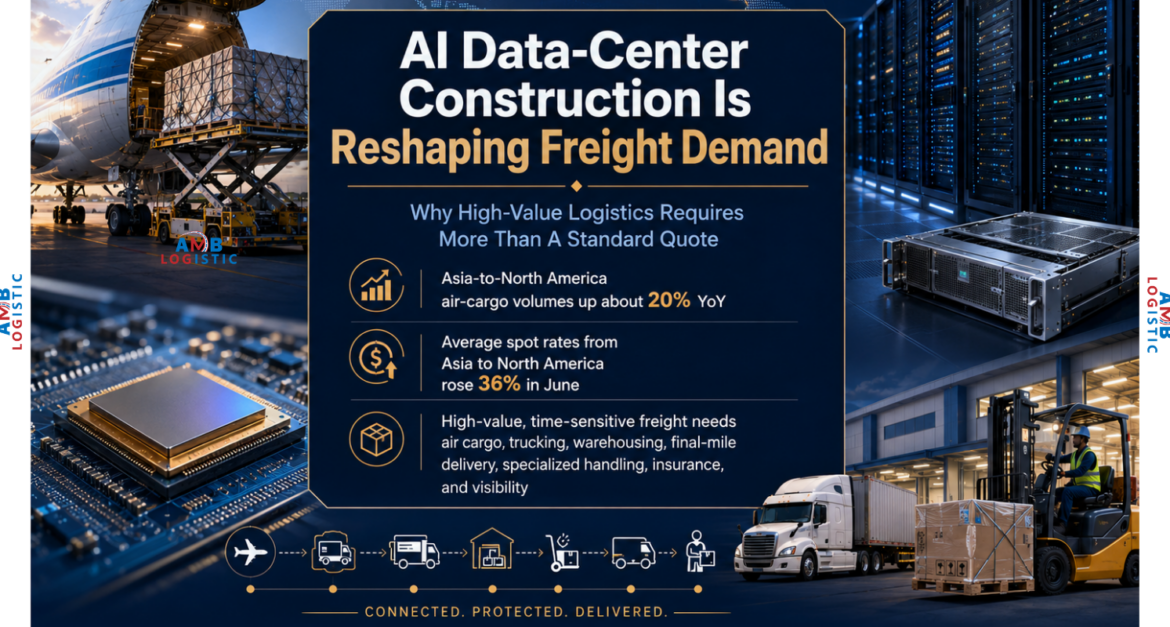
The rapid expansion of AI infrastructure is creating a new freight demand story in the United States. As data-center construction accelerates, companies are moving bulky server racks, semiconductors, networking equipment, cooling systems, and other high-value technology components from Asia to North America by air instead of waiting on slower ocean freight. This shift is pushing up air-cargo volumes and spot rates, while creating new complexity for freight brokers, shippers, 3PLs, and project logistics teams. For the brokerage market, the message is clear: AI infrastructure freight is not ordinary freight. It requires visibility, coordination, risk control, specialized handling, and disciplined execution from origin to final delivery.
Introduction
The AI infrastructure boom is now becoming a logistics story. Across the United States, data-center construction is accelerating as technology companies, cloud providers, and infrastructure partners race to support growing demand for artificial intelligence, cloud computing, and high-performance digital services.
That buildout is changing freight patterns. Data centers require large volumes of specialized equipment, including servers, chips, cooling systems, power components, racks, cables, switchgear, backup systems, and other mission-critical technology. Many of these shipments are high-value, time-sensitive, fragile, heavy, and directly tied to strict construction or installation timelines.
The biggest shift is showing up in airfreight. Companies that might normally rely on ocean transportation are paying more to move critical technology equipment by air from Asia to North America. The reason is speed. When a data-center project is tied to a tight construction schedule, a delay in critical equipment can slow installation, push back commissioning, and create expensive downstream disruption.
This is why the freight market should pay attention. AI data-center freight is not just another shipment category. It is project freight, high-value freight, and time-sensitive freight moving through a more complex logistics chain. It may begin overseas, move by air, transfer to domestic trucking, require warehouse staging, and end with controlled delivery into a construction site or data-center facility.
For freight brokers, this trend creates both opportunity and responsibility. The broker’s role is no longer simply to quote a truck. The broker must help coordinate air-to-truck handoffs, visibility, final-mile scheduling, appointment control, insurance requirements, equipment fit, cargo security, and exception management.
Why This Matters
AI-related data-center construction matters for freight brokers because it creates demand for logistics services that are more specialized than standard truckload coverage. These shipments often carry higher value, tighter timelines, and more serious consequences if something goes wrong.
When normal consumer freight is delayed, the cost may be missed retail availability or customer inconvenience. When critical data-center equipment is delayed, the impact can reach construction schedules, installation crews, contractors, power-up timelines, cloud capacity planning, and customer commitments. A single missed delivery window can create a chain reaction across multiple teams.
That makes freight execution more important. A broker handling this type of cargo needs to think beyond pickup and delivery. The broker needs to understand the project timeline, cargo sensitivity, delivery site restrictions, equipment requirements, handling instructions, insurance exposure, appointment discipline, and communication cadence.
Airfreight demand also affects cost. As more technology companies use air cargo for bulky and high-value data-center equipment, available aircraft space can become tighter and more expensive. That pressure can spill into domestic trucking because cargo arriving by air needs fast ground coordination, warehouse movement, drayage-style transfers, expedited trucking, or specialized delivery.
For shippers, the market shift means logistics planning must begin earlier. Waiting until the equipment is ready to move may be too late. Freight decisions should be connected to procurement timelines, supplier readiness, construction schedules, airport arrival windows, warehouse capacity, and final-site availability.
For brokers, this is where value is created. The best brokerage partner is not the one that simply finds the lowest rate. The best partner is the one that understands the risk, builds the plan, monitors the freight, and keeps the project moving.
The Broader Picture
The logistics industry is being shaped by several forces at once: AI infrastructure investment, changing import patterns, airfreight capacity constraints, higher service expectations, project cargo complexity, and demand for faster freight visibility.
In recent years, airfreight demand was heavily influenced by e-commerce flows. Now, a different category is gaining attention: AI-related infrastructure freight. Instead of small parcels and lightweight consumer goods, the market is seeing more heavy, bulky, high-value technology equipment moving by air because project timelines cannot wait for ocean transit.
This is a very different operating environment. Server racks, semiconductors, cooling systems, and power components require careful handling. Some freight may need temperature awareness, shock protection, security controls, liftgate planning, specialized loading equipment, or controlled delivery access. Construction sites and data-center campuses may also have strict appointment windows, security requirements, dock limitations, escort rules, or delivery sequencing needs.
The result is a freight category where coordination matters as much as capacity. It is not enough to know that a truck is available. The right truck, driver, insurance, communication process, equipment type, arrival time, and delivery plan all matter.
The broader signal for freight brokers is important. High-value logistics is becoming more visible as companies invest in infrastructure, technology, manufacturing, and supply chain resilience. Brokers who can handle complex freight will be better positioned than brokers who only compete on transactional quotes.
AI data-center logistics also shows how global freight disruption can quickly become domestic transportation pressure. A shipment may start in Asia, move by air into a U.S. gateway, require immediate trucking, need warehouse staging, and then move to a project site. If any part of that chain fails, the entire project can be affected.
What This Means For Freight Brokers
For freight brokers, AI data-center freight should be treated as a strategic logistics opportunity, not just another spot shipment. The requirements are different. The customer expectations are higher. The risks are more serious.
The first impact is planning. Brokers need to ask better questions before quoting. What is the commodity? What is the value? Is the freight fragile? Does it require specialized equipment? Is there a delivery appointment? Is the site a construction location, warehouse, airport, or live data-center campus? Are there security rules? Is the shipment part of a larger project schedule?
The second impact is visibility. High-value project freight requires proactive tracking and communication. A shipper should not have to chase updates. If the shipment is delayed, rerouted, held at an airport, delayed at a warehouse, or facing final-mile constraints, the broker should communicate early and clearly.
The third impact is carrier selection. Not every carrier is right for high-value technology freight. Brokers should consider safety, insurance, equipment quality, driver communication, appointment discipline, cargo-handling experience, claims history, and reliability.
The fourth impact is risk control. Data-center freight may carry higher insurance requirements and greater exposure. Brokers need to ensure that cargo coverage, carrier insurance, documentation, pickup details, delivery conditions, and chain-of-custody expectations are understood before the shipment moves.
The fifth impact is exception management. In project freight, delays happen. Aircraft delays, customs holds, warehouse congestion, airport transfer issues, driver shortages, equipment mismatch, site restrictions, and appointment changes can all disrupt the plan. The broker must have a process to respond quickly.
The Freight Broker Playbook
1) Treat AI Data-Center Freight As Project Freight
Data-center freight should not be handled like ordinary transactional freight. It is often part of a larger construction, installation, or commissioning timeline. That makes timing, sequencing, and communication critical.
Brokers should ask whether the shipment is tied to a project milestone. Is a contractor waiting for the freight? Is installation scheduled? Is there a crane, crew, or dock appointment involved? Is the delivery site ready to receive? These details determine how the shipment should be planned.
Project freight requires more discipline before the truck is booked. The broker needs to understand the consequence of failure and plan accordingly.
2) Build Air-To-Truck Coordination Into The Plan
When freight moves by air into North America, the ground side must be ready. A delay in handoff from air cargo to truck can erase the speed advantage that the shipper paid for.
Brokers should coordinate airport recovery, warehouse transfer, customs release timing, truck availability, final-mile routing, and delivery appointment windows before the freight lands. Waiting until the cargo is available can create avoidable delays.
The value of airfreight depends on what happens after the plane lands.
3) Match Carrier Capability To Cargo Risk
High-value technology freight needs the right carrier, not just any available carrier. Brokers should evaluate whether the carrier has the equipment, communication discipline, insurance coverage, and service history needed for the shipment.
Carrier selection should consider trailer condition, driver reliability, claims history, cargo security, appointment performance, shipment visibility, and ability to follow handling instructions.
The cheapest option can become expensive if the freight is damaged, delayed, misrouted, or mishandled.
4) Confirm Insurance Before The Load Moves
Data-center equipment can carry significant value. Brokers should confirm cargo value, insurance requirements, carrier coverage, exclusions, deductibles, and any special conditions before tendering the load.
The shipper, broker, and carrier should understand what is covered and what is not covered. Assumptions can become costly if there is a claim.
Insurance review is not an afterthought. It is part of the freight plan.
5) Use Stronger Visibility Standards
High-value project freight requires stronger visibility than standard freight. Customers need regular updates, accurate status, and early warning when something changes.
Brokers should set a communication cadence before pickup. That may include pickup confirmation, departure update, airport recovery update, in-transit check-ins, arrival ETA, delivery confirmation, and exception alerts.
Visibility is not only about tracking the shipment. It is about helping the customer manage the project.
6) Control Final-Mile Delivery Details
Final-mile delivery to a data-center construction site or technology facility can be complicated. The site may have gate controls, security rules, limited receiving hours, dock restrictions, escort requirements, construction traffic, or staging instructions.
Brokers should confirm receiving contact, appointment time, access rules, unloading method, equipment needs, site map, delivery restrictions, and any special handling instructions before the driver arrives.
Final-mile failure can undermine the entire shipment.
7) Prepare For Capacity And Rate Pressure
When airfreight demand rises, transportation costs can move quickly. If bulky technology freight takes up more air-cargo capacity, rates may increase and space may become more limited. That pressure can also affect domestic trucking tied to airport transfers and project freight.
Brokers should communicate market conditions to customers early. If a project has a fixed deadline, waiting too long to secure capacity can increase cost and risk.
Early planning gives the customer more options.
8) Protect Against Theft And Security Risk
High-value technology freight can be attractive to thieves. Brokers should treat security as part of the shipment plan.
That means verifying carrier identity, confirming pickup contacts, controlling load information, avoiding unnecessary exposure of cargo details, monitoring route progress, and using trusted carriers with appropriate security discipline.
Security begins before pickup. It does not start after something looks wrong.
9) Document The Shipment Clearly
High-value freight requires clean documentation. Shipment details, cargo value, handling requirements, insurance confirmation, pickup instructions, delivery appointment, receiving contact, and proof of delivery should be clear and organized.
Poor documentation creates confusion, delays, claims issues, and customer frustration. Strong documentation supports accountability.
For project freight, the paper trail is part of the service.
10) Move From Transactional Brokerage To Logistics Coordination
AI infrastructure freight shows where brokerage is heading. Customers do not simply need a quote. They need a partner who can coordinate multiple moving parts.
That includes supplier timing, airfreight arrival, warehouse transfer, carrier selection, delivery scheduling, site coordination, visibility, exception management, and final confirmation.
Brokers who can manage that full process will stand out in a market that increasingly rewards control and communication.
What This Means For Shippers
For shippers, the AI data-center logistics trend is a reminder that freight planning must happen earlier. High-value technology equipment should not be moved with a last-minute freight strategy unless there is no other option.
Shippers should work with logistics partners who understand the project timeline, cargo value, handling requirements, delivery site, insurance needs, and urgency of the shipment. The right partner should ask detailed questions before quoting and should communicate clearly throughout the move.
Shippers should also understand that the cheapest transportation option may not be the best option for mission-critical freight. When the freight supports a data-center buildout, equipment delay can cost far more than the rate difference between carriers.
The best freight strategy balances cost, speed, security, visibility, and execution reliability.
What This Means For Carriers
For carriers, AI data-center freight creates opportunities for those who can meet higher service standards. Carriers with strong communication, clean equipment, cargo security, insurance discipline, appointment reliability, and professional drivers may become more valuable to brokers and shippers.
Technology freight customers often need more than basic transportation. They need accurate updates, careful handling, delivery discipline, and the ability to follow site instructions. Carriers that can provide that level of service will be better positioned as high-value freight demand grows.
This market can reward carriers that operate with precision.
What This Means For 3PLs And Project Logistics Teams
For 3PLs and project logistics teams, AI infrastructure freight reinforces the need for end-to-end coordination. Airfreight, warehousing, trucking, installation timing, site readiness, and inventory control must be aligned.
The challenge is not only moving freight quickly. The challenge is keeping each step connected. A shipment that arrives at the airport but cannot be recovered quickly, stored properly, or delivered into the site on schedule still creates project risk.
Strong project logistics requires early planning, clear communication, defined responsibilities, and disciplined exception management.
AMB Logistic’s Role
At AMB Logistic, we understand that high-value freight requires more than a standard quote. It requires planning, communication, carrier fit, visibility, and disciplined execution.
As AI infrastructure and data-center construction continue to shape freight demand, our role is to help customers move freight with clarity and control. Whether the shipment requires truckload, LTL, time-sensitive coordination, or support for more complex logistics needs, the goal is the same: move freight the right way.
AMB Logistic supports customers with freight brokerage solutions built around practical service, reliable communication, and shipment visibility. We help customers think through transportation needs, carrier selection, timing, and execution so freight moves with fewer surprises.
- We help customers evaluate freight options beyond price alone.
- We support shipment planning with carrier-fit discipline and clear communication.
- We focus on visibility, updates, and proactive exception management.
- We understand that high-value freight requires stronger coordination.
- We help shippers move with clarity, control, and confidence in a changing market.
FAQ
Why Is AI Data-Center Construction Affecting Freight Demand?
AI data-center construction requires large volumes of specialized technology equipment, including servers, semiconductors, racks, cooling systems, power components, and networking hardware. Many of these shipments are high-value and time-sensitive, which increases demand for faster logistics options.
Why Are Companies Using Airfreight For Data-Center Equipment?
Companies use airfreight when speed is more important than cost. If equipment is needed to keep a construction or installation timeline on track, air cargo may be used to avoid longer ocean transit times.
Why Does This Matter To Freight Brokers?
It matters because this type of freight requires more than rate quoting. Brokers need to manage carrier selection, insurance review, visibility, security, air-to-truck coordination, appointment control, and final-mile delivery details.
Is Data-Center Freight High-Risk?
It can be. Data-center freight may be high-value, fragile, bulky, time-sensitive, and tied to strict project schedules. That creates higher exposure if the shipment is delayed, damaged, mishandled, or poorly coordinated.
What Should Shippers Look For In A Logistics Partner?
Shippers should look for a partner that asks detailed questions, understands the project timeline, verifies carrier fit, confirms insurance, provides visibility, communicates proactively, and manages exceptions quickly.
Can Standard Truckload Carriers Handle Data-Center Freight?
Some can, depending on the shipment. The right carrier must have suitable equipment, proper insurance, reliable communication, careful handling practices, and the ability to meet appointment or site requirements.
Final Word From AMB Logistic
AI data-center construction is creating a new freight demand pattern in the United States. As companies move critical technology equipment faster, airfreight and domestic trucking coordination are becoming more important.
For freight brokers, this is a clear signal that logistics value is moving beyond basic rate shopping. High-value freight requires planning, visibility, carrier quality, risk control, and active communication.
For shippers, the lesson is straightforward. Mission-critical freight should be planned with care. The lowest rate is not always the best decision when timing, cargo value, and project impact matter.
For carriers, the opportunity belongs to those who can provide reliable service, strong communication, and careful execution.
The freight market is changing as AI infrastructure expands. In this environment, the strongest logistics partners will be the ones who combine speed with control, visibility with communication, and freight execution with real project awareness.
Talk To AMB Logistic Today
If your business needs truckload, LTL, or freight brokerage support for time-sensitive, high-value, or complex shipments, AMB Logistic can help you move with clarity, control, and confidence.
Web: amblogistic.us
Phone: +1 (888) 538-6433
Email: info@amblogistic.us
Tags
AI data centers, airfreight demand, data-center logistics, high-value freight, freight brokerage, project logistics, air cargo, truckload logistics, LTL logistics, supply chain visibility, technology freight, freight brokers, U.S. logistics, AMB Logistic