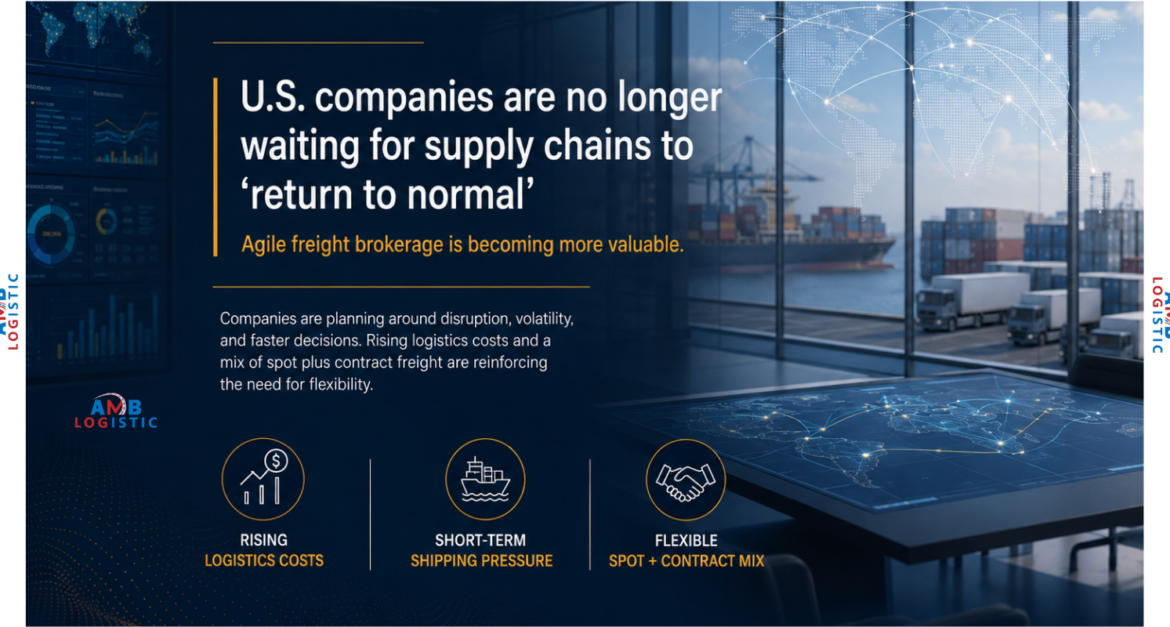
Why Agile Freight Brokerage Is Becoming More Valuable As U.S. Companies Stop Waiting For Supply Chains To Normalize
U.S. companies are no longer building logistics strategies around the hope that supply chains will return to a quiet, predictable, pre-pandemic rhythm. Instead, they are planning around disruption, cost movement, capacity shifts, changing sourcing strategies, and faster decision-making. For freight brokers, this is an important market signal. Shippers are not just looking for someone to quote a lane anymore. They need brokerage partners who can help them move through volatility with better carrier access, faster routing decisions, stronger visibility, and disciplined freight execution.
Introduction
For years, many companies treated supply-chain instability as a temporary problem. The assumption was simple: once pandemic disruption faded, freight markets would settle, inventory cycles would normalize, rates would stabilize, and logistics teams could return to older operating models. That assumption is no longer strong enough.
The modern supply chain is not returning to a single version of normal. It is becoming a permanent operating environment shaped by disruption, market swings, policy changes, labor pressure, carrier capacity shifts, port congestion, equipment imbalance, cyber risk, inventory resets, and changing consumer demand. Companies are learning that waiting for stability is not a strategy.
That is why agile freight brokerage is becoming more valuable. Shippers need partners who can respond quickly when lanes change, capacity tightens, rates move, service conditions shift, or a shipment requires a different plan than the one originally expected. The value of a broker is no longer limited to finding a truck. The value is in helping the shipper make better decisions under pressure.
In this environment, freight brokerage becomes a strategy function, not just a transaction function. A broker who understands lane conditions, carrier behavior, spot-market movement, LTL options, truckload alternatives, service risk, and cost exposure can help a shipper protect both budget and performance. A broker who only reacts to loads after they are tendered will struggle to create the same value.
For AMB Logistic, this shift reinforces a core belief: freight execution should be built around clarity, control, and confidence. When the market is unstable, the right logistics partner helps customers move with discipline instead of guesswork.
Why This Matters
Agile freight brokerage matters because supply chains are now operating in a state of constant adjustment. Shippers are dealing with changing cost structures, inconsistent demand signals, transportation-rate movement, import timing shifts, and unpredictable service conditions. The companies that can adapt quickly have a major advantage over those that remain locked into rigid freight processes.
In a stable market, a shipper may be able to rely heavily on fixed routing guides, long-term rates, and predictable carrier patterns. But when volatility becomes normal, those tools alone are not enough. A routing guide may fail. A contracted carrier may reject a load. A spot lane may suddenly reprice. A facility may need to shift volume. A shipment may require faster recovery than the original plan allowed.
This is where freight brokers play a bigger role. A strong broker brings market flexibility into the shipper’s operation. That flexibility can include backup capacity, alternative equipment options, spot-market awareness, access to reliable carrier relationships, LTL and truckload comparison, regional capacity insight, and fast communication when conditions change.
The importance of brokerage is also increasing because logistics costs are no longer easy to predict. Fuel exposure, insurance costs, labor pressure, equipment costs, accessorial charges, detention risk, and lane imbalance can all affect the final cost of freight. Shippers need support interpreting these cost movements before they turn into budget surprises.
The freight market now rewards companies that can plan, adjust, and execute quickly. Agile brokerage is becoming one of the ways shippers build that ability into their transportation strategy.
The Broader Picture
The broader supply-chain environment has changed because disruption is no longer viewed as an exception. It is part of the operating model. Companies are managing supplier changes, inventory strategy shifts, nearshoring conversations, port diversification, tariff uncertainty, labor volatility, freight fraud, cyber-enabled cargo theft, and uneven transportation capacity.
In the past, some companies built logistics systems around efficiency above all else. Lean inventory, tight delivery schedules, narrow carrier networks, and fixed transportation assumptions could work when conditions were stable. But when disruption becomes frequent, efficiency without flexibility can become fragile.
That does not mean companies should abandon efficiency. It means they need a better balance between efficiency and resilience. Freight strategy must support cost control while still allowing the business to respond when the market shifts. The cheapest freight plan is not always the strongest freight plan if it cannot adapt under pressure.
Freight brokers are increasingly important in that balance because they operate close to real-time market conditions. Brokers see lane pressure, carrier behavior, rate movement, service challenges, and customer urgency across multiple shipments and regions. That gives them a practical view of what is happening on the ground.
When that visibility is used properly, a broker can help a shipper avoid reactive decisions. Instead of waiting until a load fails, the broker can flag pressure early. Instead of accepting the first available option, the broker can compare service risk and cost. Instead of treating every shipment as isolated, the broker can help the customer understand patterns across lanes, facilities, and carrier performance.
This is why the conversation around freight brokerage is changing. The market no longer needs brokers who only chase the lowest available rate. It needs brokers who can interpret volatility, secure capacity, protect service, and help shippers build transportation plans that hold up under pressure.
What This Means for Freight Brokers and Logistics Teams
For freight brokers, the shift toward agile supply-chain planning creates both opportunity and responsibility. The opportunity is clear: brokers can become more valuable to shippers by helping them navigate a more complicated logistics environment. The responsibility is that brokers must operate with more discipline, transparency, and market intelligence than before.
A broker cannot simply wait for a load, post it, quote it, and move on. That model may still handle basic transactions, but it does not fully support shippers who are dealing with recurring disruption. The modern broker needs to understand the customer’s freight profile, high-risk lanes, service requirements, facility behavior, budget sensitivity, and backup options.
Logistics teams also need to stop separating pricing from execution. In a volatile market, the lowest quote can become expensive if it creates service failure, delay, claims exposure, or last-minute recovery costs. A strong brokerage strategy considers both cost and reliability.
Carrier relationships become even more important in this environment. When a shipment needs a fast solution, a broker with real carrier relationships can respond better than a broker relying only on broad market posting. Trusted capacity is a major advantage when timelines are tight and service failure is costly.
Visibility also becomes a core part of brokerage value. Shippers do not only need freight moved. They need to know what is happening, when it is happening, and what decisions need to be made if something changes. Accurate tracking, proactive updates, and clear exception communication are no longer optional. They are table stakes.
For logistics teams, the message is direct: agility has to be built into the process before disruption happens. Waiting until a load is already at risk is too late.
The Freight Broker Playbook
1) Build Flexibility Into Every Freight Strategy
Agile freight brokerage begins with flexibility. Shippers need transportation plans that can adjust when a lane tightens, a carrier rejects, a facility changes schedule, or costs move faster than expected. Brokers should help customers identify where flexibility is needed most.
Not every shipment needs the same level of flexibility. Some freight is routine and predictable. Some freight is time-sensitive, high-value, seasonal, or exposed to strict appointment requirements. Brokers should help shippers separate standard freight from higher-risk freight so the right level of planning can be applied.
Flexibility may include backup carriers, alternate routing, different equipment options, LTL-to-truckload conversion, partial options, expedited recovery, regional carrier coverage, or adjusted pickup timing. The goal is not to overcomplicate every shipment. The goal is to prevent one failed assumption from disrupting the entire plan.
A flexible freight strategy gives the shipper more control when conditions change.
2) Use Brokers As Market Interpreters, Not Just Quote Providers
Shippers should expect more from brokers than rate quotes. A strong broker should help explain what the market is doing, why a lane is changing, where capacity is tightening, and what options are available. That interpretation helps shippers make better decisions.
In a volatile market, a quote without context is incomplete. A low rate may come with higher service risk. A higher rate may reflect limited capacity or a better carrier fit. A lane may look expensive because available equipment is thin. Another lane may have room for savings because backhaul capacity is available.
Brokers should translate these details into practical customer guidance. The best brokerage conversations are not only about price. They are about risk, service, timing, and execution.
This is especially important when companies are trying to manage supply-chain volatility. They need partners who understand the difference between a temporary rate spike, a structural lane issue, and a service-risk problem.
3) Balance Spot Flexibility With Long-Term Control
Many shippers are using a mix of spot and contract freight to manage uncertainty. This can be effective, but it requires discipline. Spot freight can provide flexibility, but too much spot exposure can create budget volatility. Contract freight can provide control, but rigid contracts may fail if market conditions shift.
Brokers can help shippers find the right balance. Stable, predictable lanes may benefit from structured pricing and trusted carrier relationships. Irregular or seasonal lanes may need more spot-market flexibility. High-risk lanes may need backup capacity even if a contract plan is in place.
The key is not choosing spot or contract as a blanket strategy. The key is matching the procurement approach to the lane, volume pattern, service requirement, and market condition.
Agile brokerage helps shippers avoid being trapped by a single freight model.
4) Strengthen Carrier Relationships Before Disruption Hits
Carrier access is one of the most important parts of agile freight brokerage. When the market is disrupted, the broker with stronger carrier relationships can often respond faster and more reliably.
Strong carrier relationships are not built only when a load is urgent. They are built through consistent communication, accurate load details, fair treatment, reliable payment, and professional issue resolution. Carriers are more likely to support brokers who respect their time and understand their operating needs.
Brokers should know which carriers are reliable by lane, region, equipment type, service profile, and communication style. They should also know which carriers are strong on appointment freight, which can handle difficult markets, and which are dependable for recovery moves.
In an unstable market, a carrier network is not just a database. It is a strategic asset.
5) Make Visibility Operational, Not Cosmetic
Visibility has become one of the most important logistics expectations. But visibility is not valuable just because a shipment can be tracked. It is valuable when it helps the customer make better decisions.
Real visibility includes accurate status updates, proactive exception communication, clear delivery expectations, and fast escalation when something changes. A tracking link by itself is not enough if no one is managing the information.
Brokers should treat visibility as an operating discipline. Customers need to know when freight is on schedule, when it is at risk, what caused the issue, what options exist, and what decision needs to be made. This turns visibility from a passive feature into an active control tool.
In volatile supply chains, visibility is not a nice-to-have. It is part of risk management.
6) Plan For Exception Management Before Exceptions Happen
Freight exceptions are unavoidable. Weather, traffic, carrier issues, facility delays, missed appointments, equipment problems, documentation errors, and market disruptions can all affect shipments. Agile brokerage does not mean avoiding every exception. It means responding faster and better when exceptions occur.
Brokers should define escalation paths before problems happen. Who needs to know if a truck is delayed? What is the recovery option if a carrier falls off? How quickly should the customer be updated? What information is needed before a decision can be made?
Strong exception management protects service and trust. Customers may accept that problems happen. They are less forgiving when communication is slow, unclear, or reactive.
The best brokers do not just move freight when everything goes right. They protect the shipment when something goes wrong.
7) Watch Cost Pressure Across The Full Shipment Lifecycle
Freight cost is not only the linehaul rate. Accessorials, detention, layover, re-delivery, storage, missed appointments, fuel exposure, and recovery moves can all affect total transportation cost. In a volatile market, these costs can become harder to control.
Brokers should help shippers understand total cost, not just quoted cost. A cheap truck that creates delays, poor visibility, claims exposure, or recovery costs may not be the best option. A slightly higher-cost carrier with stronger execution may protect the customer’s total outcome.
This is especially important when companies are managing tighter budgets and rising logistics pressure. The goal is not only to reduce cost. The goal is to reduce preventable cost.
Agile brokerage requires looking beyond the first number on the quote.
8) Align Freight Planning With Business Volatility
Freight planning should reflect the volatility of the business it supports. A company with seasonal demand, import variability, production changes, retail promotions, construction cycles, or customer delivery commitments needs a freight strategy that can adjust quickly.
Brokers should understand the customer’s business context. Why does this freight move? What happens if it is late? Which lanes are most sensitive? Which customers are most important? Which facilities create bottlenecks? Which shipments need backup plans?
When brokers understand the business behind the freight, they can provide better logistics support. They can identify risk earlier, recommend smarter options, and respond with more relevant solutions.
Agile brokerage is strongest when it is connected to the customer’s real operating needs.
What This Means For Shippers
For shippers, this market requires a different mindset. Waiting for supply chains to fully normalize may leave companies underprepared for the next disruption. Instead, shippers need transportation strategies that can handle change without losing control.
That means evaluating freight partners differently. The right broker is not only the one who offers the lowest rate. The right broker is the one who can secure reliable capacity, communicate clearly, adjust quickly, provide visibility, and help the shipper understand market conditions before problems become expensive.
Shippers should also look closely at their internal freight processes. Poor lead time, unclear pickup instructions, slow appointment scheduling, inaccurate shipment details, and weak communication can make freight harder to cover. In a volatile market, operational discipline inside the shipper’s own process becomes more important.
Shippers that want more control should focus on better planning, stronger partner relationships, clearer data, and faster decision-making. Freight agility is not only the broker’s responsibility. It is a shared operating model between the shipper, broker, and carrier.
What This Means For Carriers
For carriers, agile brokerage can create stronger freight relationships when handled correctly. Carriers want freight that fits their network, pays fairly, provides accurate details, and respects their time. Brokers who understand carrier needs can build better capacity access for shippers.
In a volatile market, carriers may become more selective. They may avoid freight with poor facility performance, unclear instructions, unreliable payment, or excessive dwell. They may prioritize brokers who communicate well and provide consistent opportunities.
This means shippers and brokers must treat carrier relationships as a long-term asset. Reliable carriers are not interchangeable commodities. They are operating partners. When disruption hits, those relationships can make the difference between coverage and failure.
A healthier freight market depends on stronger alignment between shipper expectations, broker execution, and carrier economics.
AMB Logistic’s Role
At AMB Logistic, we understand that modern freight strategy requires more than simple lane quoting. Companies are operating in a supply-chain environment where disruption, rate movement, capacity shifts, visibility expectations, and service pressure are part of daily decision-making.
Our role is to help customers move through that environment with clarity, control, and confidence. That means supporting freight decisions with practical market understanding, reliable carrier sourcing, proactive communication, and disciplined execution.
AMB Logistic focuses on helping shippers stay flexible without losing control. We understand that every shipment carries business impact. A delayed load can affect production, customer commitments, inventory flow, or revenue. That is why freight brokerage must be responsive, transparent, and operationally grounded.
- We help customers respond quickly when market conditions shift.
- We support truckload, LTL, and freight brokerage needs with practical execution.
- We focus on reliable carrier relationships and disciplined shipment management.
- We prioritize visibility, communication, and exception control.
- We help shippers move freight with clarity, control, and confidence.
In today’s logistics market, agility is not a luxury. It is a competitive requirement. AMB Logistic helps customers build that agility into their freight strategy without sacrificing accountability or service quality.
FAQ
Why Is Agile Freight Brokerage Becoming More Important?
Agile freight brokerage is becoming more important because supply chains are operating with constant disruption, cost movement, capacity shifts, and service uncertainty. Shippers need partners who can adapt quickly and help them make better transportation decisions.
What Does Agile Freight Brokerage Mean?
Agile freight brokerage means having the ability to adjust routing, source capacity, manage spot and contract exposure, communicate changes, provide visibility, and recover service when conditions shift.
Why Can’t Shippers Rely Only On Fixed Routing Guides?
Fixed routing guides can work well in stable conditions, but they may fail when capacity tightens, rates move, carriers reject freight, or shipment requirements change. Shippers need backup options and flexible freight planning.
How Does Visibility Support Freight Agility?
Visibility supports agility by giving shippers timely information about shipment status, delays, exceptions, and service risk. Good visibility helps teams make decisions before problems become larger disruptions.
Is The Lowest Freight Rate Always The Best Option?
No. The lowest rate may carry higher service risk if the carrier fit is weak, communication is poor, or recovery options are limited. Shippers should consider total cost, reliability, visibility, and execution quality.
How Should Shippers Prepare For Continued Supply-Chain Volatility?
Shippers should improve lead time, strengthen carrier and broker relationships, review high-risk lanes, maintain backup options, improve shipment data accuracy, and work with partners who can respond quickly when conditions change.
What Role Does AMB Logistic Play?
AMB Logistic supports shippers with freight brokerage, truckload, LTL, carrier sourcing, visibility, communication, and practical execution support designed to help customers move with clarity, control, and confidence.
Final Word From AMB Logistic
U.S. companies are learning that supply-chain stability cannot be taken for granted. The market is too dynamic, too connected, and too exposed to disruption for companies to wait passively for everything to return to the way it once was.
That shift makes agile freight brokerage more important. Shippers need transportation partners who can adjust quickly, explain market conditions clearly, secure reliable capacity, provide visibility, and protect service when plans change.
For brokers, this is a moment to move beyond transactional quoting. The value of brokerage is now tied to market intelligence, carrier relationships, communication discipline, and the ability to help customers make better decisions under pressure.
For shippers, the message is clear: freight agility should be built before disruption happens. The companies that plan early, communicate clearly, and work with responsive logistics partners will be better positioned to manage cost, protect service, and maintain control.
The supply chain may not return to a simple version of normal. But with the right freight strategy, companies can still move forward with confidence.
Talk To AMB Logistic Today
If your business needs truckload, LTL, or freight brokerage support in a changing market, AMB Logistic can help you move with clarity, control, and confidence.
Web: amblogistic.us
Phone: +1 (888) 538-6433
Email: info@amblogistic.us
Tags
agile freight brokerage, freight brokerage, U.S. logistics, supply chain volatility, freight brokers, truckload, LTL, carrier capacity, shipment visibility, logistics strategy, transportation planning, supply chain resilience, freight visibility, AMB Logistic