Rural Last-Mile Is Becoming a Major U.S. Logistics Battleground: What the Walmart–Amazon Push Means for Freight Networks
Rural delivery is no longer a side issue in U.S. logistics. When Walmart and Amazon both push harder into smaller towns and rural communities at the same time, the story stops being about retail competition alone. It becomes a freight-network story. Faster rural delivery means new inventory placement logic, tighter replenishment expectations, more pressure on middle-mile execution, and a different map for regional freight movement. That is the real significance of what is happening now.
The Broader Picture
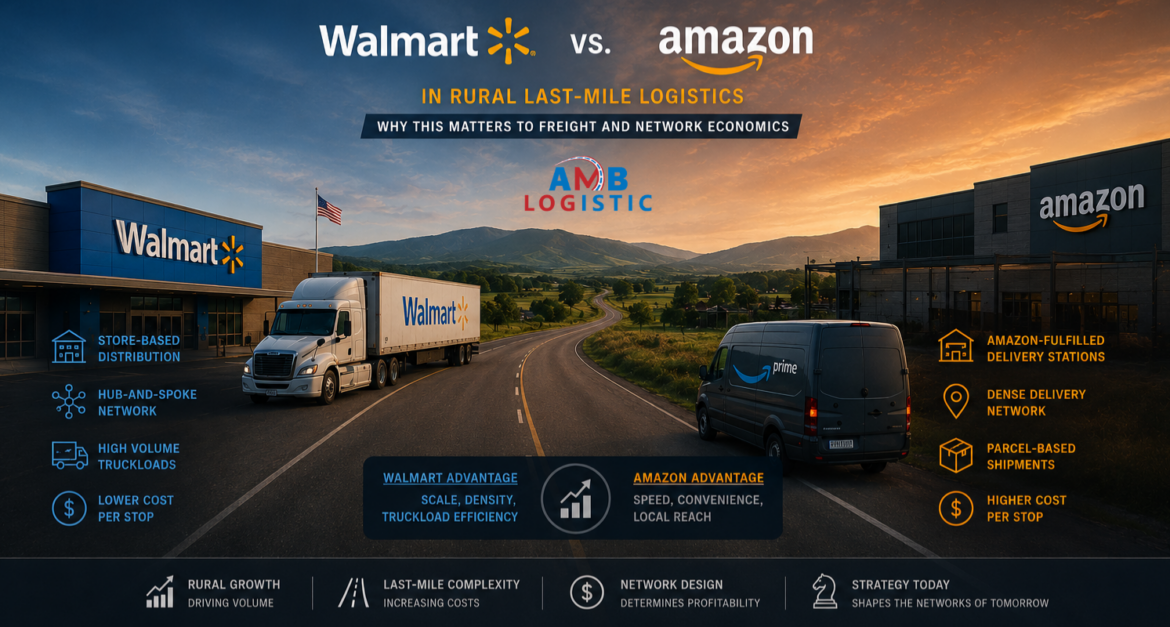
For years, rural delivery was treated as the hard part of the logistics map. Lower stop density, longer distances, and higher cost per delivery made aggressive service models harder to justify outside urban and suburban corridors. That logic is now being challenged by the biggest players in the market. Walmart is using its store footprint as a distributed logistics network. Amazon is investing aggressively to deepen same-day and next-day reach into smaller communities. When both companies commit serious capital and strategy to the same problem, the market should assume the economics are changing.
That shift matters because rural last-mile does not operate in isolation. A faster promise at the edge of the network changes everything upstream. Inventory has to be positioned differently. Replenishment cycles have to tighten. Delivery nodes that were once secondary become more important. Regional flow patterns start changing. What looks like a customer-service story on the surface is really a network design story underneath.
This is also a sign that logistics capability is becoming the real competitive weapon. Walmart has physical proximity. Amazon has forecasting, automation, and local-node strategy. The winner will not be decided by brand recognition alone. It will be decided by who can place inventory better, move it faster, and support harder geographies without breaking the economics of the system.
Why This Matters for Freight
- Rural demand is becoming worth designing for, not just serving reluctantly.
- Middle-mile and replenishment execution get more important when last-mile promises get faster in lower-density markets.
- Regional freight patterns can shift as new delivery nodes and local inventory points gain importance.
- Inventory placement becomes a freight story, not just a retail operations story.
- Logistics providers that understand network change early will be in a stronger position than those reacting after the flows have already moved.
What This Means for Freight Brokers and Logistics Teams
For freight brokers, this is a warning against using old assumptions about rural freight. If major retailers are redesigning service expectations in smaller markets, freight brokers should expect more pressure on regional replenishment, more sensitivity around timing, and more strategic value in understanding how inventory is being repositioned. Rural America cannot be treated as a low-priority afterthought if the largest networks in the country are now building around it more aggressively.
For shippers and logistics teams, the message is even sharper. Faster service into harder-to-serve areas raises the cost of sloppiness upstream. Inventory architecture, route engineering, and freight timing all become more important. This is where supply chains stop winning through size alone and start winning through precision. When geography gets harder, execution quality matters more.
For carriers, especially regional and final-mile operators, this creates real opportunity, but not easy opportunity. Rural freight can reward disciplined operators who can handle dispersed geography reliably. It can also punish weak planning and poor route economics very quickly. The opportunity is there, but it belongs to operators who can execute consistently, not just show up.
The Freight Broker Playbook
1) Stop treating rural logistics as secondary
If Walmart and Amazon are both intensifying investment in rural service, then rural logistics is no longer a fringe topic. Brokers and operators should treat it as a strategic freight signal, not a niche delivery story.
2) Watch inventory placement, not just delivery headlines
The real shift is not the delivery promise by itself. The real shift is where inventory will sit to support that promise. Service speed is the outcome. Inventory positioning is the operating change behind it.
3) Expect middle-mile precision to matter more
Faster delivery into less-dense markets only works when the replenishment system stays tight. That means regional freight execution, timing discipline, and load planning become more valuable as rural service levels rise.
4) Rethink how you evaluate freight opportunity
Low density does not always mean low strategic value. A geography can look difficult on paper and still become commercially important when the right infrastructure, technology, and demand patterns line up behind it.
5) Follow the network, not just the brand story
The visible competition is Walmart versus Amazon. The deeper story is network versus network. The companies and partners that understand where freight flows are actually moving will make better decisions than the ones focused only on the headline rivalry.
AMB Logistic’s Role
At AMB Logistic, we pay close attention to shifts like this because they usually show up in freight before they become obvious in broad market conversation. When a customer starts seeing different regional pull, tighter replenishment windows, or changing demand around smaller-market distribution, that is not random noise to us. That is a network shift that needs to be read early and acted on clearly.
Our value in moments like this is straightforward: helping customers interpret where freight is actually moving, where timing is becoming more sensitive, and how regional network changes can affect execution before the pressure becomes expensive. That is especially important for shippers and logistics teams that need disciplined middle-mile support while the last-mile map keeps changing.
FAQ
Why is rural delivery suddenly such a big logistics story?
Because major players now see enough long-term opportunity to justify building stronger service models in areas that used to be treated as too expensive or too operationally difficult.
Why does this matter for freight brokers?
Because faster rural service changes upstream freight flows. Inventory placement, regional replenishment, and timing expectations all become more important when delivery commitments expand into harder geographies.
Why is Walmart’s footprint such a big advantage?
Because store proximity gives Walmart a built-in distributed network that can support delivery and local fulfillment more efficiently than a company starting from scratch.
What makes Amazon’s move important?
Amazon is proving that rural speed is now important enough to justify deeper infrastructure, smarter forecasting, and more aggressive local positioning.
What should logistics teams do now?
Watch how inventory placement, regional delivery nodes, and replenishment timing evolve. The biggest freight implications will come from those changes, not just from the delivery-speed headlines.
Final Word From AMB Logistic
The strongest logistics stories are often the ones hidden inside broader business competition. This is one of them. Walmart and Amazon are not just fighting for more rural customers. They are testing how modern logistics networks can stretch deeper into harder markets while still protecting speed, cost, and service quality.
That makes this a serious freight story. Rural last-mile is no longer a side conversation. It is becoming a proving ground for the next phase of U.S. logistics strategy. The companies that understand the freight implications early will be in a stronger position than the ones that wait until the network has already changed.
Talk To AMB Logistic Today
If your team wants to stay ahead of shifting freight patterns, changing regional flows, and tighter replenishment expectations, AMB Logistic is ready to help you move with more clarity and control.
Call: +1 (888) 538-6433
Email: info@amblogistic.us
Web: amblogistic.us
Tags
rural logistics, last mile delivery, Walmart, Amazon, freight brokerage, AMB Logistic