Capacity Just Collapsed Again: Why April’s Freight Tightening May Be the Real Turning Point for Brokers and Shippers
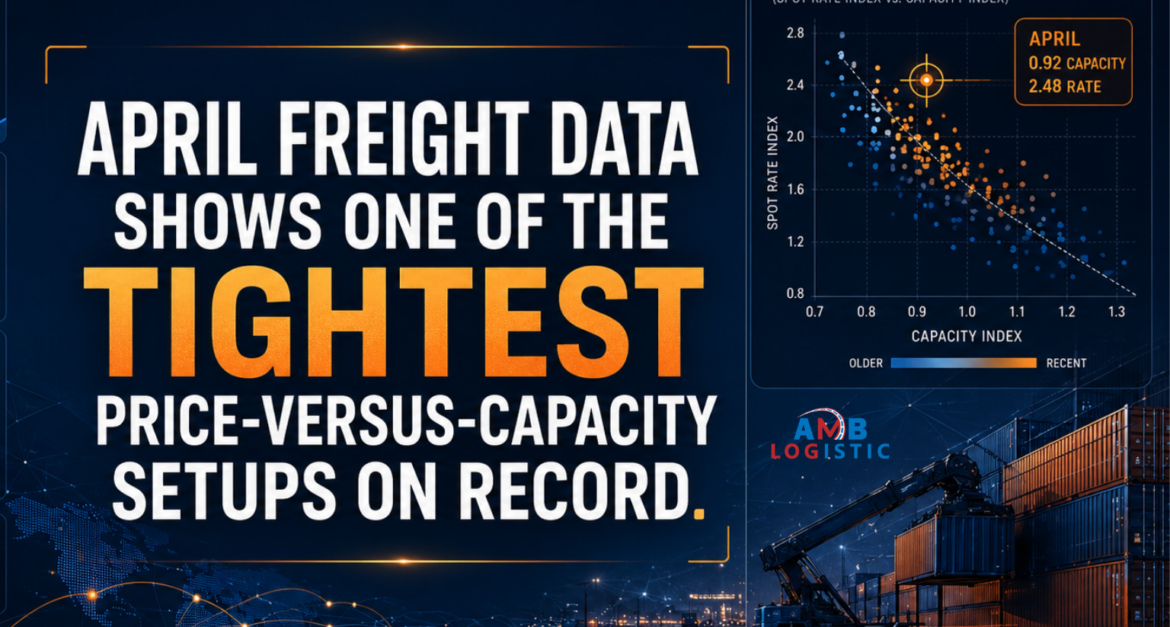
April may be the clearest sign yet that the U.S. freight market is no longer operating under the same assumptions that defined the softer stretch of the cycle. The April 2026 Logistics Managers’ Index came in at 69.9, Transportation Prices surged to 95.0, and Transportation Capacity fell to 28.4. The report says that 28.4 is one of the lowest Transportation Capacity readings in the history of the index, and that the gap between Transportation Prices and Transportation Capacity reached a historic extreme. That is not a routine freight fluctuation. It is a market signal with real implications for brokers, shippers, and carriers.
Introduction
Freight markets rarely announce a turning point in a way that feels convenient. More often, the shift shows up through operating stress before it shows up through broad consensus. A lane gets harder to cover. A quote that looked workable a few weeks ago suddenly feels thin. A routing guide starts showing more weakness than expected. Shippers still talk like the market is manageable, while brokers quietly realize the cost of keeping freight moving is rising faster than customers are prepared to accept. That is what makes April’s data so important. It does not merely say that freight is active. It says the market is getting tighter and more expensive at the same time.
The most important number in the report may be Transportation Capacity at 28.4. In normal language, that means available slack in the market has contracted sharply. Pair that with Transportation Prices at 95.0 and you get a freight environment that is both more difficult to source and more expensive to buy. That combination is what changes behavior. It changes how brokers quote, how shippers procure, and how carriers think about their leverage.
That is why this topic matters now. The real story is not simply that prices are up. The real story is that usable room in the system appears to be disappearing at the same time that transportation costs are expanding at one of the fastest rates the index has ever recorded.
Why This Matters
This matters because freight brokerage depends on more than movement. It depends on margin, timing, and recoverability. In a softer market, bad assumptions can survive longer. A weak quote can sometimes be rescued. A late tender can still find a truck. A shipper can lean harder on price without immediately breaking service. In a market where Transportation Capacity is 28.4 and Transportation Prices are 95.0, those old recovery options become less dependable.
It also matters because the April report did not describe a mild tightening. It described an extreme one. The report says the spread between Transportation Prices and Transportation Capacity is the widest it has ever tracked, meaning the market is simultaneously tighter and more expensive than at any prior point in the index history. That is exactly the kind of environment where quote error, carrier rejection risk, and buy-side pressure all start compounding at once.
- Transportation Capacity fell to 28.4, one of the lowest readings the index has ever recorded.
- Transportation Prices rose to 95.0, signaling an unusually aggressive expansion in freight cost pressure.
- The gap between price and capacity reached a historic extreme, showing the market tightening from both sides at once.
- The overall LMI rose to 69.9, making April one of the strongest logistics-cost pressure readings in recent years.
The Broader Picture
The broader picture is that April does not look like a random spike. The report says freight markets were already on a strong upward trajectory entering 2026 and that higher fuel costs accelerated moves that were already underway. In other words, the market was already tightening, and fuel-related cost pressure helped intensify what was already happening. That distinction matters because it suggests the story is not simply about temporary volatility. It points to a market that may be becoming structurally harder, not just briefly noisier.
The report also shows that this tightening is not isolated to one corner of logistics. Inventory Costs and Warehousing Prices both remain elevated, and the combined logistics-cost environment is expanding at a pace associated with broader supply-chain inflation pressure. Once transportation, warehousing, and inventory costs all begin climbing together, the pressure is no longer a carrier-only or broker-only issue. It becomes a broader supply-chain issue.
The inventory side also hints at behavioral change. Companies appear to be adjusting inventory positions and shipment patterns in response to transportation costs and surcharge risk. That is important because it shows the market reacting in real time. When businesses start changing inventory behavior because transportation has become tighter and more expensive, the freight signal is no longer theoretical. It is operational.
What This Means for Freight Brokers and Logistics Teams
For freight brokers, the practical message is simple: the market is becoming less forgiving. In this kind of environment, old quotes age badly. Backup options get thinner. The cost of late action rises. The brokers most exposed are usually the ones still acting as if cheap recovery capacity is always available somewhere in the network. It often is not in a market like this.
For shippers, April is a warning that low-cost flexibility may be fading faster than expected. A shipper can still talk like the market is soft if they are focused only on broad demand narratives, but a Transportation Capacity reading of 28.4 says the operating environment underneath that narrative has changed. This is where procurement teams have to stop confusing modest demand conditions with easy transportation conditions. They are not the same thing anymore.
For carriers, especially those that stayed disciplined through the softer cycle, tighter usable capacity tends to improve the value of dependable service. That means reliable capacity is becoming more valuable at exactly the time when many brokers and shippers need it most.
The Freight Broker Playbook
1) Reprice assumptions before the market forces the adjustment
If Transportation Capacity is at 28.4 and Transportation Prices are at 95.0, then any broker still quoting like the market is comfortably soft is probably late. This is the kind of phase where teams should tighten quote windows, refresh exposed lanes more frequently, and stop assuming the market will honor older cost logic.
2) Treat the price-capacity spread as an execution warning
A huge spread between rising prices and falling capacity matters because it means the market has less room to absorb mistakes. In practical terms, that affects coverage certainty, timing, replacement cost, and margin stability. It is not just a macro indicator. It is an operating signal.
3) Do not dismiss the role of fuel, but do not oversimplify the story either
Higher fuel costs matter, but the story is bigger than fuel. The freight market was already tightening before fuel pressure intensified the shift. The lesson is that this is tightening on top of tightening, not merely a one-variable spike.
4) Watch inventory and warehousing behavior as part of the freight signal
When inventory levels rise and companies consolidate shipments to avoid transportation surcharges, that is part of the freight market story. It means customers are already changing behavior in response to transportation conditions. Brokers who see that shift early can advise better than brokers who only watch linehaul numbers.
5) Sell resilience, not just load coverage
In a market like this, customers need more than someone who can find a truck. They need someone who can help them move through a tighter and more expensive operating environment without losing control. That means clearer communication, sharper lane awareness, and better timing discipline. The brokerage value proposition gets stronger when it looks more like guidance and less like simple transaction execution.
AMB Logistic’s Role
At AMB Logistic, we see moments like this as a test of operating discipline. A market that tightens and gets more expensive at the same time requires more than activity. It requires clarity. It requires faster adjustment. It requires a brokerage partner that understands how quickly a less forgiving market can punish slow decisions and weak assumptions.
Our role in conditions like these is to help customers move before pressure turns into loss. That means reading lane conditions honestly, communicating earlier, and building execution plans around the market that actually exists, not the market everyone hopes returns next week. When usable slack is collapsing, preparation matters more than optimism.
- Sharper market awareness,
- clearer shipper communication,
- faster response to tightening conditions,
- and freight execution built for a market with less room for error.
FAQ
Why is 28.4 Transportation Capacity such a big deal?
Because it signals an extreme level of contraction in available transportation capacity. In practical terms, it means the market has far less slack than brokers and shippers are used to in softer conditions.
What does a Transportation Price reading of 95.0 mean?
It means transportation pricing is expanding at one of the fastest rates seen in recent years. In practical terms, freight is getting more expensive very quickly.
Is this just a fuel story?
No. Fuel helped intensify the movement, but the freight market was already firming before that pressure accelerated. The April data reflects a broader tightening cycle.
What should shippers and brokers do now?
Update cost assumptions, secure exposed capacity earlier, watch inventory behavior more closely, and stop assuming the market will keep providing cheap recovery options on demand.
Final Word From AMB Logistic
The biggest message in April’s freight data is not simply that prices rose. It is that the market got more expensive while available capacity got dramatically tighter. That is a different kind of signal. It tells brokers, shippers, and carriers that the easy version of the cycle may be fading faster than many had expected.
In freight, the turning points that matter most are often the ones people argue about while they are happening. This may be one of those moments. The teams that treat it seriously now will be in a stronger position than the teams that wait for the market to become even more obvious.
Talk To AMB Logistic Today
If tighter freight conditions are starting to pressure your pricing, coverage, or planning strategy, AMB Logistic can help you stay ahead of the shift.
Call: +1 (888) 538-6433
Email: info@amblogistic.us
Web: amblogistic.us
Tags
transportation capacity, freight market tightening, transportation prices, freight brokerage, routing guide performance, AMB Logistic