Charger Logistics Plans Up to 500 Aurora Driverless Trucks
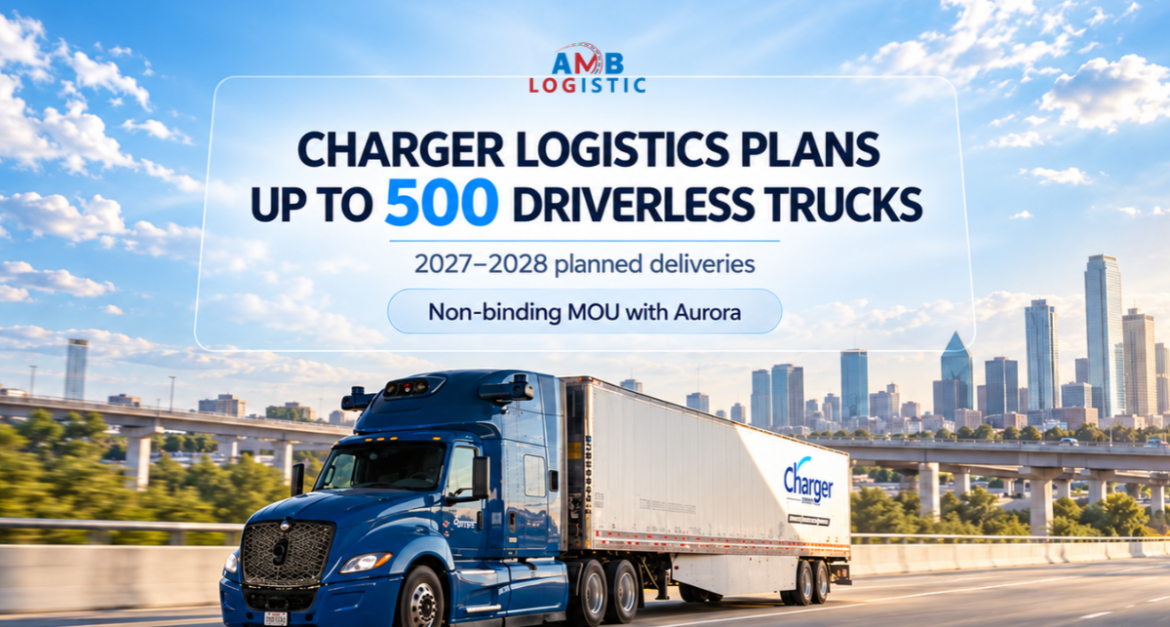
Charger Logistics is preparing for a larger role in autonomous freight. On October 26, 2026, Aurora announced a preliminary agreement outlining Charger’s intended purchase of up to 500 Aurora Driver-powered trucks, with deliveries planned for 2027 and 2028.
The announcement raises a practical question for the freight industry: how could a carrier-owned autonomous fleet change the transportation options available to shippers and brokers?
The answer will depend on the final commercial agreement, the routes introduced, and how those trucks connect with the rest of a shipment’s journey.
What the Companies Announced
The proposed expansion is outlined in a non-binding memorandum of understanding. It establishes an intended direction, while a final agreement is still required.
- Proposed fleet: Up to 500 Aurora Driver-powered trucks.
- Delivery period: Planned deliveries during 2027 and 2028.
- Operating model: Charger would own the vehicles and subscribe to Aurora’s Driver as a Service offering.
- Target network: Existing and new high-volume U.S. routes, including routes near the Mexican border.
- Existing relationship: The proposal builds on the companies’ contract signed in July 2026.
Charger also reports that autonomous operations have already begun along the Laredo corridor. Those existing operations provide context for the expansion proposal, but the proposed fleet should not be counted as capacity currently available for booking.
Why Fleet Ownership Matters
The ownership structure is a significant part of the story. A carrier purchasing autonomous trucks would be making decisions about where those assets fit within its transportation network, while relying on a separate provider for the driving technology.
For freight customers, that creates several service questions. Who accepts the shipment? Who controls dispatch? Who communicates an exception? Who arranges recovery if the planned movement cannot continue?
Those responsibilities need to be clear before a shipment is booked. The technology powering the truck is one part of the service; the commercial and operational arrangements surrounding it determine how a customer experiences that service.
For brokers evaluating an autonomous option, understanding those relationships is more useful than relying on the driverless label alone.
The Capacity Impact Will Be Lane Specific
A fleet expansion becomes commercially relevant when it creates a transportation option that matches an actual shipment requirement. The headline vehicle count cannot, by itself, establish where capacity will be available or which customers will be able to use it.
The useful questions are more precise: Which origin and destination facilities are supported? What departure windows are offered? Which equipment configurations are available? How much scheduling flexibility does the service provide?
Consider a hypothetical shipper moving consistent freight between the same two facilities every week. An autonomous service could become an option if its operating lane, equipment, handling arrangements, and delivery schedule match that shipment.
A different customer may need changing destinations, additional stops, or specialized handling. That customer would need a separate assessment. A service that fits one repeatable movement should not automatically be assumed to fit another.
Look at the Entire Shipment, Including the Handoffs
Moving a truck between two points is only part of completing a freight shipment. Cargo must also be prepared, loaded, documented, received, and checked against the customer’s requirements.
Before using an autonomous transportation option, shippers and brokers should establish how those activities connect with the driving portion of the movement. A terminal-to-terminal arrangement, for example, may involve different responsibilities from a service that includes pickup and delivery at customer facilities.
Routes near an international border also require careful service definition. A domestic movement approaching the border and a complete cross-border shipment are different transportation requirements. Customers should confirm the actual operating limits and handoff arrangements offered for their freight.
The booking decision should account for the complete movement, including any participating facilities or transportation partners.
What Brokers and Shippers Should Confirm Before Booking
If an autonomous service becomes available for a relevant lane, the evaluation should begin with the shipment’s operating requirements:
- Service coverage: Confirm the supported origin, destination, facilities, and operating windows.
- Equipment suitability: Check trailer type, cargo restrictions, loading requirements, and any temperature-control needs.
- Pickup and delivery responsibilities: Identify who manages each handoff and how shipment acceptance is documented.
- Exception handling: Establish the response process for a missed appointment, equipment problem, route disruption, or interrupted movement.
- Communication: Confirm tracking access, milestone updates, escalation contacts, and responsibility for customer notifications.
- Commercial terms: Review the full quoted service, including any additional transfers, waiting time, or related charges.
These questions turn a broad technology announcement into an operational assessment. They also provide a consistent basis for comparing the proposed service with other available carrier options.
What to Watch as the Expansion Develops
The next meaningful developments will be the completion of commercial arrangements, actual vehicle deliveries, and confirmation of available services.
For brokerage teams, specific route announcements will be particularly useful. They can show whether the expansion overlaps with existing customer freight and whether it creates an additional option worth evaluating.
Operating information will matter as well. Defined booking procedures, equipment availability, shipment visibility, and documented contingency arrangements would help customers assess how the service could fit their transportation plans.
The strongest evidence of progress will be a clearly defined service that customers can evaluate against their own requirements.
What This Means for U.S. Freight Planning
This announcement gives brokers and shippers a concrete development to monitor as they plan future transportation options. It does not require an immediate change to an existing routing strategy.
A useful approach is to identify potentially relevant lanes, follow confirmed service announcements, and evaluate any new offering against established customer requirements. That keeps the planning process grounded in available capacity and measurable service commitments.
Autonomous trucking may introduce additional choices. The decision to use one should still begin with the freight, the route, and the delivery obligation.
Discuss Your Freight Requirements With AMB Logistic
Every shipment starts with a clear understanding of what needs to move, where it needs to go, and when it needs to arrive.
Contact AMB Logistic to discuss your shipping requirements, equipment needs, lane priorities, and delivery schedules. Share the details of your upcoming freight so the conversation can focus on the transportation service your business needs.
AMB Logistic
Website: www.amblogistic.us
Email: info@amblogistic.us
Phone: +1 (888) 538-6433
Tags
Charger Logistics, Aurora Innovation, Autonomous Trucking, Driverless Trucks, U.S. Freight, Freight Brokerage, Truckload Transportation, Transportation Technology, Freight Capacity, Supply Chain Planning, AMB Logistic