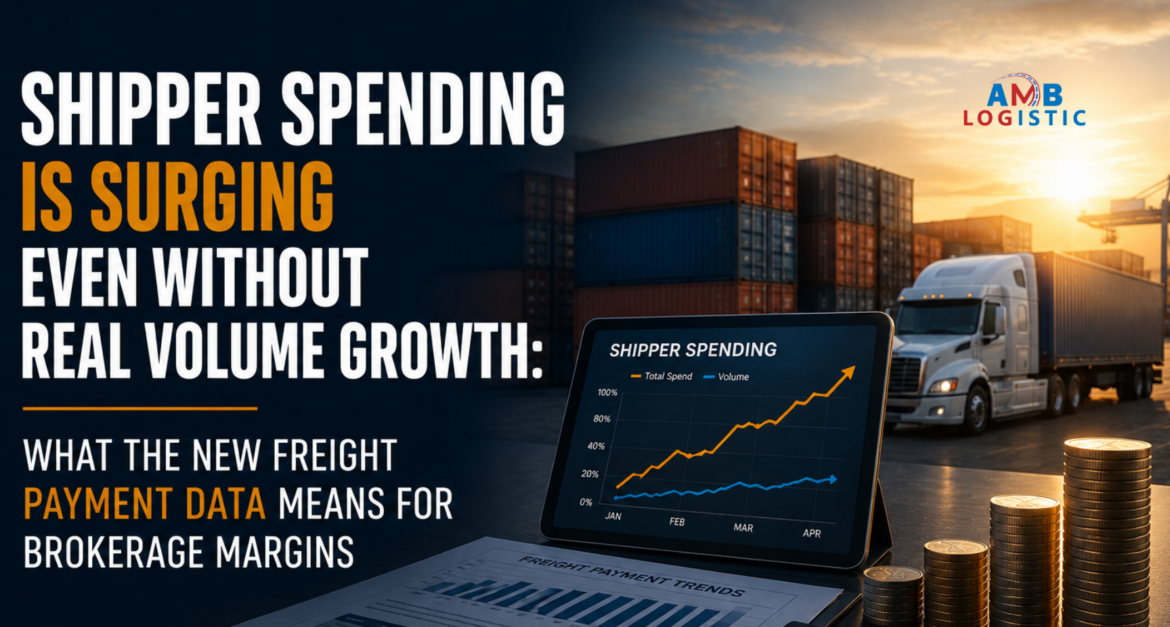
Shipper Spending Is Surging Even Without Real Volume Growth: What the New Freight Payment Data Means for Brokerage Margins
One of the clearest signals in freight right now is that cost pressure is rising faster than demand. The latest freight payment data shows national shipment volume in the first quarter of 2026 slipping only slightly from the prior quarter, while shipper spending jumped sharply at the same time. That is a market being reshaped by supply, not demand, and it matters because brokers, shippers, and carriers all operate differently when freight costs rise without a true volume-led recovery underneath them.
Introduction
For much of the last downturn, freight planning was built around a familiar assumption: if demand stayed soft enough, pricing would remain manageable and recovery options would usually exist somewhere in the network. That logic starts to break when spending surges even though shipments are barely moving. A market like that does not tell you that freight is booming. It tells you that the cost of moving freight is climbing because the system has less slack than it used to.
That is why the new freight payment data deserves close attention. The headline is not that freight volume is strong. It is that the market is getting more expensive without broad-based shipment growth to justify the increase in the way buyers are used to seeing. This is one of the most important distinctions in freight. Volume growth can create opportunity. Supply-side tightening can create margin pressure just as quickly.
Why This Matters
This matters because brokers do not make money from freight activity alone. They make money from the spread between what customers expect to pay and what it actually costs to secure dependable service. When shipment volume is nearly flat but spending jumps sharply, that spread becomes harder to manage. The same shipper who sees little volume growth may still assume they should be buying in a soft market, while the broker is already seeing tighter buy-side conditions and higher cost pressure.
It also matters because this is not a one-region anomaly. Spending is rising broadly even where shipment performance is mixed. That means brokers cannot explain the cost environment as a simple freight boom. They are looking at a market where cost inflation is spreading more broadly than shipment momentum.
- Shipment activity is not rising fast enough to explain the cost increase on its own.
- Spending is climbing much faster than volume, which points to tightening supply and more expensive execution.
- Flat demand no longer guarantees soft pricing.
- Brokers, shippers, and carriers all need to read the market differently when cost pressure leads the story.
The Broader Picture
The broader picture is that this quarter did not deliver one uniform national freight story. It delivered a divided one. Some regions still showed real shipment strength, while others remained softer. But the important common theme was that spending moved higher almost everywhere. That matters because it shows cost pressure is not waiting for a broad freight rebound to appear.
This is exactly why supply-side recoveries are so difficult for logistics teams to read. Demand-driven recoveries usually give everyone the same story: more freight, more activity, and more obvious pricing pressure. Supply-led tightening is different. It can make the market feel expensive before it feels busy. That is the kind of environment where shippers misread costs, brokers get trapped between expectations and coverage reality, and carriers with dependable capacity begin gaining leverage faster than many buyers are prepared for.
In simple terms, this is a freight market where costs are rising because the system is tighter, not because freight is suddenly exploding. That distinction matters because it changes how companies should budget, procure, quote, and plan.
What This Means for Freight Brokers and Logistics Teams
For freight brokers, the immediate implication is margin pressure. When spending is up much faster than volume, brokers cannot safely assume that more activity will offset higher buy-side costs. A busier-feeling market with tighter capacity and cost pressure can create more quote urgency, more customer resistance, and a faster erosion of the space between sell-side expectations and actual carrier economics. That makes lane discipline, timing discipline, and customer communication more important than they were even one quarter ago.
For shippers, the message is that cost control is no longer simply a function of weak freight demand. A company can see only modest shipment movement and still face a sharply higher freight bill. That means procurement teams need to separate “soft demand” from “soft pricing.” They are not the same thing anymore. If spending can rise this sharply in a near-flat-volume quarter, then budgeting, bid strategy, and lead-time planning all need to reflect a market that is tightening from the supply side.
For carriers, especially those that remained disciplined through the downturn, the quarter reinforces the value of dependable capacity. When a market is being shaped more by supply contraction than demand acceleration, reliable operators gain pricing power faster. That does not mean every carrier automatically wins, but it does mean that stability, service, and consistency become more valuable when there are fewer trucks in the competitive set.
The Freight Broker Playbook
1) Stop treating flat volume as proof of easy pricing
The first adjustment is conceptual. Shipment volume being flat or only slightly positive no longer guarantees a soft buy-side environment. This quarter shows the opposite can happen. Brokers who keep using weak-volume logic to justify old pricing assumptions risk getting caught by a market that is tightening from the supply side.
2) Re-center the cost conversation with customers
A sharp increase in spending with almost no shipment growth gives brokers a strong basis for customer conversations. The point is not to dramatize the market. The point is to explain clearly that freight bills are moving because the cost structure is changing faster than volume is. That is a more useful and more honest way to frame the quarter.
3) Watch region-by-region signals, not just national averages
Some regions may show more shipment strength than others, while cost pressure can still spread broadly. Brokers that understand where volume is genuinely growing and where spending is rising despite softer freight will make better planning decisions than teams relying only on a national headline.
4) Treat cost pressure as structural until proven otherwise
One of the biggest mistakes in markets like this is assuming that rising costs will fall back quickly simply because volumes are not booming. Sometimes that happens. Sometimes it does not. When spending rises sharply in a flat-volume market, teams should stop assuming the environment is automatically self-correcting and start planning for a phase where discipline matters more than optimism.
5) Sell resilience and planning clarity, not just transactional coverage
In a supply-led tightening cycle, shippers need more than spot execution. They need help planning around a market that looks softer in volume terms than it actually behaves in cost terms. That is where brokers can create real value: by translating a confusing freight environment into clearer decisions before the cost side gets worse.
AMB Logistic’s Role
At AMB Logistic, we see a quarter like this as a reminder that strong brokerage is not only about moving freight when the market is easy to read. It is about guiding customers through the moments when the market becomes harder to interpret. When spending climbs sharply without real volume growth, the right brokerage partner should help customers understand what is changing, where it is changing, and how to respond before the pressure shows up as lost margin or service disruption.
Our role is to help customers move ahead of that pressure. That means sharper lane awareness, better communication on cost movement, stronger alignment between pricing and execution, and a freight strategy built around the market that actually exists rather than the market everyone wishes had stayed in place.
- Clearer pricing conversations,
- stronger lane-level planning,
- faster response to tightening buy-side conditions,
- and freight execution built for a market with less easy margin.
FAQ
Why is flat shipment volume with higher spending such a big deal?
Because it means freight costs are rising without a broad demand recovery underneath them. That points to a supply-side tightening story, not a normal high-demand freight cycle.
What does this mean for brokerage margins?
It means margins can come under pressure faster if customer pricing expectations are still anchored to a softer market while buy-side costs rise because of tighter capacity and higher transportation costs.
Does this mean every region is strong?
No. The regional picture can still be mixed. What matters is that spending is rising more broadly than shipment strength, which tells you cost pressure is moving faster than freight demand.
What should shippers do now?
Revisit freight budgets, separate volume assumptions from pricing assumptions, and build procurement decisions around a market that may be tightening from the supply side even when volumes look modest.
Final Word From AMB Logistic
The most important thing about the latest freight payment data is not that spending jumped. It is why spending jumped. When shipment volume barely moves but freight bills surge anyway, the market is sending a clear signal: this is not a demand-led recovery story. It is a supply-side tightening story, and those can be harder for brokers and shippers to interpret because the price pressure arrives faster than the freight narrative does.
That is why this quarter matters. It challenges one of the most comfortable assumptions in logistics: that weak demand automatically means easy transportation economics. Right now, that assumption is getting weaker. The teams that recognize that early will plan better, price better, and execute with more control while others are still trying to reconcile soft volume with rising cost.
Talk To AMB Logistic Today
If your team is facing higher freight costs without the shipment growth to explain them, AMB Logistic can help you navigate the shift with clearer pricing, stronger planning, and better execution.
Call: +1 (888) 538-6433
Email: info@amblogistic.us
Web: www.amblogistic.us
Tags
freight payment index, shipper spending, freight brokerage margins, capacity tightening, diesel costs, AMB Logistic