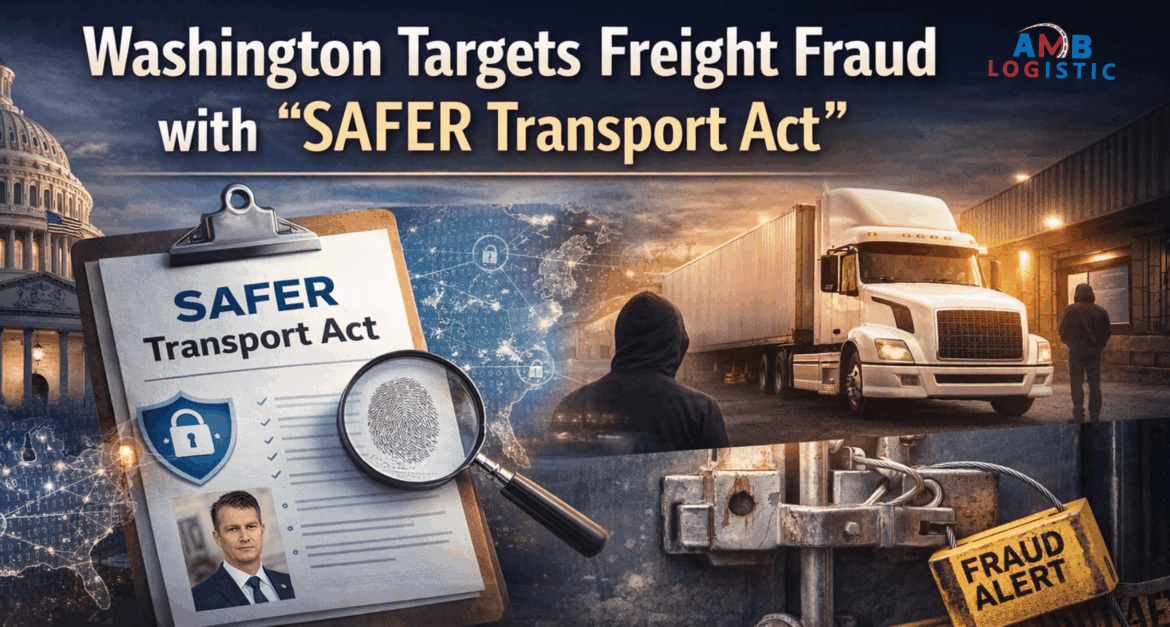
Washington Is Moving on Freight Fraud and Cargo Theft, but Brokers Cannot Wait for Regulation to Protect Their Freight
Washington is moving on freight fraud and cargo theft through the SAFER Transport Act, introduced by Sen. Todd Young on February 26, 2026, with ATA publicly backing it the same day. That matters because freight fraud is no longer a side issue buried in compliance talk. For brokers, carriers, shippers, and logistics teams, identity theft, double brokering, and fraudulent pickups have become serious operational threats, and the immediate lesson is clear: verification discipline has to improve now, not after regulation catches up.
Introduction
Freight fraud is no longer an isolated risk that appears once in a while and disappears after a few internal warnings. It has become a persistent, adaptive, and increasingly costly threat woven directly into the operating reality of modern logistics. What once looked like a handful of bad actors exploiting occasional weaknesses now looks much more like a broader criminal pattern targeting the exact places where transportation networks move fastest and trust is assumed most easily. Freight fraud today is not just about stolen loads. It is about manipulated identities, false dispatch chains, rerouted communications, fake authority signals, altered pickup information, compromised payment instructions, and organized schemes designed to exploit the speed and fragmentation of freight execution.
That is what makes the SAFER Transport Act so important at the policy level. When lawmakers start moving on freight fraud, cargo theft, and related loopholes, it signals that the issue has grown far beyond a private operational nuisance. It means the problem has reached a scale serious enough to demand federal attention, industry coordination, and stronger tools to close the gaps that bad actors continue to exploit. The policy movement matters. It reflects the fact that freight fraud is not merely irritating, embarrassing, or expensive. It is a threat to supply chain reliability, cargo control, business trust, and the basic integrity of freight transactions.
But the most important takeaway for brokers is not that Washington is finally paying attention. The real takeaway is that no legislative timeline can protect the load that is tendered tonight, the pickup scheduled for tomorrow morning, or the carrier setup rushed through under pressure this afternoon. Regulation can strengthen the environment over time. It cannot substitute for disciplined operating habits inside the brokerage today. That is why the right response is not to sit back and wait for legal fixes. The right response is to tighten verification, control communication, slow down at the right moments, and rebuild process discipline where fraud now hits hardest.
Why This Matters
This matters because freight fraud strikes at the core assumptions that make brokerage work. Freight moves because one party believes another party is who they say they are, has the authority they claim to have, and will execute the shipment within the expected chain of responsibility. When those assumptions are false, the system begins to break at the exact points where speed and trust normally make the operation efficient. A broker releases a load to a carrier profile that looks legitimate. A shipper hands over cargo because the driver appears to match the pickup information. A payment gets sent because the documentation trail appears normal. A customer assumes control remains intact because the communication looks routine. Fraud works by stepping inside those familiar patterns and turning them against the people who rely on them.
The cost is not limited to a stolen shipment or a disputed invoice. Fraud consumes labor, destroys margin, triggers claims, damages customer trust, disrupts carrier relationships, and forces teams into reactive cleanup work that spreads far beyond the original incident. A single bad handoff can create days of confusion, multiple layers of internal investigation, strained customer conversations, and reputational damage that lingers longer than the immediate financial loss. In a brokerage environment where responsiveness and reliability define competitive value, those consequences are enormous.
- Identity theft has become a live freight risk: Criminals are increasingly using stolen or imitated carrier identities to access loads, payment pathways, and operational trust.
- Double brokering destroys load control: Once freight is passed beyond the approved chain, visibility weakens and accountability begins to collapse.
- Fraudulent pickups expose cargo immediately: When the wrong party gets the freight, recovery becomes far harder and the damage accelerates fast.
- Weak verification can become a margin and customer crisis: One preventable fraud event can lead to claims, service failures, unpaid balances, and long-term trust erosion.
The Broader Picture
The broader picture is that freight fraud has evolved alongside the modernization of logistics itself. The industry has spent years building for speed. Faster onboarding, faster digital communication, faster coverage, faster tendering, faster rate response, faster documentation, and faster recovery from disruption have all made the market more dynamic. Those advances are real, and they create enormous value. But they also create more entry points for fraud when control systems have not evolved at the same pace. Every place where the freight industry reduced friction for legitimate business also created an opportunity for bad actors to imitate legitimacy more efficiently.
That is why this is not just a security issue. It is a design issue within freight operations. Brokers often work across multiple communication channels, third-party tools, changing dispatch contacts, urgent coverage windows, night and weekend operations, and customers who need answers immediately. Shippers need freight moved. Carriers need quick decisions. Operations teams are rewarded for solving problems fast. Fraudsters understand that environment. They do not need to break the system from the outside. They only need to mimic enough of the system’s normal behavior to enter it, gain trust, and exploit the moments when no one wants to be the person slowing things down.
This also explains why policy action alone cannot solve the full problem. Freight fraud is partly a law-enforcement challenge, partly a regulatory issue, and partly an operational discipline problem. Stronger federal tools can close loopholes, strengthen oversight, and improve enforcement against bad actors. That is important and overdue. But freight fraud often succeeds in the small, ordinary moments inside daily execution: a phone number that changed without adequate challenge, an email that looked close enough to familiar, a setup packet that passed because the team was under time pressure, a pickup that was released because the warehouse relied on limited confirmation, a suspicious dispatch pattern that no one escalated because the freight needed to move. The broader lesson is that the industry must treat verification as part of execution itself, not as a secondary compliance layer that activates only after something feels wrong.
What This Means for Freight Brokers and Logistics Teams
For freight brokers and logistics teams, this moment should trigger a change in posture. Fraud prevention cannot remain an exception-based process that only activates when a situation seems obviously suspicious. It has to become part of normal operating discipline, built into the load lifecycle from setup through pickup, transit communication, delivery verification, and payment control. The market has changed too much for the old assumption that routine freight can safely move on routine trust. Many fraud events now begin inside transactions that look ordinary at first glance. That means ordinary workflows need stronger control, not just extraordinary cases.
This shift also means brokers need to stop thinking about fraud as something separate from service execution. Fraud prevention is not a side project for compliance teams. It is part of how a professional brokerage protects freight, protects customer trust, protects margin, and protects its own operational credibility. A fast-moving load handled with weak verification is not efficient. It is exposed. A carefully verified load is not slow by definition. It is controlled. The teams that understand this distinction will be better positioned to avoid cargo loss, reduce chaos, and build stronger confidence with both shippers and legitimate carriers in a market where trust must be earned through process, not assumed through habit.
The Freight Broker Playbook
1) Rebuild carrier verification around identity control
The first action is to strengthen the point where trust begins. Carrier verification must go beyond collecting documents and matching surface-level information. A modern fraud strategy demands active identity control. Brokers need to verify not just that a carrier entity exists, but that the person communicating actually represents that entity, that the communication path is legitimate, that the contact information aligns with trusted records, and that recent changes are understood and confirmed before freight is released. Identity theft works precisely because a legitimate company’s credibility can be borrowed, imitated, or manipulated long enough to pass weak controls.
That means every brokerage should review how it handles contact changes, new email paths, alternate phone numbers, rushed setup scenarios, authority inconsistencies, and dispatch arrangements that do not align cleanly with the expected operating model. A fraudulent actor does not always need a perfect fake. They often need only a believable enough version of something real. The broker’s job is to make “believable enough” no longer sufficient. Good verification is not paperwork alone. It is confirmation that the specific party asking for the load is actually entitled to handle the load.
2) Treat double brokering as a preventable control failure
Too many teams still talk about double brokering mainly as an unfortunate outcome discovered after service breaks down or communication becomes messy. That mindset is dangerous. Double brokering should be treated as a control failure that can often be detected earlier and prevented through stronger operational discipline. Once a load leaves the approved chain, the broker’s ability to manage service, insurance exposure, accountability, and cargo security deteriorates quickly. The real damage is not just that a rule was broken. The real damage is that the broker no longer has clear control over who is physically handling the freight.
The right response is tighter clarity around who accepted the load, who is dispatching it, what equipment is expected, what contact path is authoritative, and whether any handoff has occurred outside approved visibility. Brokers should not be satisfied with vague assurances when the communication trail becomes inconsistent. When a new party suddenly appears in the chain, when dispatch behavior shifts unexpectedly, or when information begins moving through unfamiliar intermediaries, that is not administrative noise. It is a control signal. Smart brokers investigate early because once the freight is moved through undisclosed hands, recovery options narrow dramatically.
3) Harden pickup release procedures before the handoff happens
Fraudulent pickups are among the most damaging forms of freight fraud because the cargo itself leaves controlled hands almost immediately. That means pickup release discipline deserves far more attention than many teams currently give it. Brokers and shippers often focus intensely on setup and rate confirmation, but the final release point remains vulnerable if the warehouse or shipping location is relying on limited verification or informal information flow. Pickup numbers, driver details, tractor and trailer information, arrival instructions, and release authorization should be treated as controlled operational assets, not casually shared details moving across whatever channel is convenient in the moment.
Strong pickup control starts before the truck arrives. There should be clear expectations around who can receive pickup information, how updates are validated, what happens if the arriving identity does not match the approved details, and how suspicious discrepancies are escalated. A team that verifies the carrier carefully but releases freight loosely at the dock still leaves the most expensive door open. Fraudsters understand that the release moment is where the physical risk becomes real. Brokers and warehouse partners have to treat that moment with the same seriousness as the original onboarding.
4) Build fraud checks into fast-moving freight, not just suspicious freight
One of the biggest mistakes in the current market is assuming fraud prevention belongs mostly to high-value freight, unusual shipments, or obviously risky scenarios. In reality, fraudsters often target fast-moving, time-pressured freight because urgency weakens process. Same-day coverage, after-hours tenders, late-night dispatch changes, weekend pickups, recovery loads, distressed freight, and last-minute capacity replacements all create opportunities for bad actors to exploit teams that are focused more on solving the service problem than validating the operating counterparties. The faster the load has to move, the more discipline the process actually needs.
That does not mean brokers should become slow or impossible to work with. It means the verification model should be designed for speed without sacrificing control. Teams need predefined rules for urgent scenarios. Who has authority to approve a rapid carrier setup? What must be verified before pickup information is released? What happens when driver details change close to appointment time? How are late-night communications validated? What escalation path exists when the business urgency is high but the identity trail is weak? Fraud prevention becomes operationally powerful when it is embedded inside pressure-tested workflows rather than left to improvisation.
5) Make verification discipline part of brokerage culture
Sustainable fraud prevention is not created by one training session, one updated checklist, or one strong internal memo after an incident. It is created by culture. Verification discipline has to become part of how the brokerage defines professionalism. Teams need to understand that protecting freight is not a side activity competing with speed, sales, or customer responsiveness. It is a core part of delivering real service. A brokerage culture that rewards only fast coverage and volume growth while quietly treating verification as friction will keep creating openings for fraud. A brokerage culture that respects control, escalation, and disciplined handoffs will protect both revenue and reputation.
This cultural shift matters because fraud patterns keep evolving. Criminals study workflows. When one loophole becomes harder to exploit, they search for another. That means a static process is never enough. What gives a brokerage resilience is a team trained to notice anomalies, willing to challenge inconsistency, and empowered to pause questionable activity without fear of being blamed for slowing a shipment down. Strong culture turns verification from a checklist into an operating reflex. In the current environment, that reflex may be one of the most valuable assets a brokerage can build.
AMB Logistic’s Role
At AMB Logistic, we treat freight fraud and cargo theft as serious execution threats that require disciplined control, not passive concern. The right answer is not panic, and it is not empty talk about industry risk. The right answer is strong process around carrier validation, communication control, pickup awareness, and load oversight from the first handoff to the final delivery milestone. Freight moves too fast, customer expectations are too high, and the cost of one bad release is too severe for casual verification habits to remain acceptable.
Our approach is grounded in practical logistics execution. That means paying attention to identity consistency, respecting operational red flags, maintaining tighter control over pickup and communication flow, and supporting customers with responsive coordination when freight risk appears to rise. In a market where bad actors exploit routine behavior, disciplined process becomes a real competitive advantage. Customers do not just need freight moved. They need freight moved under control, with reliability, visibility, and verification strong enough to protect the shipment as well as the service promise.
- Disciplined verification across load handling,
- stronger communication control and pickup awareness,
- responsive coordination when fraud signals appear,
- reliable execution built around freight protection as well as freight movement.
FAQ
Why should brokers care about the SAFER Transport Act if fraud prevention is already their job?
Because the legislation confirms that freight fraud and cargo theft have become serious enough to demand stronger public attention and stronger federal tools. That matters at the industry level. But at the brokerage level, the more immediate lesson is that a live operational problem cannot be solved by waiting for future system improvements. The existence of legislation should increase urgency inside brokerage operations, not create false comfort that regulation will soon protect every shipment automatically.
Is double brokering mainly a compliance problem or an operations problem?
It is both, but its most immediate consequences are operational. When a load is passed beyond the approved carrier chain, the broker loses clear control over who is handling the freight, how the shipment is being managed, and whether the promised service can still be trusted. That affects visibility, accountability, claims exposure, payment confidence, and customer trust. Treating double brokering as only a paperwork issue ignores how quickly it can become a live freight control failure.
Why are fraudulent pickups so dangerous compared with other fraud schemes?
Fraudulent pickups are especially dangerous because they immediately transfer physical control of the cargo to the wrong party. Once that happens, the problem is no longer limited to suspicious communication or questionable paperwork. The freight is already exposed, recovery becomes more difficult, and the downstream impact can spread quickly into claims, customer escalation, operational confusion, and reputational damage. That is why pickup release discipline matters so much.
What should brokers do right now, before any regulation changes the landscape?
They should tighten carrier identity validation, harden pickup release procedures, treat communication inconsistencies more seriously, embed fraud checks into urgent freight workflows, and reinforce a culture where verification is part of professional execution rather than a secondary administrative step. The most practical response is immediate improvement in operating discipline, because freight protection works best before the handoff, not after the loss is discovered.
Final Word From AMB Logistic
The biggest mistake brokers can make right now is reading legislative action as a sign that the system is about to solve the problem for them. Freight fraud and cargo theft have already become serious enough to force movement in Washington. That should not reduce urgency inside the brokerage. It should sharpen it. Every rushed setup, every weak identity check, every loose pickup release, and every ignored inconsistency creates an opening that bad actors can exploit long before policy reform has time to reach the street-level reality of freight execution.
The smart response is straightforward. Treat freight protection as part of freight execution. Build verification into speed, not against it. Tighten control before the pickup, not after the claim. And understand that in today’s logistics environment, disciplined verification is not administrative overhead. It is one of the strongest defenses a broker has against stolen cargo, broken trust, damaged margins, and avoidable operational loss.
Talk To AMB Logistic Today
If freight fraud, cargo theft, or weak verification is becoming a growing risk in your network, AMB Logistic can help you strengthen execution before the next load is exposed.
Call: +1 (888) 538-6433
Email: info@amblogistic.us
Web: www.amblogistic.us
Tags
freight fraud, cargo theft, double brokering, fraudulent pickups, carrier verification, AMB Logistic