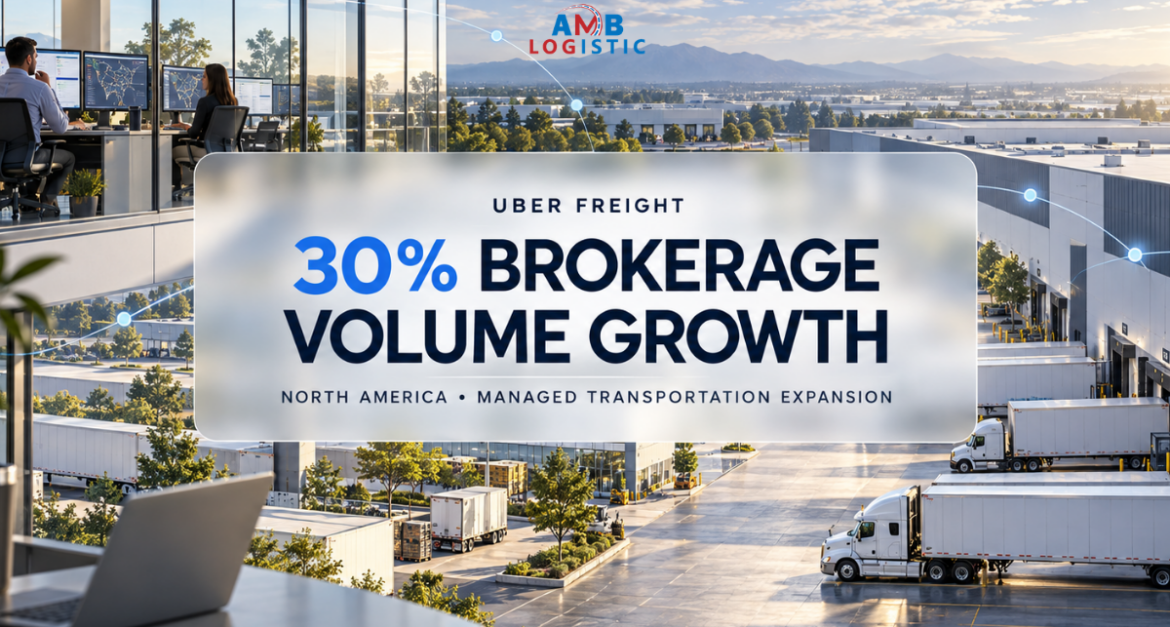
A freight broker can grow by covering more loads. It can also grow by taking responsibility for more of a customer’s transportation operation. Uber Freight’s latest business update highlights both approaches.
In an October 14, 2026 update outlining CEO Rebecca Tinucci’s strategy, the company reported a 30% increase in North American brokerage volume, its second consecutive quarter of year-over-year revenue growth, and a doubling of new managed-transportation customer additions compared with 2025.
The update also emphasized investment in artificial intelligence, network scale and closer connections between middle-mile freight and last-mile logistics through the broader Uber platform.
For freight brokers and shippers, the development raises a practical question: how much of a customer’s transportation operation can one provider coordinate effectively?
What Uber Freight Actually Reported
The company’s update identifies three separate indicators of business momentum:
- North American brokerage volume increased 30%. The short announcement does not identify the comparison period, so this figure should not be described as year-over-year growth.
- Revenue grew year over year for two consecutive quarters. This describes the revenue trend, not the size of the increase.
- New managed-transportation customer additions doubled compared with 2025. This concerns new customer additions, not a doubling of the entire customer base.
These measures describe different parts of the business. Brokerage volume reflects freight activity, revenue reflects commercial performance, and customer additions indicate expansion in managed transportation.
Together, they suggest broader operating momentum. They do not, by themselves, establish profitability or explain how much each service contributed to growth.
Why Brokerage Volume and Revenue Need Separate Attention
Moving more freight is an important indicator, but shipment volume alone does not explain the financial health of a brokerage.
Revenue can change because of shipment counts, transportation prices, customer mix, shipment characteristics or the services provided. A broker can handle more loads while earning less on each transaction, or increase revenue without a similar improvement in operating profit.
That makes the distinction between growth and profitability essential.
Recent reporting describes Uber Freight as remaining unprofitable while Tinucci prioritizes investment and business expansion. The latest growth figures should therefore be understood as evidence of commercial progress rather than proof that the turnaround is complete.
The longer-term test is whether additional freight and customer relationships translate into sustainable earnings and consistent service.
From Individual Loads to Managed Transportation
Traditional freight brokerage typically involves arranging transportation for a shipment: finding a suitable carrier, negotiating the movement, coordinating execution and communicating with the customer.
Managed transportation can extend that relationship across a larger portion of a shipper’s network.
Depending on the agreement, responsibilities may include:
- Transportation planning and shipment coordination
- Carrier procurement and performance management
- Routing-guide administration
- Transportation-management-system support
- Shipment visibility and exception handling
- Freight audit and payment coordination
- Network analysis and service reporting
These are common managed-transportation functions. The exact scope varies by customer and should not be assumed from the announcement alone.
Uber Freight’s reported increase in new managed-transportation customer additions matters because these relationships can involve recurring coordination across many shipments, facilities and transportation providers.
Why Some Shippers Want Fewer Logistics Providers
A shipper using several disconnected providers may spend considerable time reconciling information.
One provider reports the pickup. Another manages the warehouse appointment. A third handles the final delivery. Each may use different systems, operating procedures and performance measures.
Consolidating responsibilities can simplify communication and provide a more consistent view of the shipment network.
Potential benefits include:
- Fewer disconnected operating systems
- Clearer escalation paths
- More consistent shipment information
- Standardized performance reporting
- Better coordination between transportation stages
- A clearer owner for resolving exceptions
However, consolidation also creates dependence. If a provider experiences a service disruption, technology outage or capacity problem, the effects can reach more of the customer’s network.
Shippers should therefore evaluate both the convenience of consolidation and the resilience of the resulting operating model.
Where Artificial Intelligence Fits
Uber Freight’s update places artificial intelligence within its broader growth strategy. The announcement does not provide enough detail to attribute the reported volume increase to a particular AI application.
Across freight brokerage, potential applications include identifying suitable capacity, processing shipment information, supporting appointment workflows and helping operations teams prioritize exceptions.
The practical value depends on whether the technology improves a measurable outcome.
Useful questions include:
- Does it reduce the time needed to identify suitable carriers?
- Does it improve the accuracy of shipment information?
- Does it help teams detect delays earlier?
- Does it reduce repetitive administrative work?
- Does it improve communication without obscuring accountability?
- Can a person review and correct the system’s decisions?
A faster process is valuable only if the underlying information and resulting decisions are reliable.
Carrier qualification, shipment requirements, customer commitments and exception management still require clear controls and responsible oversight.
Connecting Middle-Mile Freight with Last-Mile Delivery
The company also highlighted the opportunity to connect middle-mile freight with last-mile logistics through the broader Uber platform.
These stages serve different functions. Middle-mile transportation generally connects facilities such as warehouses, distribution centers and fulfillment locations. Last-mile delivery completes the movement to the final recipient.
Coordinating them can help reduce the gap between an inbound freight arrival and the next delivery commitment.
But coordination requires more than connecting software. The physical handoff must work.
Teams need to know when freight will arrive, when it will be available for release, who accepts custody and how delays affect the next stage.
The announcement describes a strategic direction. It does not establish that every Uber Freight customer already receives a fully integrated middle-mile-to-last-mile service.
What This Means for Independent Freight Brokers
The competitive implication is that some customers may increasingly compare providers on their ability to coordinate transportation beyond an individual load.
That does not mean every broker needs to become a large managed-transportation company.
A focused brokerage can remain valuable by serving a specific customer need exceptionally well, whether that involves a difficult lane, specialized equipment, urgent shipments or close operational attention.
The useful response is to make that value visible.
Show Consistent Execution
Track pickup performance, delivery performance, carrier acceptance and communication quality. Customers need evidence that the broker can repeat a successful result.
Strengthen Shipment Visibility
Provide timely, accurate updates and make exceptions clear. A customer should understand what happened, what it affects and what action is underway.
Understand the Customer’s Wider Operation
A missed appointment may affect production, warehouse labor or downstream deliveries. Understanding those consequences helps a broker plan and communicate more effectively.
Use Technology Where It Improves Service
Automation can support document handling, tracking and routine updates. Its value should be judged by accuracy, time saved and the quality of the customer experience.
Keep Ownership Clear
When a shipment encounters a problem, the customer needs a responsible person who can coordinate the response. Technology should support that ownership.
What Shippers Should Evaluate Before Expanding a Provider’s Role
A provider offering more services may simplify a transportation network, but the proposed scope should be specific.
Before transferring additional responsibilities, shippers should ask:
- Which activities will the provider manage directly?
- Which activities will involve subcontractors or other partners?
- Who owns carrier selection and performance management?
- How will shipment information connect with existing systems?
- Who handles urgent exceptions outside normal business hours?
- How will service performance and savings be measured?
- What happens during a technology outage?
- How will data access and business continuity be protected?
- What arrangements apply if the customer changes providers?
These questions help determine whether a broader relationship will deliver operational value rather than simply move existing complexity to a different organization.
What to Watch Next
Uber Freight’s latest update provides evidence of growth. The next questions concern the durability and economics of that growth.
Important indicators will include whether brokerage activity remains strong, new managed-transportation relationships develop into sustained business, and additional scale improves financial performance.
Service quality will matter just as much. More volume increases the demands on carrier relationships, operating teams, technology and customer communication.
For the wider brokerage industry, the story is a useful reminder that customers purchase more than access to a truck. They also purchase coordination, reliable information and confidence that someone will manage the shipment when the original plan changes.
A Broader Test of Freight Brokerage Value
Uber Freight’s reported 30% increase in North American brokerage volume, consecutive quarters of annual revenue growth and expansion in new managed-transportation customers point to commercial momentum.
Profitability remains a separate challenge, and the comparison period for the 30% volume figure has not been specified in the short company update.
For brokers and shippers, the development highlights an increasingly important competitive question: who can combine transportation capacity with dependable execution, useful technology and clear accountability?
Winning more freight is one milestone. Managing it reliably—and building a sustainable business around it—is the continuing test.
Plan Your Freight with AMB Logistic
Whether you are arranging an individual shipment or coordinating recurring freight, clear requirements and consistent communication help build a stronger transportation plan.
Connect with AMB Logistic to discuss your lanes, equipment needs, pickup and delivery expectations, and contingency requirements.
Website: www.amblogistic.us
Email: info@amblogistic.us
Phone: +1 (888) 538-6433
Tags: Uber Freight, Freight Brokerage, Managed Transportation, North American Freight, Transportation Management, Logistics Technology, Artificial Intelligence in Logistics, Middle-Mile Logistics, Last-Mile Delivery, Carrier Management, Freight Visibility, Supply Chain Management, Shipper Strategy, AMB Logistic