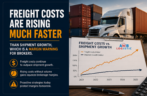
Truckload Volatility Returns: October 2025 Spot Market Surge and What It Means for U.S. Capacity Strategy
After months of calm, the freight market roars back — and shippers must rethink how they buy, plan, and pivot.
A Quiet Market Just Got Loud
For most of 2025, U.S. trucking looked stable.
Spot rates hovered near three-year lows, contract lanes were predictable, and carriers finally caught their breath after pandemic whiplash.
Then came October.
According to ITS Logistics’ latest Supply Chain Report, spot truckload rates spiked sharply as non-domiciled CDL enforcement tightened driver supply and hurricane disruptions hit the Southeast.
For the first time in over a year, capacity scarcity is back on the board.
What’s different this time is the structure of the volatility: it’s not about panic — it’s about systemic pressure points that could stretch well into 2026.
Why This Matters to U.S. Shippers and Carriers
Freight volatility doesn’t just move prices — it rewrites operating models.
When spot rates swing 10–20 percent in a month, the ripple reaches procurement, warehousing, and even customer pricing.
1. Compliance Shock Shrinks Driver Pool
New DOT enforcement on non-domiciled CDL drivers removed thousands from active rosters overnight.
With roughly 12 percent of long-haul drivers falling under that category, the result was an immediate tightening in lane coverage — especially in border states and major ports.
2. Weather Disruptions Amplify the Crunch
Hurricane season forced diversions through the Gulf and Mid-Atlantic corridors, tying up capacity in FEMA and relief contracts.
That left fewer trucks for commercial freight, driving short-term spot bids up 15–18 percent in affected regions.
3. Inventory Restocks Collide with Peak Season
Retailers front-loaded Q4 inventory earlier this year, but delayed replenishment schedules now overlap with e-commerce demand — creating a double peak.
4. Contract vs. Spot Gap Narrows
For most of 2024, contract rates were 15–20 percent higher than spot.
Now, the gap has collapsed to under 5 percent, tempting carriers to reject contract loads in favor of higher-margin spot freight.
5. Fuel and Insurance Inflation Returns
Diesel ticked back above $4.20 per gallon, and liability premiums climbed again after major verdicts — adding fixed cost pressure that feeds directly into rate floors.
Together, these forces mark the return of true cyclical volatility — not the chaos of 2021, but a leaner, harder market where strategy replaces luck.
The Broader Picture: The Freight Cycle Reawakens
The U.S. truckload market runs on rhythm — expansion, oversupply, correction, and recovery.
October 2025 marks the transition from “deflationary calm” to “strategic tightening.”
1. Demand Is Normalizing, Not Exploding
Freight volumes aren’t skyrocketing; they’re stabilizing at pre-pandemic averages.
The surge is about capacity contraction, not runaway demand.
2. Smaller Fleets Are Exiting
Months of soft rates and high costs have pushed many single-truck and small-fleet operators out of business.
FMCSA revocations rose 9 percent quarter-over-quarter — shrinking the active truck base just as demand recovers.
3. Large Fleets Are Getting Selective
Top 50 carriers are optimizing asset deployment using AI-based profitability scoring.
That means cherry-picking freight and declining low-yield lanes — reinforcing regional imbalances.
4. Brokerages Are Reinventing Playbooks
Digital brokerages now use real-time pricing APIs to quote in seconds — but the volatility means algorithmic bids must be re-trained weekly.
Human experience is back in demand.
5. Shippers Are Redefining “Capacity Strategy”
Instead of chasing the lowest rate, leading shippers are designing elastic capacity networks — blending contract stability with on-demand flexibility.
What Shippers and 3PLs Need to Do Now
1. Rebalance Contract and Spot Exposure
Keep at least 70 percent of volume under contracts to stabilize budgets, but reserve 30 percent for agile spot coverage.
Use predictive indices to time buy-in when the market softens again.
2. Map Carrier Health
Monitor partner carriers’ operating authority status, CSA scores, and equipment counts.
Early detection of struggling fleets prevents mid-lane failures.
3. Build Regional Flex Pools
Position drop trailers and short-term carrier partners in surge regions.
Elastic pools absorb rate spikes without breaking national SLAs.
4. Integrate Real-Time Market Intelligence
Feed rate indices, weather feeds, and capacity data into your TMS.
The faster you see shifts, the cheaper your response.
5. Expand Modal Options
Shift overflow freight into intermodal or LTL consolidation to reduce exposure to full-truckload volatility.
6. Run Scenario Simulations
Use digital-twin modeling to stress-test how 10%, 20%, or 30% rate spikes would impact total landed cost.
7. Strengthen Carrier Relationships
When capacity tightens, loyalty matters.
Offer consistent freight, faster pay terms, and transparent communication — relationships outperform algorithms in volatile markets.
AMB Logistic’s Role
At AMB Logistic, we’re helping clients turn volatility into advantage through data-driven resilience and adaptive routing.
✅ Predictive Rate Intelligence – AI models forecast rate movements by lane, region, and commodity weeks ahead.
✅ Elastic Capacity Networks – Hybrid frameworks combining core carriers, vetted spot partners, and intermodal options.
✅ Real-Time Visibility Dashboards – Live tracking of rate indices, dwell times, and weather disruptions.
✅ Carrier Health Monitoring – Automated alerts for authority changes, insurance lapses, and performance dips.
✅ Strategic Procurement Support – Dynamic bid strategies that align with market cycles, not static annual RFPs.
✅ Crisis Routing Solutions – Rapid re-allocation of freight when storms, strikes, or compliance shocks hit.
Our commitment: to keep your freight predictable — even when the market isn’t.
FAQs
Q: What caused the sudden October 2025 spot rate surge?
A mix of non-domiciled CDL enforcement, weather disruptions, and restocking demand squeezed capacity simultaneously.
Q: How long will volatility last?
Analysts expect elevated spot rates through Q1 2026 before stabilizing in spring.
Q: Should shippers lock long-term contracts now?
Yes — secure key lanes before carriers fully reprice for 2026. Keep flexible volume clauses for volatility.
Q: Is intermodal a viable hedge?
Absolutely. Rail capacity remains available and can offset long-haul truck exposure if service time allows.
Q: How are smaller carriers affected?
Many are exiting due to compliance and cost pressure, reducing total available trucks.
Q: Does AI pricing actually help?
Yes — predictive tools improve timing for contract negotiations and short-term bids.
Q: What’s the biggest risk ahead?
Driver availability. Enforcement and aging demographics will continue to squeeze supply into 2026.
Q: How can AMB Logistic help mid-size shippers specifically?
Through tailored carrier-mix modeling, dynamic rate forecasting, and surge-region capacity sourcing.
Final Word from AMB Logistic
After two quiet years, the freight cycle is alive again.
This isn’t 2021’s chaos — it’s the disciplined volatility of a maturing market learning to price itself properly.
For shippers, the lesson is clear:
You can’t predict the market perfectly — but you can prepare your capacity intelligently.
At AMB Logistic, we design that preparedness.
With predictive intelligence, multimodal agility, and real-time insight, we make sure your loads move — whatever the index says tomorrow.
Because in trucking, stability isn’t found — it’s engineered.
Call to Action
Turn volatility into strategy with AMB Logistic’s predictive capacity planning and rate-intelligence solutions.
Let’s stabilize your lanes before the next surge hits.
📧 info@amblogistic.us
📞 +1 (888) 538-6433
🌐 www.amblogistic.us
Tags
truckload volatility 2025, spot rate surge, ITS Logistics report, capacity strategy, driver shortage, intermodal alternatives, freight forecasting, logistics resilience, U.S. supply chain trends, AMB Logistic insights