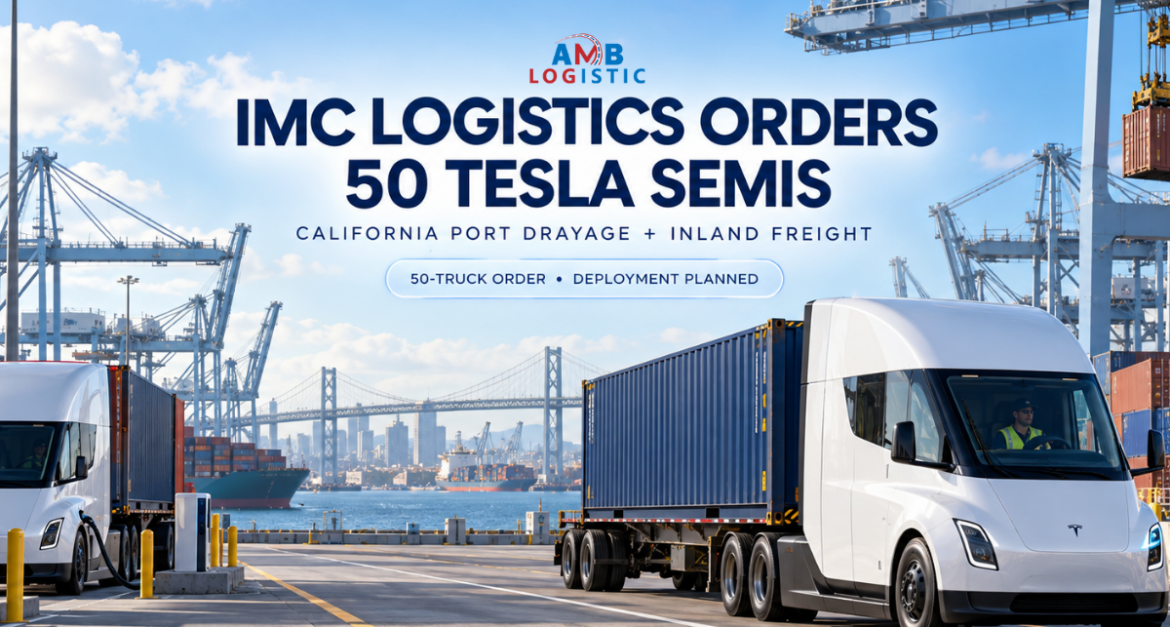
A container’s journey does not end when it leaves the ship. It still needs a truck to connect the marine terminal with a warehouse, rail facility or inland distribution center. IMC Logistics is preparing to electrify more of those connections with an order for 50 Tesla Semi battery-electric trucks for its California operations.
The order includes Standard Range and Long Range configurations. IMC plans to use Standard Range trucks for California port drayage and Long Range trucks for freight movements between Southern California and inland destinations.
The company expects deliveries during the fourth quarter of 2026. However, the number of trucks assigned to each configuration and the date when all 50 will enter service have not been disclosed.
This is an equipment order and planned deployment—not confirmation that all 50 trucks are already operating.
One Order, Two Different Freight Applications
IMC’s approach separates two operationally different jobs: moving containers around port markets and transporting freight farther inland.
Port drayage typically connects marine terminals with nearby warehouses, container yards, rail ramps and distribution facilities. These trips may cover relatively short distances, but terminal queues, appointment windows, chassis availability and container-release delays can make them difficult to schedule.
Inland transportation introduces a different challenge. Greater distances increase the importance of energy consumption, charging access, road conditions and the ability to complete the trip without disrupting delivery commitments.
By ordering both configurations, IMC is matching equipment to route requirements rather than treating every container movement as the same application.
- Standard Range: Planned for California drayage operations.
- Long Range: Planned for freight movements between Southern California and inland destinations.
- Total order: 50 Tesla Semi battery-electric trucks.
- Expected deliveries: Fourth quarter of 2026.
- Full deployment schedule: Not publicly disclosed.
Why Port Drayage Is a Practical Starting Point
Electric trucks are often discussed through their advertised range. In practice, successful deployment depends on how well the vehicle fits the complete working day.
Some drayage operations involve repeat customers, familiar terminals and regular returns to a fleet facility. Those characteristics can make charging easier to organize than on an unpredictable long-haul route.
A truck that returns to a known location provides an opportunity to coordinate charging with its next assignment. Dispatchers can evaluate the previous trip, remaining battery charge and upcoming workload before releasing the equipment again.
However, a short route is not automatically an easy route. A container pickup can become an extended assignment when terminal congestion, customs holds or warehouse delays change the schedule.
The planning question is not simply whether the truck can cover the mileage. It is whether it can complete the assignment, absorb reasonable delays and remain ready for the next movement.
Electric Trucks Change the Dispatch Equation
Conventional dispatch planning already considers driver hours, appointments, equipment availability and delivery deadlines. Battery-electric trucks add another operating variable: available energy and the time required to replenish it.
A realistic plan must account for more than the outbound distance. It should also consider loaded travel, empty repositioning, detours, elevation changes and the return movement.
For example, a truck may have sufficient charge to reach a warehouse but insufficient flexibility to accept an additional pickup afterward. Another assignment may require a charging stop that conflicts with a terminal appointment.
That makes coordination between dispatch, charging infrastructure and customer schedules essential.
- Confirm battery charge before assigning the load.
- Evaluate the entire trip, including empty miles and repositioning.
- Identify charging availability where replenishment is required.
- Allow time for charging within the operating schedule.
- Maintain a recovery plan for unavailable chargers or equipment faults.
- Communicate any constraints before committing to pickup and delivery appointments.
These are practical planning considerations for electric freight operations, not a description of undisclosed IMC procedures.
Charging Infrastructure Is Part of Freight Capacity
A truck cannot provide dependable capacity if the infrastructure needed to operate it is unavailable.
For battery-electric fleets, charging access is therefore part of the transportation service. The number of usable charging positions, equipment reliability and coordination of simultaneous charging sessions can influence how many trucks are ready for dispatch.
Fleet expansion must be matched with infrastructure planning. Adding vehicles without sufficient charging support can reduce utilization and create avoidable scheduling conflicts.
For freight brokers, this means an electric truck’s availability should be evaluated as a complete operating package: vehicle, driver, charging access, route suitability and contingency support.
IMC Is Taking a Mixed-Technology Approach
The Tesla Semi order forms part of a broader strategy. IMC already operates battery-electric, hydrogen fuel-cell and renewable-diesel equipment in California.
Rather than committing every freight movement to one technology, the company describes its approach as a blend of equipment suited to different operating needs.
That distinction matters. Port drayage, regional distribution and longer inland movements do not necessarily have the same infrastructure, utilization patterns or service requirements.
A mixed fleet gives an operator different tools, but it also requires disciplined equipment assignment. Dispatch teams must understand which trucks fit each lane and what support those trucks need.
The commercial test is consistent service—not simply the number of alternative-powertrain vehicles in the fleet.
What the Order Means for Freight Brokers
For brokers handling California import freight, electric drayage creates another capacity option to evaluate.
Some customers may request lower-emission transportation as part of their supply-chain objectives. Others will focus primarily on pickup reliability, transit performance and total shipment cost.
In either case, the broker’s responsibility remains the same: match the customer’s freight with equipment capable of completing the assignment.
Verify Lane Suitability
Confirm that the carrier can support the actual origin, destination, cargo weight and expected operating conditions. Do not assume that every route qualifies because it falls within a vehicle’s advertised range.
Confirm Equipment and Container Compatibility
Container size, chassis configuration, axle limits and legal payload requirements still apply. An electric tractor does not remove the need to verify the complete tractor-chassis-container combination.
Understand Appointment Constraints
Ask whether charging requirements affect pickup availability, delivery scheduling or the ability to recover from a delayed appointment.
Establish Backup Arrangements
Understand what happens if the assigned truck develops a fault, charging equipment becomes unavailable or a terminal delay changes the trip requirements.
Separate Marketing Claims from Shipment-Level Evidence
Battery-electric trucks produce no exhaust emissions at the vehicle. Broader environmental claims require additional context, including electricity generation and the boundaries used to calculate shipment emissions.
Customers requesting emissions reporting should receive information that reflects the actual transportation performed—not a generic sustainability statement.
What Shippers Should Ask Before Booking Electric Drayage
Shippers do not need to become vehicle engineers to assess electric transportation. They need clear answers about service capability.
- Is electric equipment available for this specific lane?
- Can the assigned truck handle the shipment’s weight and equipment requirements?
- Where will the truck charge?
- Does charging affect the pickup or delivery window?
- How are terminal delays handled?
- What backup equipment is available?
- Who communicates exceptions during the movement?
- Can the provider support repeat shipments consistently?
- What emissions information can be provided for the completed service?
These questions help turn a technology announcement into an informed transportation decision.
What to Watch as the Trucks Arrive
The order is significant, but delivery and deployment will determine its operational impact.
The next milestones include how many trucks enter service, which routes they support and how charging infrastructure accommodates their daily workload.
For brokers and shippers, useful measures will include appointment performance, equipment availability, completed trips, charging-related interruptions and the ability to maintain service during exceptions.
The strongest evidence will come from repeatable results: containers collected when promised, freight delivered within agreed windows and equipment ready for the next assignment.
The Bottom Line
IMC Logistics’ 50-truck Tesla Semi order represents a meaningful investment in battery-electric capacity for California port drayage and inland freight.
The planned division between Standard Range and Long Range models shows that the company is considering different operating requirements rather than applying one truck configuration to every lane.
For freight brokers, the lesson is straightforward: electric capacity must be qualified through route suitability, charging support, equipment compatibility and service resilience.
The truck may change. The obligation to protect the customer’s schedule and move the freight reliably does not.
Plan Your Next Freight Movement with AMB Logistic
Changing equipment options make clear transportation planning more important. Before committing to a movement, businesses need to understand capacity, route requirements, appointment expectations and contingency arrangements.
Connect with AMB Logistic to discuss your freight requirements and coordinate a transportation plan built around your shipment.
Website: www.amblogistic.us
Email: info@amblogistic.us
Phone: +1 (888) 538-6433
Tags: IMC Logistics, Tesla Semi, Electric Trucks, California Freight, Port Drayage, Inland Freight, Freight Brokerage, Container Transportation, Battery-Electric Trucks, Charging Infrastructure, Fleet Electrification, Sustainable Logistics, Intermodal Logistics, Supply Chain Management, AMB Logistic