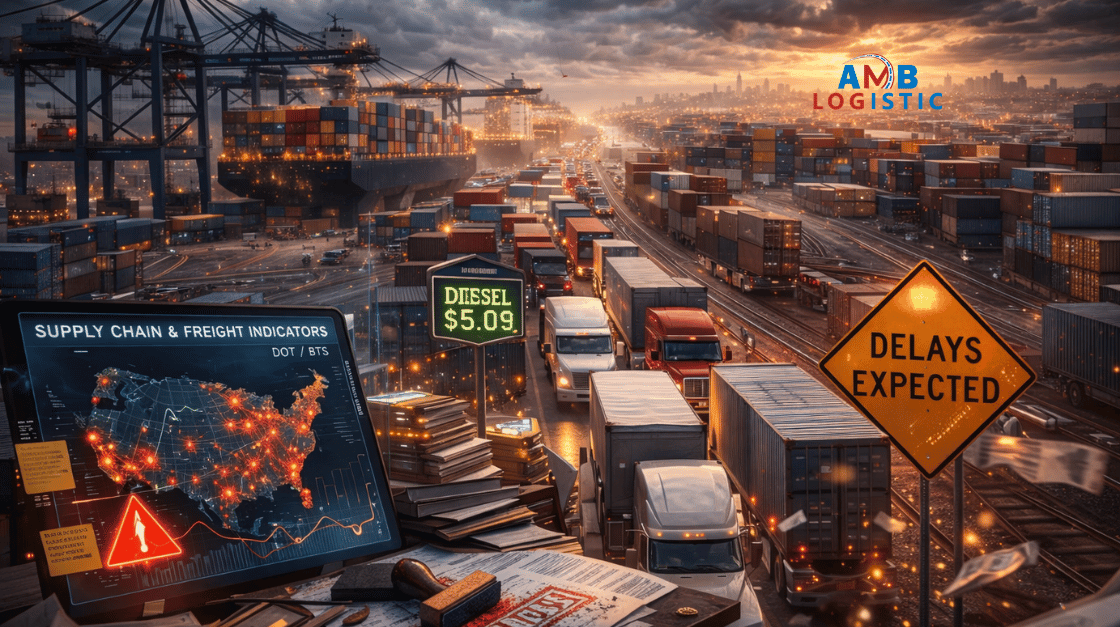
The U.S. Congestion Signal Most Freight Brokers Miss: How “Inside-the-Gate” Port Pressure Turns Into Inland Chaos—and How to Stay Ahead
Most freight brokers only react once a customer’s load is already late. The smarter move is to read the U.S. supply chain signals early—port congestion, anchored vessels, container availability, and capacity tightness—so you can protect appointments, margins, and customer trust before the breakdown hits your inbox.
Introduction
If you broker freight long enough, you learn a painful truth: the biggest disruptions don’t start on the highway.
They start quietly “inside the gate”—when ports, terminals, and rail ramps begin to tighten, and nobody outside the fence feels it yet.
Then, a few days later, the rest of the chain explodes: missed appointments, chassis scarcity, stacked demurrage, and a surge of urgent tenders that all want miracles.
The good news for freight brokers is that the U.S. now has more visibility into supply chain pressure than ever.
When you treat those indicators like an early-warning system, you stop being a reactive middleman and start behaving like a control tower:
predicting congestion, staging capacity, and preventing surprises.
This blog is a practical guide for freight brokers. It focuses on what matters most in 2026 U.S. logistics: early signals, clean playbooks, and execution that holds up when volumes bunch and networks get noisy.
Why This Matters
In modern U.S. logistics, a disruption cycle usually follows this pattern:
- Step 1: Port pressure builds quietly. Ships wait, berths tighten, loaded import boxes accumulate, empty equipment gets displaced.
- Step 2: Terminal velocity slows. Appointment availability narrows, turn times worsen, and “free time” becomes a trap.
- Step 3: Inland gets ambushed. Dray is late, rail cutoffs are missed, OTR and intermodal plans break, and warehouses get slammed with bunched arrivals.
- Step 4: The broker gets blamed. The customer calls for a rescue—often after the cheapest option is already impossible.
Freight brokers make money in the gap between “what is happening” and “what customers realize is happening.”
When you can see pressure early, you can:
- protect your customer’s delivery windows,
- protect your carrier relationships by tendering cleanly and early,
- and protect your margin by pricing time risk before it becomes loss.
The Broader Picture
A major mistake in freight brokerage is treating congestion as random.
It isn’t. Congestion is measurable—and it leaves fingerprints.
The most broker-relevant “fingerprints” typically include:
- Ships anchored / waiting to berth: a leading indicator of upcoming bunching in container flow.
- Loaded import containers stacking: a sign that terminal throughput is lagging arrivals.
- Empty container imbalance: a quiet warning for chassis/equipment pain and repositioning costs.
- Rail/intermodal tightness: a clue that port-to-inland transfer will miss cutoffs, not just run late.
- Labor and capacity tightness: the difference between “a bad day” and “a bad month.”
When these signals stack at once, it creates a “timing tax” across the network:
more waiting, more accessorial exposure, and more customer frustration.
Freight brokers who recognize the stack early can shift from firefighting to prevention.
What Freight Brokers Need To Do Now
If you want to become the broker customers keep during congestion cycles, your job is to do three things:
predict the squeeze, stage the handoffs, and sell the plan.
- Build a weekly “pressure scan.” Track the ports and ramps your customers depend on. Watch for ship queues, container buildup, and capacity tightness.
- Switch from single-date thinking to window thinking. When pressure rises, build buffer into appointments and tender timing.
- Pre-approve rescue triggers. Define what qualifies for premium dray, alternate pickup strategy, or mode change—before it’s urgent.
- Price time risk explicitly. Congestion is not free. If you don’t price it, you’ll eat it.
- Protect your carrier ecosystem. In chaotic weeks, carriers choose brokers who tender clean and communicate clearly.
The Freight Broker Playbook
1) Drayage and port moves: Win “inside the gate” first
Most brokerage losses during congestion come from drayage friction: missed appointments, long turn times, chassis scarcity, and failed first attempts.
Your dray posture should look like this:
- Appointment-first discipline: no dispatch without confirmed pickup and delivery windows.
- Chassis strategy: know where chassis risk lives and price it as a real variable.
- Second-attempt planning: every critical container move needs a fallback plan.
- Time-stamped documentation: protect yourself on disputes with clean exception notes and proof of attempts.
2) Inland staging: Stop letting ports ambush your OTR
When ports bunch, inland plans break unless you stage capacity early.
Freight brokers should:
- Pre-stage capacity on “hot corridors.” Port-to-DC lanes tighten first. Protect them first.
- Hold flexible appointment windows. A rigid timestamp is fragile in a noisy network.
- Use mode optionality when needed. When rail cutoffs get risky, have a truck-first fallback posture ready.
3) Quoting: How to protect margin in congestion cycles
Congestion isn’t just a rate move. It’s an accessorial multiplier.
Your quote posture should keep the relationship honest and your margin protected:
- Time-box your quotes. Congestion markets change quickly; stale quotes become losses.
- Offer tiers: Standard vs Protected (priority handoffs, tighter cadence, stronger contingency plan).
- Declare assumptions: detention posture, wait time policy, reattempt conditions, and appointment change fees.
4) Communication: The broker script that prevents churn
During congestion, customers don’t want panic. They want clarity.
Use a calm structure:
- What we’re seeing: “Port and inland indicators are tightening, so reliability is shifting from dates to windows.”
- What it means: “More wait-time risk, wider arrival ranges, and higher likelihood of second attempts.”
- What we’re doing: “We’re staging capacity, locking appointments, and pre-approving alternates.”
- What we need: “Your no-fail shipments, your escalation triggers, and faster approvals on exceptions.”
How Freight Brokers Turn Congestion Into an Advantage
In congestion cycles, the market briefly rewards discipline.
The broker advantage comes from being early, not loud.
- Early warnings create better decision-making and fewer surprises.
- Staged handoffs reduce detention, missed appointments, and customer escalations.
- Tiered service protects margin while giving the customer a clear choice.
- Clean execution strengthens carrier trust and capacity access.
AMB Logistic’s Role
Congestion cycles are where execution partners prove their worth. AMB Logistic supports freight brokers and shippers with a stability-first approach:
- Appointment-first coordination: lock the handoffs that prevent the domino effect.
- Exception management: proactive handling when congestion shifts ETAs and disrupts ramps and terminals.
- Routing optionality: practical alternates ready before the network forces a rescue.
- Communication cadence: clear updates, clear options, faster decisions.
The goal is simple: reduce surprises, protect windows, and keep freight moving cleanly even when the network is noisy.
FAQ
What’s the earliest sign that congestion is coming?
Look for multiple signals stacking at once: ship queues, container buildup, equipment imbalance, tightening appointments, and inland cutoff misses.
One signal is noise. A stack is a warning.
Where do brokers lose the most money in congestion?
In unpriced time risk: detention, reattempts, missed appointments, chassis friction, and late-stage rescues without pre-approved customer thresholds.
What should we do this week?
- Identify the ports and ramps that feed your top customers.
- Build a weekly pressure scan and share it with customers as calm guidance.
- Define escalation triggers and protect “no-fail” freight with staged capacity.
- Price time risk explicitly instead of hoping the week stays calm.
Final Word From AMB Logistic
In U.S. logistics, the most expensive surprise is the one you could have seen coming.
Port congestion and inland ripple effects don’t appear out of nowhere—they build, then break.
Freight brokers who read the signals early and execute a disciplined playbook will protect margins and customer trust while others scramble.
Talk To AMB Logistic Today
Want a stability-first execution partner during congestion cycles?
Call: +1 (888) 538-6433
Email: info@amblogistic.us
Web: www.amblogistic.us
Tags
U.S. port congestion, inside-the-gate, drayage strategy, chassis availability, intermodal staging, warehouse appointments,
detention and demurrage, capacity tightness, freight brokers, exception management, AMB Logistic
“`