Introduction: Weather Strikes. Freight Adapts.
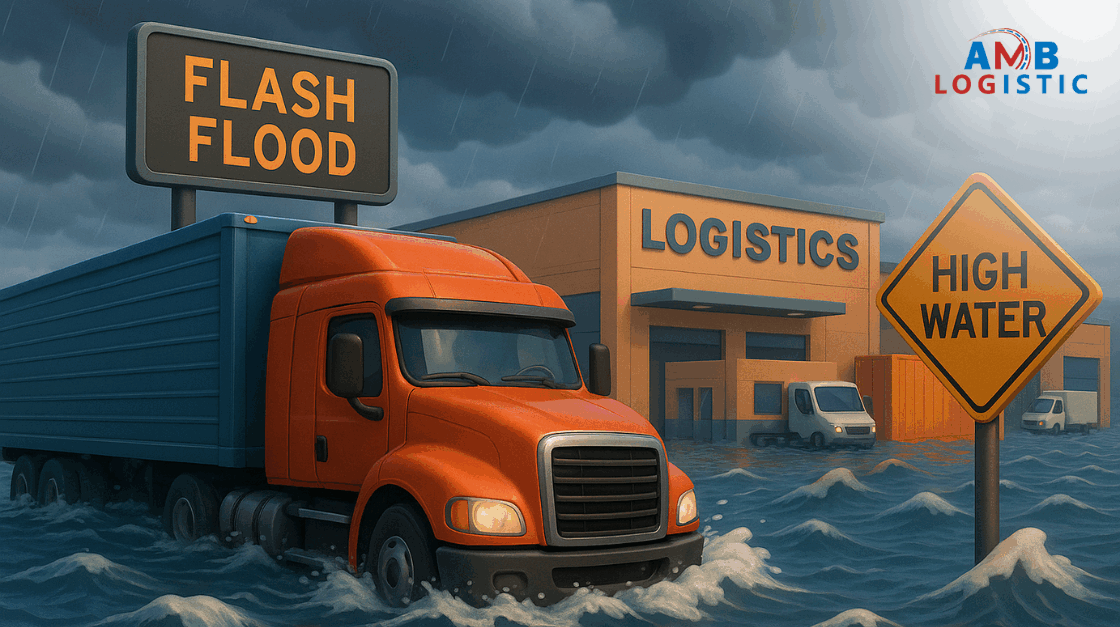
Between July 5th and 15th, 2025, a sweeping wave of flash floods struck the United States—shutting down roadways, submerging intermodal corridors, and triggering immediate logistical fallout across major shipping regions.
At AMB Logistic, we’ve seen this firsthand. Routes we rely on every day—from Texas to the Northeast—were underwater. Deliveries were delayed. Facilities paused operations. Drivers were rerouted in real-time.
This isn’t just a storm. It’s a stress test for the U.S. freight system. And the results are clear: agility, real-time routing, and proactive customer communication are no longer optional—they’re operational requirements.
The Scale of the Disruption: Regions Underwater
Texas: Central & Hill Country Submerged
Key freight zones—including Kerrville, Austin, San Antonio, Houston, and Dallas—were hit by record-breaking rain. Low-lying segments of I‑10 and feeder highways closed for days. San Antonio’s inner-ring delivery network saw over 40% route disruptions.
Northeast & Mid-Atlantic: Densely Packed, Deeply Affected
In cities like New York (all five boroughs), Union County, Westchester, and Washington, D.C., flooding not only cut off roads but also paralyzed last-mile services, especially for high-volume e-commerce.
Southern New Mexico: Mountain Access Lost
The town of Ruidoso and surrounding mountain communities were largely cut off, blocking service to the region’s hospitality and tourism logistics sector.
Wider U.S. Corridors: Flooding Across the Map
Additional disruptions hit:
- Florida Peninsula & Gulf Coast
- Arkansas, Missouri (ArkLaTex region)
- Southern Minnesota
- Mid-Mississippi and Ohio River Valleys
These regions are more than dots on a map—they’re core arteries in the freight network, and they’ve been constricted by floodwater.
Logistics Impacts: What’s Changing on the Ground
1. Freight Delays & Rescheduling
AMB Logistic rerouted more than 200 shipments during the peak of the flooding. Average delay time across affected lanes ranged from 18 to 72 hours.
2. Warehouse Downtime & Fulfillment Backlogs
Flooded zones in Texas and New Jersey caused temporary shutdowns in major fulfillment hubs. Many 3PL partners moved operations inland or reprioritized outbound loads.
3. Driver Safety Measures
We implemented emergency protocols for route clearance, mandatory delay approvals, and regional hazard pay—protecting both safety and service.
4. Increased Customer Communication Needs
Transparency became key. AMB Logistic initiated proactive alerts, daily ETA updates, and load-specific risk summaries to maintain customer trust.
How AMB Logistic Responded in Real Time
From the moment the first warnings came in, AMB activated its Emergency Routing Contingency Protocol—a four-layer response plan designed for precisely this type of disruption.
1. Real-Time Geofencing & Route Blocking
We integrated FEMA, DOT, and NOAA flood data into our dispatch systems to automatically block flooded regions from route plans.
2. Regional Prioritization
High-risk ZIP codes were flagged in our TMS, triggering reallocation of assets and scheduling adjustments across affected terminals.
3. Partner Coordination
We connected directly with brokers, carriers, and drivers across the DAT and internal networks to shift capacity toward safer lanes and backfill critical regions.
4. Customer Alerting & SLAs
We launched load-level delay notifications, updated our tracking dashboards, and worked with customers to reset SLAs based on evolving flood forecasts.
Lessons the Industry Must Take Forward
This flood season won’t be the last. What we learn—and build—now will define the future of reliable freight in a climate-volatile world.
1. Weather-Aware TMS Must Be Standard
Static routing is over. Systems must now incorporate weather and infrastructure feeds to auto-adapt before failure.
2. Diversified Fulfillment Networks
Shippers should consider dual-hub or multi-region warehousing strategies to reduce dependency on coastal or flood-prone zones.
3. SLA Flexibility with Real-World Context
Contracts must evolve to include dynamic SLAs tied to environmental risk, not just time zones and mileage.
4. Driver-Centric Routing & Safety Investment
Drivers are front-line responders in these disruptions. Their safety is not just ethical—it’s operational. Visibility tools and incentive structures must reflect that.
A Message to Our Clients and Partners
At AMB Logistic, we remain committed to operating through uncertainty with precision, honesty, and speed.
When water covered roads—our dispatch didn’t stop.
When systems flagged risk—we adapted with intelligence.
When deliveries were delayed—we communicated clearly and acted fast.
This is what it means to build a logistics operation for the future: one that doesn’t just move freight, but navigates disruption and earns trust in every mile.
We thank all our drivers, partners, and clients for their flexibility, understanding, and ongoing collaboration through this high-impact event.
Safety First. Freight Second. Precision Always.
For updates, questions, or shipment rescheduling support, reach out to our operations team or your dedicated AMB representative.
Contact AMB Logistic
Email: info@amblogistic.us
Website: www.amblogistic.us
Phone: +1 (888) 538-6433
Tags: U.S. Flooding, Freight Disruption, July 2025 Logistics, Emergency Routing, Warehouse Delays, AMB Disaster Response, DAT Routing, Climate Risk Logistics, Driver Safety, Real-Time Freight Updates