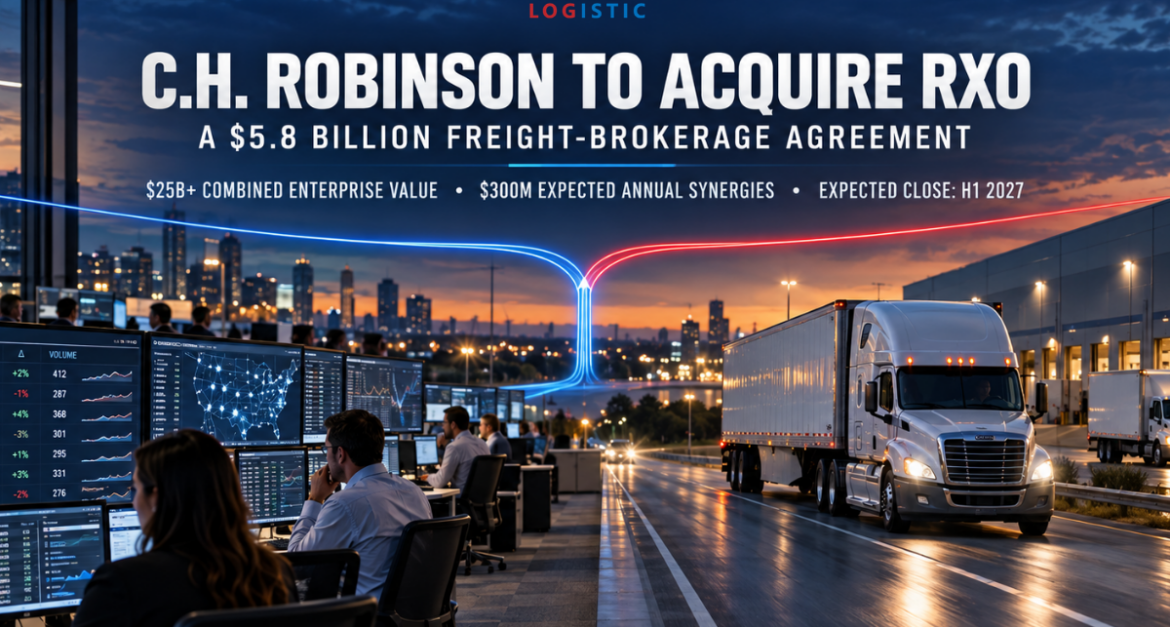
A proposed combination of two major transportation platforms could create a freight and logistics enterprise valued at more than $25 billion—bringing greater scale, broader capabilities and a new competitive dynamic to the U.S. brokerage market.
C.H. Robinson has entered into a definitive cash-and-stock agreement to acquire RXO in a transaction carrying an implied value of approximately $5.8 billion.
The agreement is one of the most consequential developments in the modern U.S. freight-brokerage sector. If completed, it would combine two extensive customer portfolios, large contract-carrier networks, established brokerage operations and technology-driven transportation platforms.
The transaction is expected to close during the first half of 2027, subject to shareholder approval, regulatory clearance and customary closing conditions. Until those requirements are satisfied, C.H. Robinson and RXO will continue operating as separate companies.
The Agreement at a Glance
| Transaction Detail | Reported Information |
|---|---|
| Acquiring Company | C.H. Robinson |
| Company Being Acquired | RXO |
| Implied Transaction Value | Approximately $5.8 billion |
| Transaction Structure | Cash-and-stock agreement |
| Combined Enterprise Value | More than $25 billion |
| Expected Annual Cost Synergies | Approximately $300 million |
| Synergy Timeline | Expected within two years following completion |
| Anticipated Closing | First half of 2027 |
| Current Status | Definitive agreement; transaction not yet completed |
Why This Is More Than a Traditional Acquisition
This agreement is not simply about one brokerage buying another. It represents a potential consolidation of transportation capacity, customer relationships, operational data and technology across several important logistics services.
C.H. Robinson already operates one of the world’s largest asset-light logistics networks, with significant capabilities in truckload brokerage, less-than-truckload transportation, global forwarding and managed transportation.
RXO contributes additional strength in technology-enabled truck brokerage, managed transportation, expedited freight and last-mile delivery. Combining those capabilities could allow the proposed organization to manage a larger share of a customer’s transportation requirements through a more unified platform.
The strategic value, therefore, extends beyond load volume. It includes the ability to connect more freight with more capacity, coordinate multiple transportation modes and use a larger pool of shipment data to improve planning and execution.
Scale Could Become a Bigger Competitive Advantage
Freight brokerage has traditionally been a highly fragmented industry. Thousands of brokers compete for freight while depending on overlapping pools of motor carriers.
That market structure has allowed smaller and specialized brokerages to compete through relationships, industry knowledge, responsiveness and customer service. However, the growing importance of technology, fraud prevention, automation and real-time visibility is increasing the cost of operating a modern brokerage platform.
A larger combined organization could spread those investments across more shipments and customers. It could also process more information about lanes, rates, capacity availability, carrier performance and service disruptions.
This does not make smaller brokers irrelevant. It does, however, raise the operating standard across the market.
Brokerages will increasingly need to demonstrate that they can deliver more than transactional load coverage. Customers will expect dependable capacity, fast communication, continuous carrier verification, accurate market intelligence and the ability to respond when transportation plans change.
Technology and Data Will Be Central to the Strategy
Both companies have invested heavily in digital freight-management capabilities. A successful integration could create a much larger operational data environment covering pricing, carrier availability, service performance and shipper demand.
That scale could support several potential improvements:
- Faster matching of available freight with qualified carrier capacity
- More accurate lane-level pricing and forecasting
- Better visibility across active shipments
- Improved detection of service and security risks
- More automated routine brokerage processes
- Broader transportation reporting for large shippers
The critical issue will be execution. Technology platforms do not create value merely because they are connected. Data definitions, operating procedures, customer workflows and employee responsibilities must also be aligned.
If integration is handled effectively, technology could become one of the strongest benefits of the transaction. If it is handled poorly, system complexity could create service disruptions during the transition.
The $300 Million Synergy Target
C.H. Robinson expects the combination to generate approximately $300 million in net annual run-rate cost synergies within two years after the transaction closes.
Achieving that target will likely require disciplined integration across corporate functions, technology infrastructure, procurement, real estate and overlapping operational processes.
Cost savings will be closely watched, but they should not be evaluated independently from service performance. Reducing duplicated expenses may strengthen the combined business, while aggressive changes introduced too quickly could affect customer experience or employee productivity.
The strongest outcome would pair lower operating costs with improved shipment execution, better data and more consistent service.
What the Agreement Could Mean for Shippers
For shippers, the proposed combination could create access to a wider portfolio of transportation services through one provider.
Potential advantages include:
- Access to a larger contract-carrier network
- Broader coverage across truckload, managed transportation, expedited and last-mile services
- Improved transportation visibility and reporting
- More alternatives during regional capacity disruptions
- Fewer operational handoffs between different providers
- Greater support for complex, multi-location shipping programs
However, size alone does not guarantee better service. Shippers should continue evaluating performance at the lane and facility level.
Important measurements will include tender acceptance, on-time pickup, on-time delivery, communication speed, claims performance and the ability to secure qualified backup capacity when primary plans fail.
What It Could Mean for Carriers
Motor carriers may gain access to a larger and more diverse pool of freight if the transaction is completed successfully. Greater shipment density could help carriers reduce empty miles, improve equipment utilization and find more consistent opportunities within preferred operating regions.
At the same time, integration could bring more standardized operating requirements. Carriers may encounter changes involving onboarding, safety reviews, documentation, payment systems, tracking compliance and shipment-security procedures.
Carrier relationships will remain essential. Even the most advanced brokerage platform cannot move freight without dependable motor-carrier capacity.
The companies that maintain accurate records, communicate consistently and meet service expectations will be best positioned to benefit from a larger network.
Fraud Prevention Must Remain a Priority
Freight fraud, identity theft, double brokering and fictitious pickups remain serious threats across the transportation market. A larger network means more transactions, more carrier records and more contact points that must be protected.
The proposed combination may create opportunities to apply more extensive data and risk controls, but scale also increases the importance of disciplined verification.
Effective freight security requires more than confirming that a carrier authority is active. Brokers and shippers must verify the complete pickup chain, including:
- The contact channel used to book the shipment
- The identity of the assigned driver
- The tractor and trailer arriving for pickup
- The insurance information connected to the load
- The pickup number and shipping documentation
- Any recent changes to phone numbers, email addresses or ownership records
As brokerage platforms grow, continuous verification will become even more important than one-time carrier approval.
Integration Will Be the Real Test
Announcing a major transaction creates a clear strategic story. Integrating two large transportation organizations is more difficult.
The combined company will need to manage customer relationships, carrier communications, technology systems, employee responsibilities and operating procedures without weakening daily shipment execution.
Several questions will shape the final outcome:
- How quickly can the companies integrate their technology platforms?
- Can they achieve the targeted savings without reducing service quality?
- How will existing customers experience the transition?
- Will carrier onboarding and payment processes become simpler?
- Can the combined network generate stronger shipment density?
- How effectively will the organization manage freight fraud and cybersecurity risk?
The transaction’s long-term value will be determined less by its headline size and more by the quality of its operational execution.
A New Competitive Standard for Freight Brokerage
If completed, the C.H. Robinson–RXO combination could accelerate the divide between basic transactional brokerage and integrated logistics management.
Freight brokers will increasingly compete through a combination of capacity access, technology, market intelligence, security controls and human expertise.
That shift creates pressure, but it also creates opportunity. Independent brokerages can remain highly competitive by focusing on the areas where disciplined service matters most: direct communication, customer-specific planning, verified carrier relationships and rapid problem resolution.
The market does not need every brokerage to become enormous. It does require every brokerage to become more precise.
What Comes Next
The agreement still requires the necessary shareholder and regulatory approvals. The companies expect the transaction to close during the first half of 2027, but the timing could change as the review process continues.
Until closing, both businesses remain independent. Shippers, carriers and industry observers should separate the definitive agreement from a completed acquisition when discussing the transaction.
Over the coming months, the freight market will be watching for regulatory developments, integration planning, customer-retention signals and additional information about the combined operating model.
Whatever the final outcome, the announcement already sends an important message: scale, technology, security and end-to-end transportation capabilities are becoming increasingly connected in U.S. freight brokerage.
Build a More Resilient Freight Strategy with AMB Logistic
Major industry changes can reshape capacity access, pricing behavior and transportation expectations. Businesses need a logistics partner that can interpret those changes and turn them into practical shipment decisions.
AMB Logistic supports shippers with responsive freight coordination, dependable capacity solutions and experienced transportation management designed around real operating requirements.
Connect with AMB Logistic:
Website: www.amblogistic.us
Email: info@amblogistic.us
Phone: +1 (888) 538-6433
Tags: C.H. Robinson, RXO, Freight Brokerage, Freight Mergers and Acquisitions, U.S. Logistics, Truckload Brokerage, Managed Transportation, Last-Mile Delivery, Logistics Technology, Carrier Networks, Transportation Strategy, Supply Chain Management, Freight Market News, AMB Logistic