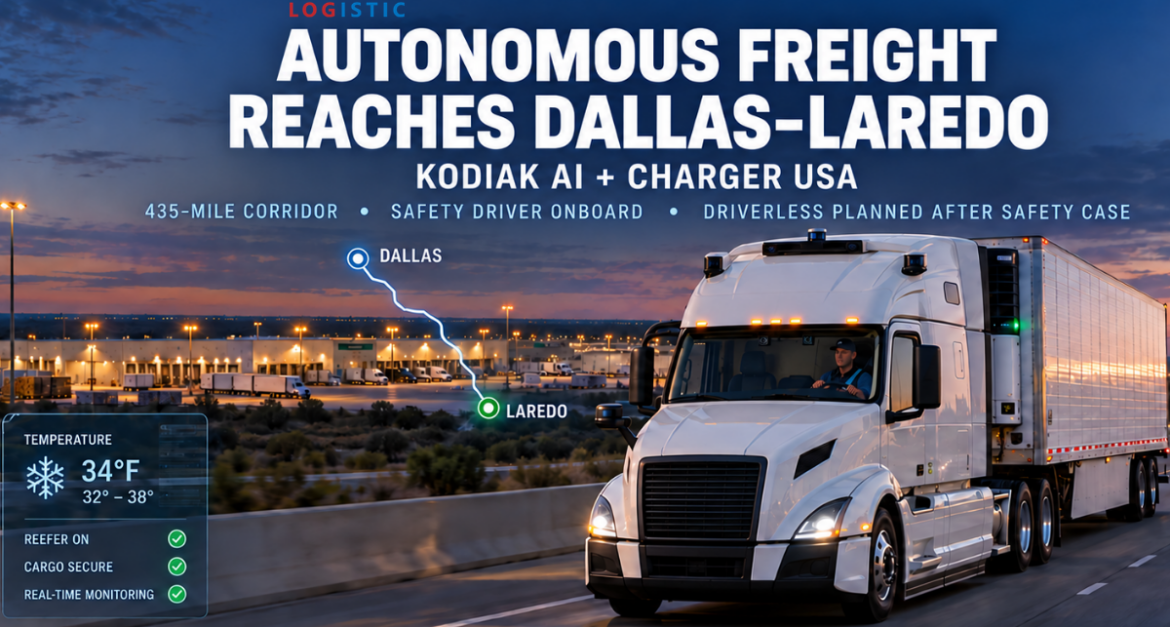
Kodiak AI and Charger USA have launched commercial autonomous freight operations on a 435-mile Texas corridor connecting Dallas and Laredo, bringing automated-driving technology to one of North America’s most important freight routes.
The operation is already transporting refrigerated and dry freight for consumer-goods and food-and-beverage customers. The first delivery was completed on September 8, 2026, before the partnership was publicly announced on October 8.
This is a meaningful development for freight brokers, carriers and cross-border shippers—but it requires one important clarification: these trucks are not currently operating without a human inside the cab.
A safety driver remains onboard during every trip. Any transition to driverless operation is expected only after Kodiak completes its safety case and determines that the system is ready to operate without a driver.
Why the Dallas–Laredo Corridor Matters
The significance of this operation extends far beyond its 435-mile distance. Dallas and Laredo form a critical connection between major U.S. distribution networks and the country’s largest commercial gateway with Mexico.
Laredo processed more than $350 billion in trade during 2025 and accounted for nearly 40% of total U.S.–Mexico trade. Large volumes of freight move through the region’s warehouses, terminals, transfer yards and cross-dock facilities before continuing deeper into the United States.
The corridor offers several characteristics that make it suitable for autonomous linehaul development:
- High and relatively consistent freight volume
- Long stretches of repeatable interstate driving
- Established terminals at both ends of the route
- Strong demand from food, beverage and consumer-goods shippers
- Freight schedules that benefit from predictable transit times
- Direct connections to cross-border transportation networks
Instead of attempting to automate every stage of a shipment, this model concentrates on a defined highway corridor where the operating environment can be studied, mapped and managed more consistently.
What the Operating Model Actually Looks Like
The trucks are equipped with the Kodiak Driver, an autonomous-driving system designed for commercial trucking operations. Charger USA supplies the freight network, terminal infrastructure and transportation operations supporting the Dallas–Laredo service.
The current model functions as a structured linehaul operation:
- Freight enters the network. Refrigerated or dry freight is prepared for transportation through an established terminal operation.
- The autonomous-equipped truck performs the long-haul movement. A human safety driver remains inside the cab during the current operating phase.
- The vehicle arrives at the destination terminal. The load can then be transferred into the next stage of the customer’s transportation network.
- Local or cross-border partners complete the remaining movement. Conventional drivers may continue handling local delivery, border transfers, final-mile service and other complex operating environments.
The announcement does not mean that an unmanned truck is independently crossing the international border. The autonomous operation connects Dallas and Laredo, while the border crossing and any movement into Mexico remain separate stages of the freight journey.
Why Refrigerated Freight Makes the Launch More Significant
Autonomous-trucking discussions frequently focus on dry van freight because those shipments are generally easier to standardize. This operation also includes refrigerated freight, adding another layer of operational responsibility.
Temperature-controlled transportation requires more than consistent vehicle movement. The transportation provider must also monitor:
- Trailer temperature and refrigeration performance
- Fuel levels for the refrigeration unit
- Transit-time requirements
- Door openings and seal integrity
- Product-specific temperature ranges
- Response procedures for equipment or route disruptions
Autonomous-driving technology may control the tractor’s movement, but it does not eliminate the need for disciplined cold-chain management. Brokers and shippers still require clear visibility into the truck, trailer and condition of the freight.
This Is Not Driverless Freight—Yet
The difference between commercial autonomous service and fully driverless operation is essential.
The Dallas–Laredo trucks currently operate with safety drivers onboard. These drivers monitor the vehicle and can intervene when necessary. Kodiak has indicated that the corridor may transition to driverless operations after the company completes its safety case.
A safety case involves more than a general claim that the technology works. It requires structured evidence demonstrating that the system can identify hazards, respond to expected conditions and manage failures within its intended operating environment.
That evaluation may include:
- Performance across different traffic conditions
- Response to construction zones and lane changes
- Detection of stopped vehicles and roadway hazards
- Operation during darkness, rain, glare and reduced visibility
- System redundancy for steering, braking and power
- Remote-support and emergency-response procedures
- Safe behavior when the vehicle encounters an unfamiliar condition
Until that process is complete, the safety driver remains an active part of the operation.
What This Means for Freight Brokers
Autonomous trucking does not remove the freight broker from the transaction. It changes the questions brokers must ask when evaluating capacity and designing transportation solutions.
Traditional carrier qualification focuses on operating authority, insurance, safety history, equipment and service performance. Autonomous-equipped capacity introduces additional considerations.
1. Is the Shipment Suitable for the Corridor?
Autonomous operations are most practical when freight moves repeatedly between defined terminals. Loads requiring multiple stops, irregular routing, residential delivery or complex on-site maneuvering may remain better suited to conventional transportation.
2. Who Controls Each Handoff?
Brokers must understand where the autonomous movement begins and ends, who handles the freight before departure, and who assumes responsibility after arrival. Every terminal, yard and cross-dock handoff must have clearly assigned ownership.
3. What Happens When the System Cannot Continue?
A serious operating plan must explain how the provider responds to severe weather, road closures, vehicle faults, refrigeration problems, communication failures and other exceptions.
4. How Is Shipment Visibility Shared?
Autonomous equipment can generate detailed operating data, but brokers and shippers still need usable information. Location, estimated arrival time, trailer temperature and exception alerts should be integrated into the transportation workflow.
5. How Are Liability and Insurance Structured?
Responsibility may involve the motor carrier, autonomous-driving provider, equipment manufacturer, terminal operator and other partners. Contracts and insurance requirements must clearly define responsibility before the load moves.
The Technology Does Not Eliminate Operational Risk
Automation may reduce certain risks associated with fatigue, inconsistent driving behavior and limited operating hours. It can also introduce different forms of exposure.
Freight brokers and shippers should evaluate:
- Cybersecurity and unauthorized system access
- Remote communication reliability
- Sensor and hardware maintenance
- Software-update controls
- Emergency-response coordination
- Cargo-security procedures at terminals
- Contingency capacity when an autonomous unit is unavailable
The vehicle may be technologically advanced, but the shipment still depends on people, facilities, maintenance, data and clearly documented operating procedures.
Potential Benefits for Cross-Border Supply Chains
If autonomous linehaul operations prove reliable, the Dallas–Laredo corridor could become a model for connecting high-volume border gateways with inland distribution centers.
Potential benefits include:
- More consistent transit planning: Repeatable highway operations may reduce variability on scheduled lanes.
- Improved equipment utilization: Autonomous systems may eventually support longer operating windows without traditional driver-hour limitations.
- Greater network density: Regular corridor service could support more predictable freight consolidation.
- Stronger terminal coordination: Defined handoff points can create clearer operating responsibilities.
- Additional capacity options: Autonomous-equipped trucks may complement conventional fleets on high-volume lanes.
These benefits will depend on execution. Technology alone cannot overcome poor scheduling, weak exception management, inadequate maintenance or uncoordinated handoffs.
What Shippers Should Ask Before Using Autonomous Capacity
Companies considering autonomous-equipped transportation should request specific operational answers rather than relying on broad technology claims.
- Will a safety driver be onboard for this shipment?
- Which portion of the route will be operated autonomously?
- Does the truck cross the border or stop at a U.S. terminal?
- Who monitors the vehicle during transit?
- How are route disruptions managed?
- What backup equipment is available?
- How is refrigerated-trailer performance monitored?
- Who is responsible for the cargo during each handoff?
- What shipment data is available to the broker and shipper?
- How are claims, insurance and liability handled?
Clear answers to these questions are more valuable than simply knowing that a truck is equipped with autonomous technology.
What Comes Next
The Dallas–Laredo launch represents an operational step, not the end of the autonomous-trucking transition.
The immediate priority will be demonstrating reliable performance while safety drivers remain onboard. The companies will need to show that the service can consistently manage freight schedules, equipment availability, terminal handoffs, changing road conditions and customer expectations.
If the operation successfully advances to driverless service, the impact could extend beyond one Texas corridor. Similar models may emerge on other high-volume routes connecting ports, border gateways, manufacturing regions and major distribution markets.
Expansion will depend on more than technical capability. Insurance, regulation, shipper acceptance, infrastructure, emergency-response coordination and commercial economics will all influence how quickly the model develops.
The Bottom Line
Kodiak AI and Charger USA are introducing autonomous-equipped commercial freight service to one of the most strategically important transportation corridors in North America.
The trucks are carrying real refrigerated and dry freight across a 435-mile Dallas–Laredo lane, but they are still operating with safety drivers onboard. Driverless service remains a planned future phase dependent on the completion of Kodiak’s safety case.
For freight brokers, this development is not simply about replacing a driver. It is about redesigning how capacity, visibility, terminal handoffs, cold-chain control and operational responsibility work together on repeatable freight corridors.
The companies that benefit most will be those that evaluate autonomous capacity with the same discipline applied to every other transportation decision: verify the operating model, define responsibility, prepare for exceptions and protect the freight from origin to destination.
Build a More Reliable Freight Strategy with AMB Logistic
New transportation technology creates opportunities, but successful freight still depends on disciplined planning, reliable capacity and clear communication.
AMB Logistic helps businesses coordinate dependable freight solutions across the United States and North American supply chains. Whether your operation involves dry freight, temperature-sensitive products, high-volume corridors or cross-border transportation, our team is ready to help plan every movement with greater visibility and control.
Connect with AMB Logistic:
Website: www.amblogistic.us
Email: info@amblogistic.us
Phone: +1 (888) 538-6433
Tags: Autonomous Freight, Autonomous Trucking, Freight Brokerage, U.S. Logistics, Dallas–Laredo Corridor, Kodiak AI, Charger USA, Cross-Border Logistics, Texas Freight, Refrigerated Freight, Dry Van Freight, Supply Chain Technology, Transportation Technology, Freight Capacity, Carrier Management, Cold Chain Logistics, U.S.–Mexico Trade, Linehaul Transportation, Commercial Trucking, AMB Logistic