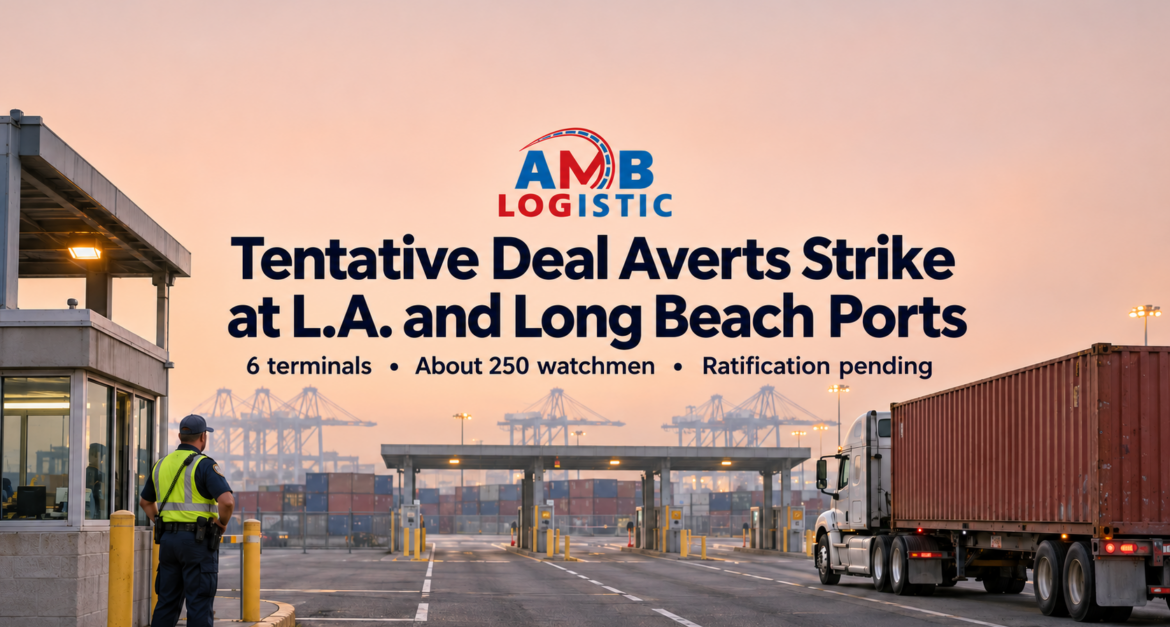
A tentative labor agreement reached Saturday, November 21, 2026, averted a strike by the security officers who control access to six container terminals at the ports of Los Angeles and Long Beach. For importers and freight brokers heading into Thanksgiving week, that means they can keep plans for port pickups in place while they confirm which containers are ready to move.
The Pacific Maritime Association (PMA) reached the agreement with International Longshore and Warehouse Union (ILWU) Local 26, which represents about 250 port watchmen. As of Sunday, November 22, the agreement still requires approval from Local 26 members. The existing contract remains in effect pending that vote.
The reach of this dispute was easy to underestimate. The watchmen work at terminals that handle roughly 85% of cargo at Long Beach and 33% at Los Angeles. A labor agreement covering a relatively small group of workers mattered to shippers across the country because those workers staff the gates through which trucks must pass.
Why a contract for 250 watchmen mattered across two ports
At a marine terminal, moving a container from ship to truck involves several groups of workers. The watchmen’s role comes into view when a driver arrives at the entrance: they check credentials and control access to the facility. A container can be off the vessel, cleared for release, and booked for pickup, but a driver still needs to get through the gate to collect it.
Local 26 members had authorized a strike. One concern was that longshore workers, marine clerks, and foremen outside the bargaining unit could have honored a watchmen’s picket line. That possibility gave the dispute consequences beyond gate security. The six terminals account for substantial cargo volumes, but the negotiations concerned the Local 26 contract specifically. Other waterfront workers were not bargaining under this agreement.
The distinction matters when updating customers. The parties averted a threatened walkout; the announcement did not report a shutdown followed by a reopening. Telling a consignee that “the ports reopened” could prompt it to reschedule a delivery that never needed to move.
What the agreement changes for a broker’s Monday dispatch
Before the deal, a broker arranging a Monday pickup had to account for the possibility that a strike might prevent the driver from entering the terminal. With the existing contract extended, the broker can plan against the terminal’s actual gate hours and appointments. There is no reason to change a routing solely on the assumption that the threatened strike went ahead.
The next decision belongs at the shipment level. A vessel arrival notice tells the importer that the ship has reached port. A terminal availability record tells dispatch whether a particular container can be collected. A receiving appointment tells the driver where and when that container can be delivered. Each answers a different question, and a workable truck order needs all three answers to agree.
One container, two appointments, and a holiday cutoff
Consider an importer with a container at Long Beach and a Tuesday morning delivery appointment at an Inland Empire warehouse. The drayage carrier has a driver available Monday afternoon. After the labor announcement, it is tempting to tell the warehouse that Tuesday delivery is confirmed. At that point, however, the broker knows only that the immediate strike threat has eased and a driver is available.
Suppose the terminal shows the container ready for pickup, but the only gate slot the carrier can secure is Tuesday morning. The driver cannot collect it at the port and unload it inland at the same time. The useful call on Monday is to the receiving warehouse: can it move the appointment to Tuesday afternoon? If so, the broker can keep the truck and give the importer a delivery time it can use. If the next receiving slot is after Thanksgiving, the importer has a different decision to make.
In that second case, the broker can check the container’s last free day, the deadline relevant to potential terminal storage charges, and compare the available options. Collecting it early and holding it at an authorized yard may make sense, but that can add a yard move, storage, and equipment costs. Leaving it at the terminal may also carry a cost. The right choice depends on the actual deadlines, charges, and receiving hours for that container. The importer should know those tradeoffs before authorizing the move.
What to confirm before sending a truck
- Container availability: Check the container number against the correct terminal’s latest availability record. Confirm that the required releases are in place and identify any remaining hold before dispatching the driver.
- Gate appointment and equipment: Have the drayage carrier confirm its pickup slot, driver, and chassis arrangement. If the dispatch depends on a particular gate shift, verify that shift’s holiday hours with the terminal.
- Warehouse receiving cutoff: Ask when the facility will accept its last inbound truck, how much unloading time it needs, and whom dispatch should call if the driver runs late. A building can be open after its receiving crew has stopped accepting loads.
- Free time and return instructions: Confirm the last free day for terminal pickup separately from the deadline and location for returning the empty container. A Monday pickup settles the first question; it does not settle the second.
What freight customers need to hear next
The next labor milestone is the Local 26 ratification vote. Until members approve the agreement, “strike averted; ratification pending” accurately describes its status. For a customer waiting on inventory, the more useful update goes one step further: identify the container, say whether it is available, give the confirmed gate slot, and state whether the receiver has accepted the delivery time.
That is the significance of the weekend deal for freight brokerage. It allows dispatchers to plan without assuming a picket line will interrupt access. The opportunity before Thanksgiving is to use that time well: secure the pickup, coordinate the inland delivery, and tell the customer early if the two appointments do not fit.
Coordinate your next freight move with AMB Logistic
Planning an inland shipment tied to a Los Angeles or Long Beach container pickup? Share the terminal, cargo availability, destination, equipment requirements, and receiving cutoff with AMB Logistic to discuss coverage that fits your delivery window.
Website: www.amblogistic.us
Email: info@amblogistic.us
Phone: +1 (888) 538-6433
Tags: Port of Los Angeles, Port of Long Beach, ILWU Local 26, Pacific Maritime Association, Port Labor Agreement, Container Drayage, U.S. Freight Brokerage, Thanksgiving Freight Planning