Introduction: Last-Mile, First Priority
In the complex chain of modern freight, last-mile delivery is the shortest distance—but often the most expensive, unpredictable, and customer-sensitive segment. It’s where packages meet doorsteps—and where logistics providers either meet expectations or fall behind.
But in 2025, the game is changing.
Thanks to the rise of real-time data, predictive algorithms, and vehicle-integrated intelligence, AI is no longer just an experiment in logistics—it’s the backbone of smarter last-mile systems.
At AMB Logistic, we’re seeing firsthand how AI is delivering real-world value across speed, safety, accuracy, and customer experience. This isn’t about the future. It’s about freight now.
The Problem AI Was Built to Solve
Last-mile logistics has long been known for three challenges:
- High Cost: Up to 53% of total shipping costs come from the last mile alone.
- Low Efficiency: Traffic, misrouting, customer no-shows, and delivery reattempts drain resources.
- Customer Expectations: The “Amazon standard” has made same-day accuracy the norm.
For years, these were seen as operational headaches. Today, AI provides solutions—not bandages.
Core Ways AI Is Reshaping the Last Mile
1. Predictive Route Optimization
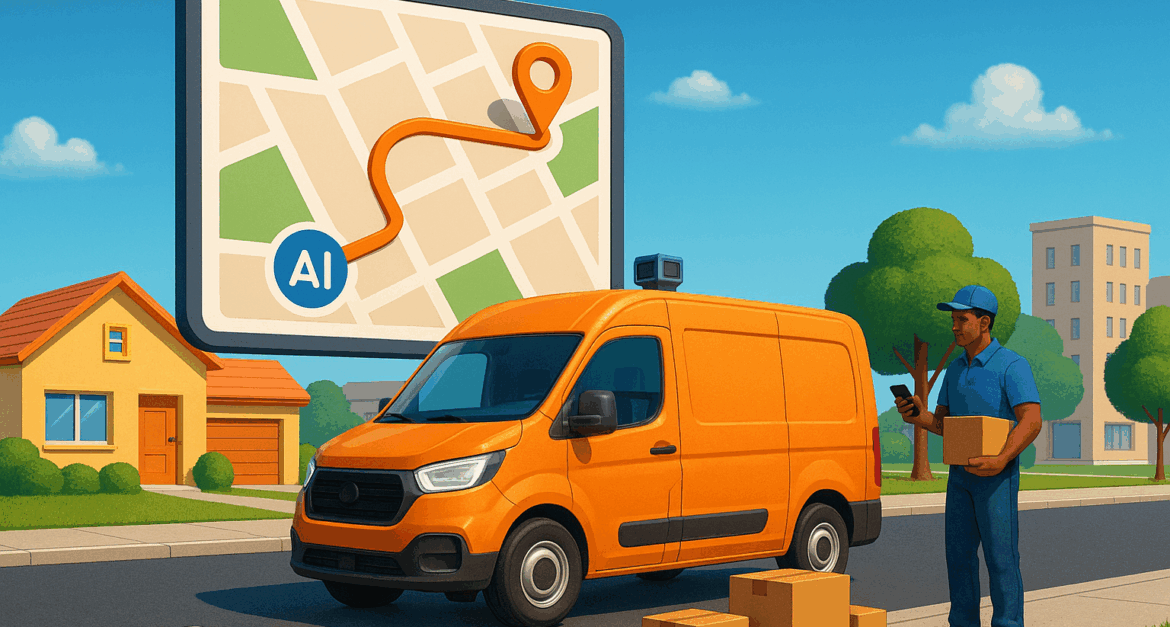
AI-powered routing platforms now adjust driver paths in real time—based on traffic flow, weather, construction zones, and package density.
Result:
Fewer fuel miles, more deliveries per hour, and real-time rerouting if conditions change mid-route.
AMB Insight: Our AI-enhanced route engine has reduced urban delivery time by 21% and cut failed deliveries by nearly 30%.
2. Dynamic ETAs & Customer Communication
AI integrates driver location, congestion analytics, and historical data to generate accurate ETAs and auto-notify customers via text or app.
Result:
Fewer missed handoffs, improved delivery windows, and greater customer satisfaction.
3. Driver Behavior Monitoring & Safety Alerts
Fleet AI tracks driving patterns—speeding, harsh braking, idling, sharp turns—and provides real-time feedback to prevent accidents and optimize fuel usage.
Result:
Lower risk exposure, improved compliance, and extended vehicle lifespan.
4. Predictive Maintenance
Machine learning analyzes onboard diagnostics to forecast component failures before they happen—especially in high-mileage delivery vans.
Result:
Less unplanned downtime, fewer breakdowns, and stronger on-time performance.
5. Package-Level AI Vision Systems
Some advanced couriers now use AI-enabled cameras and computer vision to verify package placement, confirm correct delivery location, and auto-document proof of delivery.
Result:
Reduced customer disputes, enhanced audit trails, and better reverse logistics intelligence.
Big Players Are Already All In
Companies like Amazon, UPS, FedEx, and newer players like Veho and Dispatch have already embedded AI into their last-mile infrastructure:
- Amazon’s AI predicts delivery delay risks 3 hours before driver arrival.
- UPS uses Orion, a proprietary AI engine, to optimize over 200,000 driver routes daily.
- Startups like Veho use AI to match freelance drivers to routes based on proximity, vehicle type, and past performance.
At AMB Logistic, our TMS integrations now pull in AI-enhanced ETA feeds, driver scoring, and real-time route deviation alerts—all aimed at elevating last-mile outcomes.
Challenges Still Ahead
While AI is delivering major wins, it’s not without obstacles:
- Data Quality Gaps: Inconsistent real-time traffic or address data can throw off predictions.
- Privacy & Ethics: Driver tracking and behavior scoring require strict governance.
- SMB Accessibility: Smaller operators often struggle to afford high-end AI tools—widening the tech gap.
That’s why at AMB Logistic, we work to bridge the adoption gap, offering our SME clients access to AI-driven features through our platform-level services—without the massive tech spend.
Why This Matters to Shippers and Retailers
AI isn’t just a fleet tool. It’s a competitive edge for brands who rely on final-mile precision.
Here’s what shippers should focus on in 2025:
1. Prioritize Real-Time Visibility
Partner with 3PLs and carriers who offer dynamic tracking, predictive ETAs, and automated exception alerts.
2. Optimize Urban Fulfillment
Use AI to map ideal microhub or dark store locations based on delivery patterns and congestion zones.
3. Measure SLA Confidence, Not Just Completion
Use AI confidence scores to understand not only whether an SLA was hit, but how likely it was to succeed at dispatch.
AMB Logistic: Powering the Smartest Mile
We’ve evolved our last-mile model around what matters most: accuracy, safety, and trust.
Through our AI-enhanced systems, we now provide:
- Live ETA dashboards for clients
- Predictive driver behavior analysis
- Mid-route adjustment engines based on weather, traffic, and incident data
- Client-accessible delivery confidence metrics
We’re not just using AI—we’re turning it into ROI.
Conclusion: The Smartest Mile Is the One That Learns
In 2025, logistics success depends on more than just moving fast. It depends on moving smart.
AI is helping us do just that—one delivery, one decision, one block at a time.
Because the last mile isn’t the end of the journey.
It’s the moment of truth.
And AMB Logistic is ready to deliver.
Contact AMB Logistic
📧 info@amblogistic.us
🌐 www.amblogistic.us
📞 +1 (888) 538-6433
Tags: Last-Mile AI, Predictive Routing, Delivery Optimization, Driver Safety, AI Logistics, AMB TMS, Freight Innovation, Fleet Intelligence, Final-Mile Automation, Customer ETAs