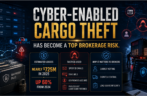
Hackers, Freight Marketplaces, and the New Wave of U.S. Cargo Hijacking
How organized crime, hacked load boards, and fake carriers are turning U.S. trucking and intermodal into a high-tech crime scene.
Introduction: When Cargo Theft Moves Online
For decades, cargo theft was mostly a physical crime. A cut seal in a dark yard. A trailer stolen from a truck stop. A driver robbed at gunpoint.
In 2025, that picture has changed dramatically.
Today’s cargo thieves are teaming up with hackers. They are infiltrating freight brokers, carriers, and logistics firms through phishing emails, stolen passwords, and remote-access tools. Once inside, they use online freight marketplaces and load boards to impersonate legitimate carriers or brokers, win real loads, and simply drive away with high-value freight—often without breaking a single lock on-site.
Recent research and industry briefings paint a stark picture:
- Cargo theft losses in the U.S. are estimated in the tens of billions of dollars per year, with incidents and average loss values climbing sharply.
- Strategic, cyber-enabled diversion schemes—fake carriers, hijacked accounts, fraudulent reconsignments—are now the leading method of cargo crime, surpassing simple trailer break-ins.
- Threat actors are using remote monitoring and management (RMM) tools to burrow into trucking and logistics networks, then bid on and reroute real shipments from the inside.
In other words, cargo crime has been upgraded: same stolen freight, very different attack chain.
This article breaks down how these schemes work, who is most at risk, and how shippers, brokers, and carriers can defend themselves—before their next load is “won” by a criminal using a laptop instead of a crowbar.
How Cyber-Enabled Cargo Hijacking Actually Works
Every attack looks a little different, but most follow a recognizable pattern: find a way in digitally, look like a real player on the marketplace, then turn a legitimate shipment into stolen freight.
1. Recon on Load Boards and Freight Marketplaces
Most schemes begin where legitimate freight starts: online platforms that match loads to trucks.
Attackers:
- Monitor public load boards and freight platforms to identify high-value, high-demand shipments—electronics, food and beverage, pharmaceuticals, energy drinks, crypto-mining rigs, and other easily resold goods.
- Profile brokers and carriers, learning their processes, documents, and common lanes.
- Collect basic information that will later make them look like just another carrier or intermediary.
2. Phishing and Account Takeover
Next, they target the weakest digital link: user accounts.
Common tactics include:
- Phishing emails that mimic load offers, rate confirmations, or platform notifications, but contain malicious links or attachments.
- Credential harvesting pages that look like login screens for TMS platforms, load boards, or email portals.
- Compromising low-privilege accounts first—dispatchers, carrier sales reps, or small carrier logins—then moving laterally to higher-privilege access.
Once they have a valid login, they no longer look like strangers; they look like your own people or your trusted partners.
3. Remote Access and Deep Network Compromise
In many campaigns, attackers push remote monitoring and management tools onto victim machines—software that IT teams legitimately use for support and administration.
With those tools, criminals can:
- Watch live TMS, email, and load board activity as if they were sitting at the desk.
- Capture new passwords and authentication tokens.
- Quietly adjust contact information, routing instructions, and payment details without triggering alarms.
They’re not just breaking in once; they are installing themselves into day-to-day operations.
4. Impersonation, Bidding, and Load Diversion
Armed with access and intelligence, attackers can now act like a legitimate carrier or broker.
They may:
- Hijack a real carrier’s identity—FMCSA details, MC/DOT number, insurance certificates—and use those credentials to win bids on attractive loads.
- Post fake loads to lure carriers into email exchanges, then deliver malware links inside normal-looking message threads.
- Change delivery addresses or reconsignment instructions mid-shipment, sending freight to criminal-controlled warehouses or yards.
To the shipper or broker, everything appears legitimate: a known carrier, correct documents, normal communication patterns. Behind the scenes, a criminal group is in control.
5. Physical Pickup and Disappearing Cargo
Eventually, all the digital manipulation leads to an old-fashioned moment: a truck shows up to pick up freight.
But now:
- The driver may be working directly with the crime ring—or may be an unwitting subcontractor dispatched through a fraudulent assignment.
- The paperwork may look correct, but the shipment is headed somewhere entirely different than the systems say.
- Once loaded, the truck disappears—often with phones off, GPS disabled, and the cargo quickly moved or broken down in another location.
By the time anyone realizes what happened, systems show a load “picked up” and “in transit” with a carrier that appears legitimate on paper.
Why This Wave of Cargo Crime Is Different
Cargo theft has always existed. What makes this wave fundamentally different is the mix of cyber capabilities, organized crime, and logistics digitalization.
1. From Parking Lots to Passwords
Traditional cargo theft relied on physical opportunity: unguarded yards, overnight parking, or weak locks. Today’s criminals can steal freight without ever approaching a parked trailer.
By abusing credentials and remote access, they can:
- Select the highest-value freight in the network.
- Time attacks to match peak shipping or holiday demand.
- Target companies of all sizes, not just those with weak fences.
What was once a crime of chance is now a crime of data and planning.
2. Speed, Scale, and “Industrialized” Theft
Because these schemes are largely digital in the early stages, criminals can run multiple campaigns at once:
- Phish hundreds of carriers and brokers in parallel.
- Scan thousands of load postings for ideal targets.
- Automate parts of the compromise process using tools and scripts.
Industry analysis shows tens of thousands of cargo theft events and a strong rise in both incident counts and average loss values, with cyber-enabled diversion now a dominant “strategic” method.
3. High-Value, Fast-Moving Targets
Criminals favor freight that is:
- High value per pallet or per trailer (electronics, semiconductors, branded consumer products, crypto-mining equipment).
- Easy to resell quickly on grey markets or online platforms.
- Hard for end buyers to distinguish as stolen (common SKUs without traceable serials or with weak chain-of-custody controls).
This focus makes every load a potential jackpot, not just the occasional trailer someone happens to stumble upon.
4. Blurred Lines Between Fraud, Double Brokering, and Theft
Double brokering, identity theft, and full-on cargo hijacking increasingly share the same tools and tactics. The same fake “carrier” that undercuts you on a lane might:
- Take the freight and never pay the underlying carrier.
- Divert the load entirely and disappear.
- Use partial legitimacy (real authority numbers, real insurance snapshots) as cover for theft.
From the outside, it can be hard to tell where aggressive but legal behavior ends and pure criminality begins—until the freight is gone.
The Risk Map: Who’s Most Exposed?
In theory, any company that touches freight digitally can be targeted. In practice, some players are more exposed than others.
1. Freight Brokers and 3PLs
Brokers sit at the intersection of shippers, carriers, and load boards. That makes them prime targets for attackers looking to:
- Hijack broker accounts to award loads to fraudulent carriers.
- Manipulate routing, contact details, and payment instructions.
- Exploit their brand reputation to recruit unwitting carriers into schemes.
A compromised broker account can be used as a launchpad to victimize multiple shippers and carriers in a short period.
2. Small and Mid-Sized Carriers
Smaller fleets often rely heavily on online load boards and email, with:
- Limited dedicated IT or cybersecurity staff.
- Shared passwords and simple authentication practices.
- High pressure to accept loads quickly in competitive markets.
Attackers know this and design phishing campaigns specifically targeting smaller carriers with realistic, time-sensitive offers.
3. Intermodal and Rail-Linked Operators
Rail-linked intermodal providers and drayage partners are also in the crosshairs. Some operators have reported sharp increases in thefts tied to rail moves, especially where data systems are integrated but cyber controls are uneven.
When multiple parties share responsibility across intermodal chains, an attacker only needs to compromise one node to exploit systemic trust.
4. Shippers of High-Value or High-Demand Commodities
Shippers dealing in highly desirable products—consumer electronics, branded goods, food and beverage, pharmaceuticals—are attractive targets regardless of their own internal security, because:
- Their freight is worth more per trailer.
- Criminal markets already exist for rapid resale.
- Brand exposure and regulatory liabilities amplify the cost of every incident.
Even if they never log into a load board themselves, their partners do—and that’s enough.
What Shippers, Brokers, and Carriers Must Do Right Now
You can’t make hackers disappear. But you can make your network, your processes, and your freight much harder to exploit.
1. Get Identity and Access Under Control
The foundation is simple, but often missing:
- Multi-factor authentication (MFA) on email, TMS, load boards, and any system that can influence freight decisions.
- Role-based access so not every user can reroute freight, change bank details, or add new carriers without checks.
- Unique credentials for each user—no shared logins, no generic “dispatch” accounts with broad access.
These are not just IT tasks; they are freight protection measures.
2. Lock Down Your Load Board and Marketplace Workflow
For organizations that use public or semi-public load boards:
- Restrict who can post loads and who can award them.
- Use pre-approved carrier lists rather than open bidding on sensitive freight.
- Regularly audit which accounts are active, and remove stale or suspicious profiles.
Think of your load board presence as part of your security surface—not just a sales channel.
3. Verify Who You’re Really Dealing With
Old rules of thumb—“They have an MC number, so they’re fine”—no longer apply. Build structured verification steps such as:
- Calling carriers and brokers using phone numbers from official FMCSA records or pre-validated contacts, not from an email signature alone.
- Checking insurance, safety records, and authority status directly from independent sources.
- Flagging rapid changes in banking details, email domains, or contact names as high-risk until validated.
The extra minutes spent verifying a partner are cheap compared to the cost of a stolen shipment.
4. Add a “Second Factor” to Freight Decisions
Just as you use MFA for logins, you can use a “second factor” for high-risk freight decisions.
Examples:
- Require a call-back or secondary approval for any mid-route reconsignment or destination change.
- Require dual approval when awarding high-value loads to a new or recently changed carrier account.
- Use simple code phrases or shared references between dispatch and drivers to confirm legitimacy at pickup.
This creates friction for criminals without crippling operations.
5. Monitor Behavior, Not Just Events
Instead of only checking whether systems are “up,” monitor how they’re being used:
- Unusual login times or locations for dispatch and brokerage users.
- Spike in changes to routing, consignee information, or payment instructions.
- Frequent use of the same new carrier or intermediary across many loads in quick succession.
These behavioral anomalies are often the first sign something is wrong.
6. Build a Cargo-Crime Incident Response Playbook
If a load disappears or you suspect digital fraud, who does what in the first 30 minutes?
Your playbook should include:
- Immediate steps to lock compromised accounts and remote sessions.
- Contact procedures for law enforcement, insurers, and critical partners.
- Standard information to gather quickly: last known location, driver details, digital logs.
- A communication plan for customers whose freight might be impacted.
In a cyber-enabled theft, minutes matter—not just hours.
How AMB Logistic Helps You Defend Against Hacker-Driven Cargo Theft
At AMB Logistic, we see cyber-enabled cargo crime as both a threat and a strategy moment.
Our role is to help you turn complex security headlines into lane-level, partner-level, and process-level changes that protect your freight without slowing your business to a crawl.
1. Risk and Exposure Assessment Across Your Network
We work through your network to map:
- Which lanes, commodities, and facilities represent your highest theft impact.
- Where you rely most on open load boards, email-driven tendering, or thinly verified partners.
- Where your current controls—identity, verification, and monitoring—are weakest.
This produces a clear, prioritized picture of where you’re most vulnerable today.
2. Secure Freight Workflow Design
We help you redesign workflows so that security is baked in, not bolted on:
- Defining which freight can be posted openly and which must use vetted networks.
- Embedding verification steps into tendering, awards, and reconsignments.
- Building practical dual-approval and call-back mechanisms for high-risk actions.
The goal is to make fraud and hijacking attempts more obvious and more expensive for criminals.
3. Partner and Carrier Vetting Frameworks
We assist in building structured vetting programs that go beyond basic paperwork:
- Standardized checklists for new carriers and brokers.
- Ongoing monitoring of authority, insurance, safety, and complaint history.
- Risk-based segmentation of partners: who can handle high-value freight, who stays on low-risk lanes.
This reduces your exposure to both fraudulent entities and structurally weak partners.
4. Training and Awareness for Operations Teams
Technology alone is not enough. Dispatchers, broker reps, warehouse teams, and drivers are your live sensors.
AMB Logistic helps you:
- Design short, practical training on red flags for cyber-enabled cargo fraud.
- Run simulations or tabletop exercises for “fake carrier” or “diverted load” scenarios.
- Build a culture where people feel safe flagging suspicious activity early.
The best defense is an operations team that knows what modern cargo crime looks like.
5. Crisis Routing and Recovery Support
If something does go wrong, our job is to help you limit damage and keep freight moving:
- Rapid rerouting and rebooking for impacted loads and customers.
- Support in coordinating with law enforcement, insurers, and secure carriers.
- Post-incident analysis to close the specific gaps that were exploited.
We don’t just help you respond—we help you come out stronger for the next attempt.
FAQ: Straight Answers on the New Cargo Crime Wave
Is this really new, or just the same old cargo theft with a tech label?
The physical outcome is the same—stolen freight—but the path to get there is very different. Today’s attackers use hacked accounts, remote tools, and marketplace manipulation to hijack loads that look legitimate from the outside. That’s more scalable, harder to detect early, and more damaging to trust across the industry.
Are only big carriers and brokers being targeted?
No. Research shows attackers going after companies of all sizes, often starting with smaller carriers or brokers who have weaker security and then pivoting into larger networks. If you touch freight digitally, you are on the radar.
If we use a 3PL or broker, are we “outsourcing” this risk?
You shift some operational responsibility, but not all risk. If a broker is compromised and a load disappears, your brand, your product, and your customer relationships are still on the line. You should assess partners on their cyber and fraud controls just as you evaluate their on-time performance and rates.
Should we stop using load boards altogether?
Not necessarily. Load boards and freight marketplaces are powerful tools when used with strong controls. The right goal is to narrow which loads you post, which carriers you accept, and what extra checks you require—especially for high-value freight and new relationships.
How long does it take criminals to adapt once we harden our systems?
They adapt constantly. That’s why you need layered defenses: strong identity controls, verified workflows, active monitoring, and trained people. There is no single “fix,” but there is a big difference between being an easy target and a hard one.
We have a limited budget. Where should we invest first?
Start with three basics: multi-factor authentication on critical systems, rigorous partner verification for high-value loads, and a simple incident response playbook. Those steps are relatively inexpensive and dramatically reduce the likelihood and impact of a successful attack.
Final Word from AMB Logistic
The U.S. is facing a new kind of cargo theft wave. The trailers and containers look the same, but the attackers are different: keyboard in one hand, remote-access tool in the other, working hand-in-glove with traditional organized crime.
The bad news: every digital improvement in logistics—more load boards, more integrations, more automation—creates new opportunities for abuse.
The good news: the same digital visibility, data, and process discipline that power modern supply chains can also make you very hard to victimize, if you design them that way.
At AMB Logistic, we help you do exactly that. We turn threat reports, policy briefings, and market anecdotes into concrete actions on lanes, partners, contracts, and workflows—so your freight keeps moving, your customers stay confident, and your cargo doesn’t become someone else’s “digital heist” success story.
Contact AMB Logistic
Email:
info@amblogistic.us
Phone: +1 (888) 538-6433
Website:
www.amblogistic.us
Tags
US logistics, cyber cargo theft, freight marketplaces, online load boards, hacked carrier accounts, cargo hijacking, organized crime in trucking, trucking cybersecurity, freight fraud, double brokering, rail cargo theft, strategic cargo theft, identity and access management, supply chain risk, AMB Logistic