The Stable-Rate Era May Be Over: What TRAFFIX’s 7% to 20% Cost Inflation Warning Means for Freight Brokers
For more than three years, much of the freight market operated inside a softer, more forgiving pricing environment. Capacity was available, freight rates stayed relatively stable by post-pandemic standards, and many brokers and shippers built their planning habits around the idea that if market conditions spiked, they would eventually settle back down. TRAFFIX is now warning that era may be over. In its Q2 2026 market update, the company said the freight market has entered a new phase marked by tightening capacity, rising rates, and sharply higher diesel costs, and it laid out planning scenarios that point to freight costs running roughly 7% to 20% above 2025 levels depending on how demand and fuel behave through the rest of the year. For freight brokers, that is not just a pricing note. It is a strategic warning that the old assumptions behind quoting, customer conversations, and capacity planning may no longer be safe.
Introduction
One of the most dangerous things about a changing freight cycle is that the market rarely tells everyone at the same time. Operationally, the shift begins underneath the surface. Carriers become a little more selective. Buy-side costs stop behaving the way they did six months ago. Spot rates rise faster than some contract conversations can keep up with. Customers still think they are budgeting in the old market, while brokers are already feeling the pressure of a new one. That is why the latest TRAFFIX outlook matters. It does not describe a brief spike or one isolated disruption. It describes a market where the floor itself may be moving upward.
TRAFFIX’s central message is direct: the three-year era of low, stable freight rates has ended. The firm said freight demand is improving, capacity is tighter after years of exits, diesel has risen sharply since early Q1, and the market is now in a phase where even modest demand growth can push rates higher because there is less room in the system than many shippers are still assuming. That framing is especially important for brokers, because transition markets are where stale assumptions become expensive. A market does not need to become chaotic to become harder. It only needs to become less forgiving.
Why This Matters
This matters because freight brokerage lives in the gap between what the market is doing and what customers think the market is doing. If that gap widens in the wrong direction, margin disappears quickly. TRAFFIX said outbound tender volume increased almost 10% year over year, reaching a seasonally adjusted multi-year high, while U.S. manufacturing returned to expansion territory for multiple consecutive months and inventories remained lean. At the same time, truckload capacity remained constrained after years of exits, and regulatory enforcement continued limiting near-term recovery on the supply side. That combination creates the exact type of environment where brokers can see more opportunity on the top line while losing flexibility underneath it.
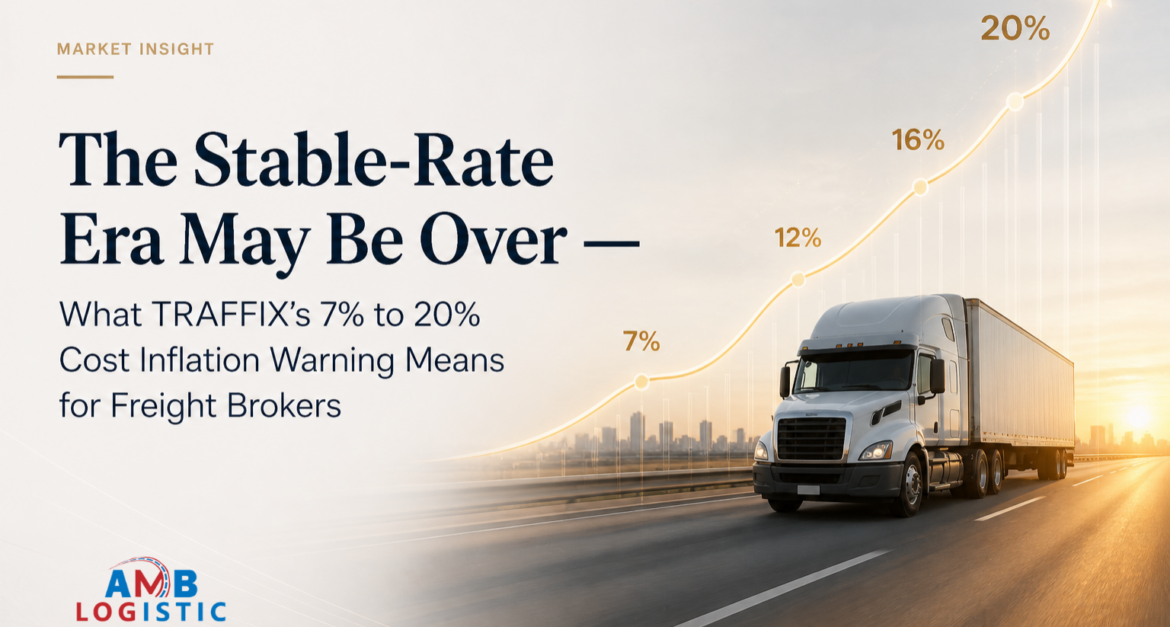
It also matters because the inflation range TRAFFIX laid out is wide enough to affect almost every freight conversation. In its softer case, the company still said shippers should expect freight costs to remain about 7% to 12% above 2025. In a more typical tightening scenario, it said freight costs could run 10% to 15% higher. In the more aggressive tightening case, it said 15% to 20% cost inflation is possible, particularly for spot-exposed lanes and shorter lead-time freight. When a market update tells shippers to stop budgeting for a return to 2025 conditions and instead treat current pricing as a new floor, brokers should hear that as an instruction to reprice assumptions before the market reprices them.
- The old freight floor may be gone: Current levels should be treated as a new floor rather than a temporary spike.
- Cost inflation has a wide risk range: The planning scenarios imply roughly 7% to 20% higher freight costs versus 2025, depending on how demand and fuel evolve.
- Capacity is not recovering fast enough to calm the market: Truckload capacity remains constrained after years of exits and continued regulatory pressure.
- Spot-heavy freight is more exposed: Short lead-time and spot-exposed freight could face the greatest pressure.
The Broader Picture
The broader picture is that this is not only a pricing story. It is a market-structure story. TRAFFIX described the current environment as the next phase of the recurring freight cycle: demand is returning, inventories are lean, and reduced capacity is making the market more reactive and volatile. The company also said the Logistics Managers’ Index transportation price component surged to its highest level since 2022 while the capacity index dropped below 40, widening the gap between pricing power and available room in the network. That tells brokers something crucial: this is not simply fuel creating temporary noise. It is a supply-demand shift that appears to be changing the baseline.
That shift is showing up across modes. TRAFFIX projected that dry-van and flatbed rates would remain elevated through mid-2026, reefer capacity would tighten further ahead of produce season, and intermodal volumes would grow about 10% year over year. It also highlighted U.S.-Mexico cross-border lanes, especially corridors such as Laredo-Bajio, as areas with persistent volume growth and localized capacity constraints. For brokers, that means the tightening narrative is not confined to one equipment type or one geography. It is a broader network story, which is exactly what makes it more dangerous for teams still planning like the market is uniformly soft.
Diesel adds another layer. TRAFFIX said diesel costs were up about 50% since early Q1 and that those increases were feeding into transportation pricing with minimal lag. That matters because markets become especially difficult when rate pressure is being reinforced by fuel rather than merely accompanied by it. A broker can sometimes absorb one pressure source. It becomes much harder when stronger demand, tighter capacity, and higher fuel all start moving in the same direction at once.
What This Means for Freight Brokers and Logistics Teams
For freight brokers and logistics teams, the practical meaning is straightforward: the era of passive quoting is likely ending. A broker who continues selling freight as though the market will always give another cheap recovery option may find that option slower, thinner, or gone. A shipper still treating Q2 pricing as a temporary spike may find that contract resets, mini-bids, and buy-side pressure move faster than internal expectations can keep up. In a market like this, the real risk is not simply that rates rise. The real risk is that assumptions remain unchanged while the operating environment already has.
That also means brokers need to stop reading activity as automatic good news. More freight opportunity is only valuable if it can be serviced intelligently. TRAFFIX explicitly said spot rates remain elevated and volatile, contract rates are still catching up, and linehaul rates have reached multi-year highs independent of fuel. That last point is especially important because it confirms this is not only a fuel-driven distortion. The underlying supply-demand balance is changing, and brokers who mistake the environment for a short-term fuel story may miss the structural part of the shift.
The Freight Broker Playbook
1) Stop pricing as if 2025 will come back by itself
The first adjustment is mental. If current rate levels should be treated as a new floor rather than a temporary peak, then brokers need to stop building strategies around automatic reversion. Waiting for the market to save an old quote is not a strategy. It is a gamble. In tightening phases, delayed adjustment usually gets paid for in margin.
2) Re-center the buy side, not just the sell side
A lot of teams focus first on what the customer will accept. In a rising-cost environment, that is not enough. Purchased transportation, fuel exposure, and lane-level capacity behavior become leading indicators. Brokers who watch their buy-side pressure closely will usually adjust earlier than those waiting for customer resistance to tell them the market has changed.
3) Use the widening scenario range to reset customer conversations
The most useful part of the guidance may be the scenario framework itself. It gives brokers a credible way to explain that even the softer case still implies higher costs than 2025, while the stronger-demand cases imply meaningfully more pressure for spot-exposed and short-lead-time freight. That kind of framing is useful because it turns a vague “market is getting tighter” message into a concrete planning conversation.
4) Watch mode-specific tightening before it becomes a service failure
Dry van, flatbed, reefer, intermodal, and cross-border are not tightening in identical ways. Reefer and produce pressure can pull capacity at seasonal speed. Flatbed can tighten quickly when industrial and infrastructure demand align. Cross-border corridors can feel localized pressure long before the whole market resets. Smart brokers will not rely only on a national narrative. They will translate it into mode-by-mode discipline.
5) Shift from price optimization to resilience thinking
In a market like this, resilience has to become part of the value proposition. Stronger bid cycles, smarter mini-bids, more deliberate carrier diversification, and less casual dependence on spot markets all matter more when the floor is rising. The cheapest answer is not always the smartest one. The stronger answer is often the one that protects continuity before the market gets more expensive.
AMB Logistic’s Role
At AMB Logistic, we look at freight cycles through the lens that matters most: execution under pressure. A market warning like this is not just useful because it predicts higher rates. It is useful because it helps define what strong brokerage should look like in a less forgiving environment. That means faster communication, sharper lane awareness, smarter planning, and routing decisions that reflect where the market is now rather than where it felt comfortable six months ago.
Our role is to help customers move ahead of pressure instead of reacting after it becomes expensive. In a tightening market, that means helping shippers see where exposure exists, when spot reliance is becoming risky, how lead times affect cost, and why stronger carrier strategy matters before the next rate reset hits. The best brokers in this phase will not be the ones who speak the loudest about market change. They will be the ones who make customers feel the least exposed to it.
- Sharper lane intelligence,
- clearer pricing discipline,
- faster communication when conditions shift,
- and freight execution built for a market with less room for error.
FAQ
Why is the 7% to 20% range important?
Because it shows that even the softer market case still points to freight costs staying above 2025, while stronger-demand and tighter-capacity scenarios could create much more painful inflation for spot-exposed and short-lead-time freight.
Is this saying every lane will tighten equally?
No. Different forms of pressure can appear across dry van, flatbed, reefer, intermodal, and cross-border lanes. The key point is not uniform tightening. The key point is that the overall market floor appears to be moving up.
What is the most important broker takeaway?
Treat current market levels as potentially structural rather than temporary, update lane assumptions faster, and stop assuming that cheap recovery options will always remain available.
What should shippers do now?
Revisit budgets, secure capacity more strategically, reduce unnecessary spot exposure, and recognize that waiting for a return to 2025 conditions may be a costly assumption.
Final Word From AMB Logistic
The most dangerous freight cycles are not always the loudest. Often they are the ones that quietly reset the baseline while part of the market is still treating the move as temporary. This warning matters because it describes exactly that kind of moment. If the stable-rate era has ended, then freight brokers and shippers cannot afford to keep planning as though nothing fundamental changed.
Markets like this reward the teams that move early, communicate clearly, and protect execution before the pressure fully shows up in service failures or damaged margins. If 2026 is becoming a year of higher floors, tighter capacity, and more rate sensitivity, then the right response is not hesitation. It is sharper discipline. And that is exactly where the right brokerage partner makes the biggest difference.
Talk To AMB Logistic Today
If your team is planning the rest of 2026 in a market with tighter capacity and less room for pricing error, AMB Logistic can help you stay ahead of the shift.
Call: +1 (888) 538-6433
Email: info@amblogistic.us
Web: www.amblogistic.us
Tags
freight inflation, freight brokerage, tightening capacity, diesel costs, spot market exposure, AMB Logistic