3PLs Are Seeing Early Signs of Recovery: What a Gradual Rebound Could Mean for U.S. Logistics in 2026
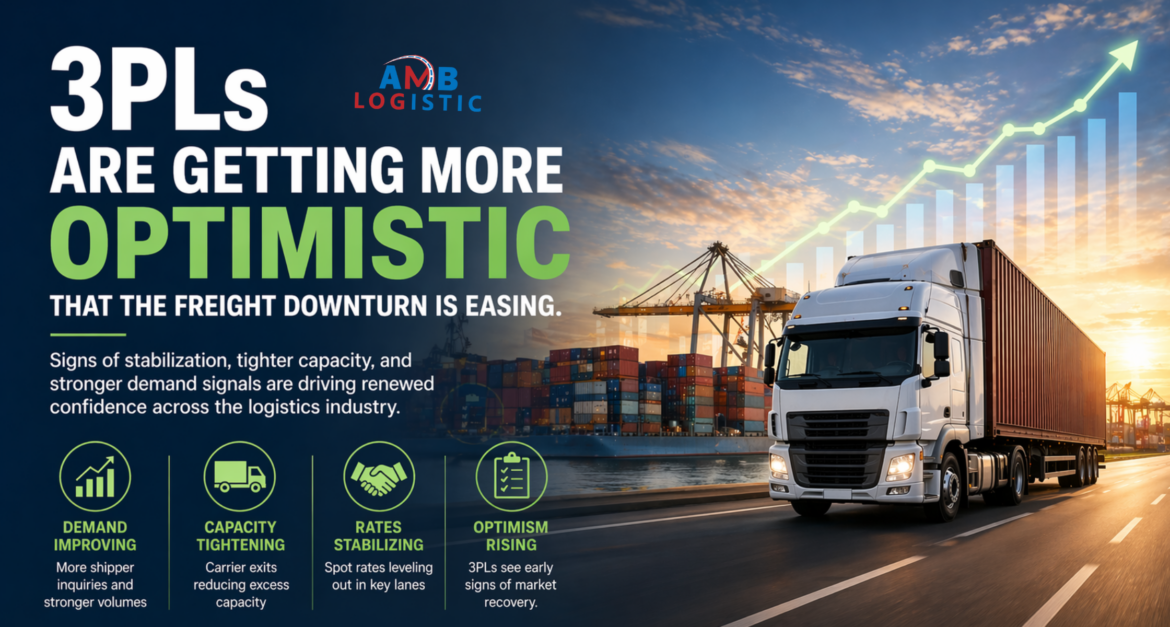
After a freight downturn that has dragged on for nearly four years, many third-party logistics providers are finally sounding more constructive about where the U.S. logistics market may be headed next. The shift is not euphoric, and it is not being framed as a sudden snapback. Instead, the tone is cautious: excess capacity appears to be leaving the market, supply and demand may be moving closer to balance, and some logistics leaders now expect modest rate firming in the second half of 2026. At the same time, diesel costs, tariff uncertainty, muted demand, and leaner inventory strategies are still keeping the recovery from turning into anything simple. For brokers, shippers, and carriers, that mix makes this moment especially important to understand clearly.
Introduction
For much of the past several years, the U.S. freight market has felt defined by the same difficult pattern: too much capacity, not enough freight, compressed rates, cautious inventory behavior, and an operating environment where everyone was waiting for a recovery that never seemed to fully arrive. That long period of weakness shaped pricing behavior, shipper expectations, and the way brokerages planned growth. It also trained a lot of teams to assume softness would persist longer than logic might otherwise suggest.
Now, however, the tone from many third-party logistics providers is beginning to change. Recent industry reporting shows a meaningful number of 3PLs expressing cautious optimism that freight conditions could improve gradually as 2026 moves forward. The reasoning is not based on one dramatic surge in freight demand. Instead, it is tied to a quieter but highly relevant change: excess capacity appears to be exiting the market, and some operators believe the supply-demand imbalance is finally narrowing. That does not mean the market is healthy yet. It means the market may no longer be deteriorating in the same way.
For logistics professionals, that distinction matters. Recovery in freight is rarely clean. It tends to arrive unevenly, with pockets of pressure appearing before broad confidence returns. Some lanes tighten before others. Some customers still act like it is last year’s market while others begin accepting firmer pricing. Some networks remain sluggish while others suddenly become harder to cover. That is why the most useful question right now is not whether recovery is officially here. The useful question is whether the underlying conditions are changing enough to force brokers and shippers to operate differently.
Why This Matters
This matters because markets usually change before the language around them does. By the time everyone agrees that a freight recovery is underway, disciplined operators have often already adjusted their assumptions, refreshed pricing logic, and repositioned customer conversations. The latest 3PL outlooks suggest that capacity is no longer behaving with the same abundance that defined the weaker part of the cycle. If that trend continues, the cost of waiting for perfect confirmation could rise quickly.
It also matters because the recovery being described is not the kind that automatically makes life easier. The same reporting that highlights optimism also points to significant constraints still in place. Diesel prices have risen, demand remains muted, and several 3PLs have made it clear that capacity exits alone will not be enough to sustain a real rebound unless freight volumes also improve. In other words, the market may be getting tighter, but it is not necessarily getting simpler.
- Capacity appears to be exiting: That means brokers should be careful about assuming truck availability will remain as easy as it felt during the softer phase of the cycle.
- Demand is still the deciding factor: Many 3PLs believe any durable recovery still depends on stronger freight volume, not just fewer trucks competing for freight.
- Fuel is adding pressure: Higher diesel costs are making the operating environment more fragile even as rate conditions show signs of stabilizing.
- Customer assumptions may lag: Shippers may still expect softer pricing and easier coverage even while the market begins to rebalance underneath them.
The Broader Picture
The broader picture is that this possible recovery is happening inside a market that remains structurally complicated. Trade policy has been volatile, tariffs continue to distort planning, and 3PLs have described uncertainty around import policy as a driver of delayed RFPs, more flexible inventory strategies, and a push toward modular supply-chain design. That means the same companies hoping for better freight conditions are also trying to operate in a planning environment where customer behavior can shift quickly based on policy rather than purely on underlying demand.
Inventory behavior is also playing a major role. Some logistics providers describe shippers as running leaner inventories, using space more intentionally, and operating with shorter planning cycles and faster resets. That creates a market where freight demand can feel less steady even when the broader economy is not collapsing. The result is a logistics environment defined less by clean seasonal rhythm and more by variability. For brokers and 3PLs, variability often matters as much as volume because it changes how predictable the business actually is.
That is why the most accurate way to view the current moment is not “freight is back” or “the downturn is over.” A better reading is that the market may be entering a transition phase. Capacity is rationalizing. Some pricing power may gradually return. But the logistics ecosystem is still dealing with diesel pressure, tariff volatility, uneven demand, and inventory discipline that can create sharper swings than many teams are used to. Recovery, if it comes, may be real without ever feeling comfortable.
What This Means for Freight Brokers and Logistics Teams
For freight brokers and logistics teams, the practical implication is that this is not the time to operate with fixed expectations. If the market is gradually tightening, then the old assumption that coverage will remain cheap and easy can become dangerous. If the market is still fragile, then overcommitting to a strong rebound is just as risky. The right response is not optimism or pessimism by itself. It is sharper market discipline.
That sharper discipline should show up in pricing cadence, routing-guide monitoring, customer conversations, and lane-level awareness. Brokers need to pay close attention to where capacity is becoming less flexible, where shipper assumptions still reflect the soft market, and where diesel or policy pressure is beginning to change cost behavior. This is especially important in a transition market because the biggest operational mistakes often happen when teams keep operating on the logic of the old cycle while the new one is already starting to form.
The Freight Broker Playbook
1) Reprice assumptions before the market forces you to
If capacity continues exiting and rates begin to stabilize or firm gradually, pricing built on the weakest part of the cycle will age poorly. Brokers should review lanes, customer-specific assumptions, and quote refresh windows now rather than waiting for a more obvious break in the market. In turning markets, stale assumptions usually cost more than cautious updates.
2) Watch fuel and policy pressure as seriously as freight volume
A gradual recovery can still be undermined by diesel pressure and tariff uncertainty. If fuel rises faster than rates adjust, carriers feel the squeeze immediately. If tariff policy keeps forcing supply-chain redesigns, freight patterns may stay volatile even while the overall market improves. Brokers that watch only rate indexes and ignore cost and policy pressure will miss part of the story.
3) Tighten customer communication before routing guides start slipping
If customers still believe they are operating in a deeply soft market, they may not react quickly enough when coverage gets harder or pricing starts moving. That is where brokers can create value. Not by dramatizing every change, but by explaining clearly where the market is tightening, why old pricing may not hold, and how supply and demand are moving closer to balance.
4) Separate a real recovery from noisy variability
Not every hot lane means the market is back. Not every weak week means the recovery failed. Many 3PL voices describe the current environment as variable, not straightforward. That means brokers need to separate structural change from day-to-day noise. Lane truth matters more than emotional market commentary. The teams that do this well are more likely to protect margin and less likely to overreact.
5) Build strategy around flexibility, not certainty
This is not a market for rigid thinking. With tariff shifts affecting network design, inventories staying lean, and capacity gradually rationalizing, the best response is flexibility. Brokers should be ready for modest improvement, localized tightening, and still-uneven freight behavior all at the same time. That may sound messy, but it is often what a real transition phase looks like before the broader market fully resets.
AMB Logistic’s Role
At AMB Logistic, we view moments like this through an execution-first lens. A possible freight recovery is not just a story about rates moving up or capacity moving out. It is a story about how quickly brokers recognize changing conditions and turn that recognition into better decisions. That means tighter lane awareness, more honest customer conversations, and stronger pricing discipline before the rest of the market catches up.
Our role is to help customers move through uncertainty without losing control. In a market where recovery is gradual and volatility remains high, that means balancing responsiveness with discipline. We do not assume softness will last forever, and we do not assume every positive signal means a full rebound is already here. We focus on staying close to the freight, reading the shift early, and helping customers adjust before market pressure turns into service pressure.
- Stronger lane-by-lane visibility,
- clearer communication when market conditions shift,
- pricing discipline built for transition markets,
- and freight execution designed for a market with less room for error.
FAQ
Are 3PLs saying the freight recession is over?
Not exactly. The tone is more cautious than that. Many are seeing signs of improvement, particularly as excess capacity exits, but they also say a durable recovery still depends on stronger freight volumes and more stable conditions.
What is making 3PLs more optimistic now?
The biggest reason is that capacity appears to be leaving the market, which is helping bring supply and demand closer together. Some also expect seasonal demand and gradual volume improvement to support modest rate firming later in the year.
What is still holding the market back?
Muted demand, higher diesel prices, tariff uncertainty, delayed planning decisions, and continued inventory caution are all keeping the recovery from becoming a simple straight-line rebound.
What should brokers do right now?
Update pricing assumptions faster, monitor cost and policy pressure more closely, communicate earlier with customers, and avoid confusing short-term noise with longer-term structural change.
Final Word From AMB Logistic
The most important lesson from the latest 3PL sentiment is that recovery does not need to be dramatic to be important. Even a modest shift in capacity, pricing power, and market tone can create very real operational consequences for brokers and shippers. The teams that wait for absolute certainty may find themselves adjusting too late. The teams that read transition signals early are more likely to protect service, protect margin, and guide customers with more confidence.
If 2026 is becoming a year of gradual freight normalization, then the right response is not complacency. It is sharper execution. Strong brokers will treat cautious optimism as a signal to get more disciplined, not less. In a market that still carries volatility, that may be the difference between simply staying busy and actually moving ahead.
Talk To AMB Logistic Today
If your team is trying to navigate a freight market that may be stabilizing but still feels unpredictable, AMB Logistic can help you stay ahead of the shift.
Call: +1 (888) 538-6433
Email: info@amblogistic.us
Web: www.amblogistic.us
Tags
3PL market outlook, freight recovery, logistics industry, capacity tightening, U.S. freight market, AMB Logistic